coronavirus
WHO warns individuals against mixing and matching COVID vaccines


The World Health Organization's (WHO) chief scientist has advised individuals against mixing and matching COVID-19 vaccines from different manufacturers, saying such decisions should be left to public health authorities, write Emma Farge and John Revill, Reuters.
"It's a little bit of a dangerous trend here," Soumya Swaminathan told an online briefing on Monday (12 July) after a question about booster shots. "It will be a chaotic situation in countries if citizens start deciding when and who will be taking a second, a third and a fourth dose."
Swaminathan had called mixing a "data-free zone" but later clarified her remarks in an overnight tweet.
"Individuals should not decide for themselves, public health agencies can, based on available data," she said in the tweet. "Data from mix and match studies of different vaccines are awaited - immunogenicity and safety both need to be evaluated."
The WHO's Strategic Advisory Group of Experts on vaccines said in June the Pfizer Inc (PFE.N) vaccine could be used as a second dose after an initial dose of AstraZeneca (AZN.L), if the latter is not available.
A clinical trial led by the University of Oxford in the UK is ongoing to investigate mixing the regimen of AstraZeneca and Pfizer vaccines. The trial was recently expanded to include the Moderna Inc (MRNA.O) and Novavax Inc (NVAX.O) vaccines.
Share this article:
EU Reporter publishes articles from a variety of outside sources which express a wide range of viewpoints. The positions taken in these articles are not necessarily those of EU Reporter. Please see EU Reporter’s full Terms and Conditions of publication for more information EU Reporter embraces artificial intelligence as a tool to enhance journalistic quality, efficiency, and accessibility, while maintaining strict human editorial oversight, ethical standards, and transparency in all AI-assisted content. Please see EU Reporter’s full A.I. Policy for more information.



Counterfeit cigarettes drive illicit tobacco trade to highest level in a decade, new study claims

EU agri-food trade surplus expands in February 2026

Libya’s fuel crisis offers lessons for energy security on both sides of the Mediterranean

Commission disburses €7.2 billion to Poland under NextGenerationEU

Spring semester package: Steering EU economies to increased competitiveness

EU and Moldova strengthen cooperation on jobs, skills and social rights

Kazakhstan seeks deeper EU partnership in science, education and innovation

In space, we can’t defend what we can’t see

Serbia’s business environment is driving its integration into the EU

The Hidden Cost of Aid Cuts.

Commission endorses Lithuania’s €884 million Social Climate Plan to support vulnerable households and micro-enterprises in the clean transition

New EU rules on pay transparency explained

Record breaking Belgian sailors making more waves

Message to Kemi Badenoch: 'Make a splash by thinking out-of-the-box on UK-Europe relationship'

Kazakhstan cuts water use by 874 mln m³ through new technologies

Europe's peripheral and maritime regions 'combine many territorial assets', meeting told

Kazakhstan reforms under scrutiny at Brussels Press Club round table

Japan should face up to history and contribute more to regional peace

Ambassador calls for 'speeding up' of co-operation between EU and Kazakhstan

Timur Turlov at Smart Moves Summit 2025: How chess can transform global education

Shevtsova’s case: Out-of-court sanctions dismantling trust in Ukrainian cause

The future of European transport

Trump Vs Trueman

US 'no longer' an 'unconditional ally' for Europe - MEP
-
 Health4 days ago
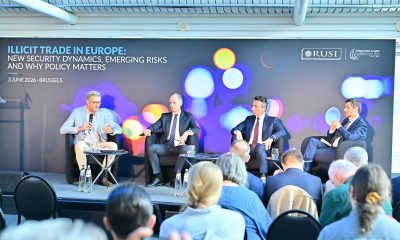
Counterfeit cigarettes drive illicit tobacco trade to highest level in a decade, new study claims
-
 Agriculture5 days ago
EU agri-food trade surplus expands in February 2026
-
 Libya4 days ago
Libya’s fuel crisis offers lessons for energy security on both sides of the Mediterranean
-
 NextGenerationEU5 days ago
Commission disburses €7.2 billion to Poland under NextGenerationEU