CO2 emissions
Interview: How to charge firms for CO2 emissions without it costing jobs

 Charging companies for CO2 emissions can be a great way of encouraging them to become cleaner, but also risks pushing them to move production to somewhere with lower environmental standards. The European Commission aims to prevent the practice known as carbon leakage by continuing to give some allowances away for free. Bas Eickhout (pictured) proposed to block this decision, saying many industries can afford to pay for the allowances. The environment committee voted against his proposal on 24 September.
Some industrial sectors in the EU are given a substantial share of their CO2 emissions allowances for free, as it is feared they would otherwise relocate if they had to pay for them. The Commission has now prepared a list of sectors at risk of relocating on the assumption of a €30 price per allowance. However, the market price today is only €5 and some say that many of the sectors listed could actually afford paying the current market price or even more for allowances without putting jobs at risk in the EU.
Eickhout discussed the situation.
What is wrong with the Commission proposal?
Sectors that are not at all exposed to the risk of carbon leakage are now receiving free allowances.
The Commission’s methodology to identify sectors eligible for the allocation of free allowances is based on a carbon price of €30 per allowance. This price is far too high and puts sectors on the list that do not belong there.
Meanwhile in an impact assessment that was not made public, the Commission uses a price of €16.5. Under this scenario, more sectors will have to buy allowances, member states will earn around €5 billion and several CO2-intensive sectors will have an incentive to innovate.
Is there a risk that some energy-intensive sectors, if removed from this list, might relocate their businesses to other regions?
No. A recent study, which was carried out for the Commission, even questions whether carbon leakage exists at all. Moreover, the aforementioned impact assessment also concludes that some sectors can be safely removed from the list. The list should only contain the sectors that face unfair competition, whereas it currently the list contains 96% of all industries participating in ETS (Emissions Trading System).
How could the EU make companies pay for CO2 emissions while still preserving the jobs in the Union?
Share this article:
EU Reporter publishes articles from a variety of outside sources which express a wide range of viewpoints. The positions taken in these articles are not necessarily those of EU Reporter. Please see EU Reporter’s full Terms and Conditions of publication for more information EU Reporter embraces artificial intelligence as a tool to enhance journalistic quality, efficiency, and accessibility, while maintaining strict human editorial oversight, ethical standards, and transparency in all AI-assisted content. Please see EU Reporter’s full A.I. Policy for more information.



Counterfeit cigarettes drive illicit tobacco trade to highest level in a decade, new study claims

Libya’s fuel crisis offers lessons for energy security on both sides of the Mediterranean

Spring semester package: Steering EU economies to increased competitiveness

In space, we can’t defend what we can’t see

EU Cybersecurity Act could expose member states to costly investment treaty claims, legal opinion warns

OceanEye: Placing the EU at the forefront of ocean observation

Kazakhstan seeks deeper EU partnership in science, education and innovation

Outrage of Iranian exiles and opposition of MEPs to inviting Reza Pahlavi to the European Parliament

EDF’s first-ever FSTP sub-call attracts strong interest from newcomers to EU defence funding

EU implements Palestine facility with $395 million for local banks and €2.1 million in technical assistance

EU exports of shark fins dropped in 2025

Commission approves €23 billion Italian state aid scheme to support renewable electricity production

Justice and Home Affairs Council

Give your career a real take off

Serbia’s business environment is driving its integration into the EU

The Hidden Cost of Aid Cuts.

Kazakhstan reforms under scrutiny at Brussels Press Club round table

Japan should face up to history and contribute more to regional peace

Ambassador calls for 'speeding up' of co-operation between EU and Kazakhstan

Timur Turlov at Smart Moves Summit 2025: How chess can transform global education

Shevtsova’s case: Out-of-court sanctions dismantling trust in Ukrainian cause

The future of European transport

Trump Vs Trueman

US 'no longer' an 'unconditional ally' for Europe - MEP
-
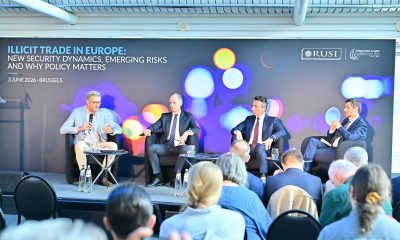 Health4 days ago
Counterfeit cigarettes drive illicit tobacco trade to highest level in a decade, new study claims
-
 Libya4 days ago
Libya’s fuel crisis offers lessons for energy security on both sides of the Mediterranean
-
 European Commission4 days ago
Spring semester package: Steering EU economies to increased competitiveness
-
 Space4 days ago
In space, we can’t defend what we can’t see