EU
#EAPM: Tipping the health-care balance through patient knowledge


Knowledge is power or, in the case of patients, empowerment, writes European Alliance for Perso-nalised Medicine (EAPM) Executive Director Denis Horgan. Internet-savvy patients are demanding to become more-and-more involved in their own treatments, although self-diagnosis via the worldwide web can lead to errors and even ‘cyber-chondria’, which is obviously potentially harmful.
Knowledge in the healthcare arena has therefore never been more important for patients. Generally speaking, patients now know more than ever and often demand meaningful dialogue with their doctors, nurses and surgeons. Increasing numbers of patient groups and individual citizens are becoming aware of the potential of shared decision and empowerment, and they want to have their illnesses and the treatment options explained in a transparent, understandable yet non-patronizing manner to allow them to become involved in co-decision making.
This is as it should be. But there are ways by which the new empowerment can be made better, and getting information out there to the patients can be key. There needs to be a better information flow on everything from clinical trial availability, eHealth methods, new treatments that may be appropriate, adherence to medicines and lifestyle management in areas such as diet and exercise, as well as potential killers such as cigarettes, drugs and excessive alcohol.
For sure, many campaigns attempt, and have attempted, to focus on patient education, but the support networks for patients trying to follow one path or another are not always satisfactory. Unfortunately, even in the age of personalised medicine, it has become clear that neither the patients nor the healthcare professionals (HCPs) know quite enough in a fast-moving world buoyed by scientific breakthroughs, not least in genomics.
How much actually do patients know about the potential benefits and, of course, pitfalls of having their genome sequenced to detect likely future diseases for preventative purposes, for example? In fact, how much do HCPs actually know? And, of course, regulators and policymakers are often left trying to play catch-up as medical scien-ce develops at breathtaking speed. (Such topics will be covered in a section in respect of EAPM’s Million European Genomes Alliance, or MEGA, initiative, at its upcoming conference in Brussels and Milan-based Congress later in the year.)
Indeed politics at EU and national level plays a big part in healthcare as part of our ‘social contract‘ and responsibility to citizens. These remain constant regardless of which party is in power in whichever member state. We will still need thousands of well-trained HCPs, and to tackle the fact that pensions and healthcare systems are under intense pressure due to Europe’s ageing population.
Politicians will tell you that, if you ask any citizen, health and healthcare are high on the agenda – and as we live longer that will become more the case, rather than less. Most areas of health remain a largely Member State competence, but a growing number of stake-holders believe that a European Union in which every nation does things differently in their health systems is no longer feasible. Despite not having a concrete mandate that covers health, the EU has had an over-arching health policy for two decades and it needs to step this up and do so now. Europe is facing a serious issue with regards to present and future patients and it is clearly time for action.
For a start, the health, research, legal, policymaking and regulatory contingent are in clear need, EAPM believes, of more focus on health literacy to increase knowledge and empowerment, and this would undoubtedly be better introduced in a co-ordinated manner across the EU as a whole. What is key is communication between the HCP and patient, based on knowledge. This has been proven to save money in healthcare budgets, and the World Health Organization (WHO), among others, has called for policy action to strengthen it. Patients need to know that modern DNA tests, for example, can throw up in advance the various likelihoods of major illnesses happening in an individual. Having said that, of course, not everybody wants to know that they may have more chance of getting breast or colon cancer than their neighbour, or that their families may also need to know.
There are practical and ethical considerations and, once again, the patient needs to be aware of them. Although still not optimal there is, these days, more co-decision as lifestyle, work and personal preferences come into play, with evidence showing that strengthening health literacy builds individual and community resilience, helps to address health inequities and improves health and well-being. Essentially, we need to empower the individual to make healthier choices, to consider stopping in-dulging in riskier behaviour, and, in patients already diagnosed with a disease, bring about better self-management of chronic diseases which are hitting Europe hard as the population ages. It has been proven in studies that health literacy is also an important form of social capital, it being an asset for individuals and communities. High literacy rates benefit societies, with the more-literate individuals participating actively in economic prosperity. For the benefit of all, it clearly needs to be better promoted.
Let us not forget that politicians, the media, civil society and employers can all play a part in ad-dressing the challenges of health literacy. With the internet and modern technology, the patient has, and deserves to have, a right to the best care possible. And the right to co-decision. Patients are, for sure, not experts on medical matters. But they are absolute experts on their own lifestyles. Some doctors (and even governments) still don’t seem to fully understand that, and it needs to change. Unfortunately, patients don’t always ask the right questions, and many doctors are unforthcoming unless asked specifically. This also needs to be improved. For the most part, patients are a long way from being stupid. But they do need more information on health, and the EU and member states have a moral duty to provide it.
Share this article:
EU Reporter publishes articles from a variety of outside sources which express a wide range of viewpoints. The positions taken in these articles are not necessarily those of EU Reporter. Please see EU Reporter’s full Terms and Conditions of publication for more information EU Reporter embraces artificial intelligence as a tool to enhance journalistic quality, efficiency, and accessibility, while maintaining strict human editorial oversight, ethical standards, and transparency in all AI-assisted content. Please see EU Reporter’s full A.I. Policy for more information.



Counterfeit cigarettes drive illicit tobacco trade to highest level in a decade, new study claims

Libya’s fuel crisis offers lessons for energy security on both sides of the Mediterranean

Spring semester package: Steering EU economies to increased competitiveness

In space, we can’t defend what we can’t see

Kazakhstan seeks deeper EU partnership in science, education and innovation

OceanEye: Placing the EU at the forefront of ocean observation

Outrage of Iranian exiles and opposition of MEPs to inviting Reza Pahlavi to the European Parliament

EU Cybersecurity Act could expose member states to costly investment treaty claims, legal opinion warns

EDF’s first-ever FSTP sub-call attracts strong interest from newcomers to EU defence funding

EU implements Palestine facility with $395 million for local banks and €2.1 million in technical assistance

EU exports of shark fins dropped in 2025

Commission approves €23 billion Italian state aid scheme to support renewable electricity production

Justice and Home Affairs Council

Give your career a real take off

Serbia’s business environment is driving its integration into the EU

The Hidden Cost of Aid Cuts.

Kazakhstan reforms under scrutiny at Brussels Press Club round table

Japan should face up to history and contribute more to regional peace

Ambassador calls for 'speeding up' of co-operation between EU and Kazakhstan

Timur Turlov at Smart Moves Summit 2025: How chess can transform global education

Shevtsova’s case: Out-of-court sanctions dismantling trust in Ukrainian cause

The future of European transport

Trump Vs Trueman

US 'no longer' an 'unconditional ally' for Europe - MEP
-
 Health4 days ago
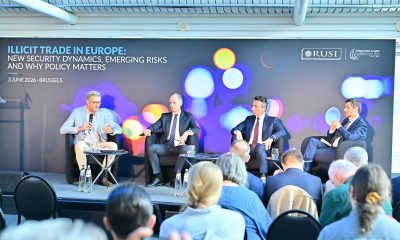
Counterfeit cigarettes drive illicit tobacco trade to highest level in a decade, new study claims
-
 Libya4 days ago
Libya’s fuel crisis offers lessons for energy security on both sides of the Mediterranean
-
 European Commission4 days ago
Spring semester package: Steering EU economies to increased competitiveness
-
 Space4 days ago
In space, we can’t defend what we can’t see