Fisheries
European Parliament hearing puts forced labour in fisheries under the spotlight


The Spanish Producers Organisation of Associated of Large Tuna-Freezer Vessels (OPAGAC) and its campaign Hands for the Oceans brought fishers’ labour rights to the forefront of the debate at the European Parliament last week with a conference entitled Advancing the Social Dimension of Sustainable Fisheries. The event was hosted by Carmen Crespo (EPP), Chair of the European Parliament’s Committee on Fisheries (PECH), and Virginia Battu-Henriksson, member of Cabinet to Commissioner for Fisheries and Oceans Costas Kadis.
The conference highlighted that a truly sustainable fishing industry must consider not only the health of the oceans but also the working conditions and rights of the people who work at sea. Representatives from the International Labour Organization (ILO), the European Transport Workers’ Federation (ETF), the Environmental Justice Foundation (EJF) and Oxfam discussed the challenges facing fishers and the measures needed to protect their labour rights.
“Europe cannot compete by lowering its standards, but rather by making those standards its greatest advantage. Our fleet leads the way in sustainability, safety, and labour rights, and we must demand the same level of responsibility from products entering our market through new trade agreements. Defending a competitive fishing industry also means protecting its workers from unfair competition and ensuring that supply chains are transparent, responsible, and free from exploitation”, Carmen Crespo said in her opening remarks.
Battu-Henriksson also stressed the importance of competitiveness, highlighting the need to deliver high-quality products while respecting the environment and workers’ rights.
Europe has established a strong piece of legislation to prevent forced labour, which will be gradually enforced until December 2027. OPAGAC launched Hands For TheOceans in early 2026, an international movement calling for the same level of attention to the people behind the catch, particularly their labour rights, working conditions, safety and protection from forced labour. The initiative seeks to put social responsibility alongside environmental sustainability as a defining element of Europe's fisheries model.
Tuna remains Europe's favourite fish, even as the continent eats less seafood overall. According to the European Market Observatory for Fisheries and Aquaculture Products (EUMOFA), tuna was the EU’s most consumed seafood product in 2023, at 2.68 kg per capita. Spain contributes about two-thirds of EU canned tuna production. Europe's canning industry depends heavily on imports, many coming from Asian fleets where human rights abuses have been repeatedly reported.
From the sea to the table: the importance of respecting human rights at sea
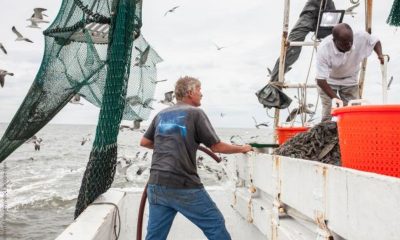
Tuna production relies heavily on distant-water fishing, often in international waters. Working conditions vary considerably across fleets and countries. While European and European subsidiary fleets respect the ILO Working in Fishing Convention (C188), others, like many in Asia, don’t even respect basic human rights.
“I was hired in 2018 through an Indonesian company, I was sent into a Chinese vessel, travelling to South Africa and then to Mauritius. I was working there, and the vessel never docked at all. I was in the vessel all the time, for 16 months”, said Fredi Seprizal, Indonesian and survivor of slavery at sea, “for 16 months I had to work for between 16 and 20 hours per day, and even days for 24 hours; I was only resting between 3 and 6 hours”.
“The food was in very bad condition, and I was only able to drink filtered water from the sea, I had no other choice, it was never fully clean. Even in bad weather conditions we didn’t have any safety equipment at all, inadequate tools. I felt worthless: if I died, there were other crew members”, shared Fredi, “if I died, and my body was returned to my family, it would be good luck, because I could be thrown overboard”. To this day, Fredi stated, most of his salary and insurance money has been stolen from his employers.
Sallie Yea, Associate Professor and researcher at the Charles Sturt University, exposed the human cost of distant-water fishing in Asian fleets. Yea’s latest study based on interviews in Philippines, Indonesia, Cambodia and Fiji found that 94% of participating fishers had their wages stolen. One in four witnessed the death of a fellow crew member, and deaths occurred on one in four of the vessels studied. "Most of the men and their families would prefer not to engage in fishing crew work", Yea states in her study. "It's not a career; it's a constrained choice."
“I had this thought of maybe jumping off the vessel or burning it, I couldn’t escape because the captain withheld my documents. I even had to pay to have them back”, confessed Fredi.
Steps needed to protect fisher’s rights
During the roundtable, moderated by Cor Blonk, Chair of the European Social Dialogue Committee for Sea Fisheries, Tariq Haq, Head of the Maritime and Fisheries Sectoral Policies Unit at the International Labour Organization (ILO); Steve Trent, CEO of the Environmental Justice Foundation (EJF); Juan Manuel Trujillo, European Transport Workers’ Federation (ETF); and Ashley Aarons, Human Rights Due Diligence Lead at Oxfam America, highlighted the need for a more integrated approach to the social dimension of fisheries.
“Convention 188 Work in Fishing Convention, crafted in 2007 in a process of social dialogue, is basically the fisher’s Bill of Rights. It sets out the minimum requirements for work in fishing vessels”, stressed Tariq Haq, “and yet 19 years on, we have only 27 Member States have ratified it. The fishing sector is characterised by high-levels of informality and vulnerability, including forced labour, and yet there has been very little attention”.
Cor Blonk stressed that ratification is also needed across the EU, as the current EU directive does not cover all fishers.
Steve Trent pointed directly to China, because in EJF vast experience documenting Chinese vessels “in every geography, in every jurisdiction, on every vessel, on every fleet” there are documented “human rights and labour abuses”. On the corporate side, Trent considers that there are many players, but “the high street, the main high street players at least” are not “doing enough to stop illegal fish entering the marketplace, or tainted fish, so whether it was caught by a slave or caught by someone that was being abused, it should not be for sale”.
For OPAGAC, a member of Europêche, the conclusions highlight the need for sustained commitment from all stakeholders to combat forced labour. They also reinforce the organisation’s position that access to the European market should be conditional on compliance with the labour standards applied to the European fleet.
"We really hope that the EU Due Diligence and Forced Labor regulations could become a turning point to assure that the EU consumers do not eat fish coming from Forced Labor and Modern Slavery, and that EU fishing production can be recognised by the market with transparent information to consumers," said Julio Morón, general director of OPAGAC.
More info
OPAGAC website
Hands for the Oceans initiative
About OPAGAC
Founded in 1982, the Organization of Associated Producers of Large Freezer Tuna Vessels (OPAGAC) brings together nine companies operating freezer tuna purse seine vessels. Its fleet of 47 purse seiners catches around 400,000 tonnes of tuna annually, representing approximately 8% of the global tuna catch. OPAGAC vessels operate across the world’s three major oceans — the Atlantic, Indian and Pacific — under the jurisdiction of the four leading Regional Fisheries Management Organisations (RFMOs) for tuna fisheries: the International Commission for the Conservation of Atlantic Tunas (ICCAT), the Indian Ocean Tuna Commission (IOTC), the Inter-American Tropical Tuna Commission (IATTC) and the Western and Central Pacific Fisheries Commission (WCPFC). Environmental and socio-economic sustainability, together with a commitment to transparency, are at the core of OPAGAC’s activities. www.opagac.org
Share this article:
EU Reporter publishes articles from a variety of outside sources which express a wide range of viewpoints. The positions taken in these articles are not necessarily those of EU Reporter. Please see EU Reporter’s full Terms and Conditions of publication for more information EU Reporter embraces artificial intelligence as a tool to enhance journalistic quality, efficiency, and accessibility, while maintaining strict human editorial oversight, ethical standards, and transparency in all AI-assisted content. Please see EU Reporter’s full A.I. Policy for more information.





Albania could conclude EU accession talks by 2027, but must reverse reform slowdown

Commission defends targeted 2027 work programme as focus shifts to delivery

Montenegro first in line for EU enlargement, accession treaty could be signed in June 2027

Household electricity prices ease in 1st half of 2026

More than 200 businesses urge von der Leyen to rethink EU tobacco rules

How Russian Developers Manage Western Sanctions and why

EU household gas prices decrease in first half of 2026

European liberals must not sacrifice their principles by hosting a divisive figure like Reza Pahlavi

Victory Day in the “Year of Urban Planning and Architecture”

Azerbaijan’s Victory Day: November 8
How Russian Developers Manage Western Sanctions and why

Gender equality week: Women in leadership

MEPs push for continued engagement and concrete results on trade with China

EU Maritime Security Strategy: Joint report highlights progress

Eligibility to publish in Open Research Europe without fees expands to researchers in 11 countries

Commission launches public consultation on making products easier to repair

Kazakhstan reforms under scrutiny at Brussels Press Club round table

Japan should face up to history and contribute more to regional peace

Ambassador calls for 'speeding up' of co-operation between EU and Kazakhstan

Timur Turlov at Smart Moves Summit 2025: How chess can transform global education

Shevtsova’s case: Out-of-court sanctions dismantling trust in Ukrainian cause

The future of European transport

Trump Vs Trueman

US 'no longer' an 'unconditional ally' for Europe - MEP
-
 Albania4 days ago
Albania could conclude EU accession talks by 2027, but must reverse reform slowdown
-
 European Commission4 days ago
Commission defends targeted 2027 work programme as focus shifts to delivery
-
 Enlargement4 days ago
Montenegro first in line for EU enlargement, accession treaty could be signed in June 2027
-
 Electricity interconnectivity5 days ago
Household electricity prices ease in 1st half of 2026