Kazakhstan
Republic Day: Seven years of change in Kazakhstan


Kazakhstan has added more than two million residents, while life expectancy has approached 76 years. Annual housing construction has grown by more than half. To mark Republic Day, a Qazinform News Agency correspondent examines seven years of change through the numbers.
More than two million additional residents
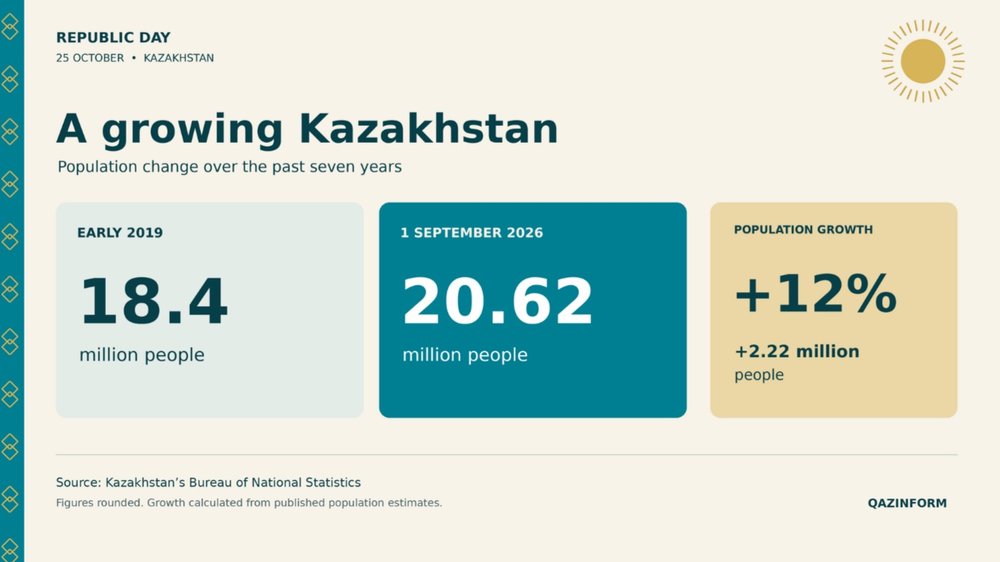
Kazakhstan’s population grew from 18.4 million in early 2019 to 20.62 million by September 2026. That represents an increase of about 2.22 million people, or 12%.
Almost three more years of life expectancy
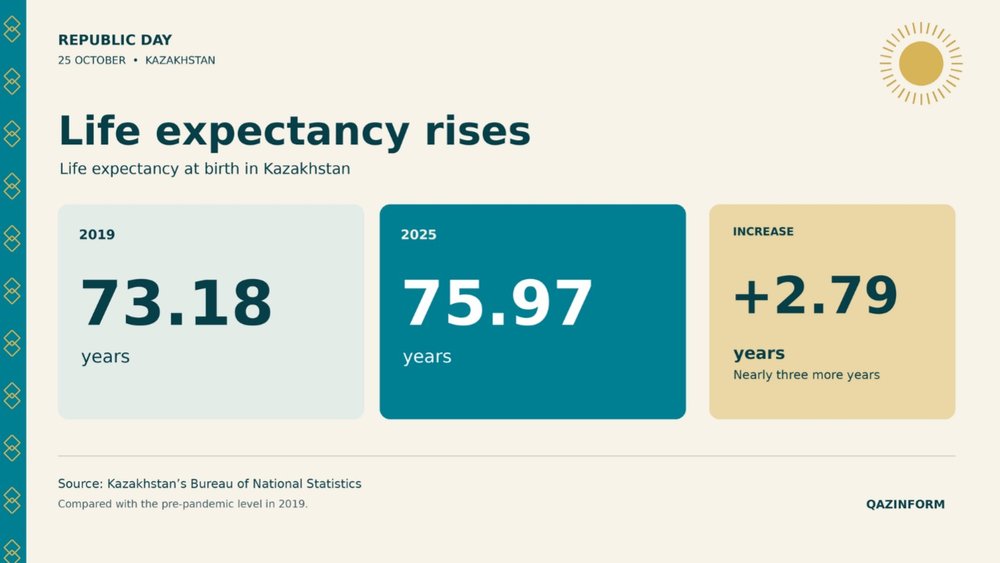
Life expectancy at birth rose from 73.18 years in 2019 to 75.97 in 2025. The increase puts the country nearly three years above its pre-pandemic level.
A gap remains between women and men. In 2025, life expectancy stood at 79.8 years for women and 72.19 for men.
More classrooms and student housing
Kazakhstan has built 1,342 schools since 2019, adding capacity for more than one million students. President Kassym-Jomart Tokayev cited these figures at the first session of Kazakhstan’s People’s Council.
For university students, the changes extend beyond the classroom. Figures Qazinform published in October show that 267 dormitories opened over seven years, adding 66,104 beds. During that period, the reported shortage fell from 82,000 to 5,200 beds.
International study options have also expanded within Kazakhstan. Government figures show 33 branches of foreign universities from 12 countries operating in 2026.
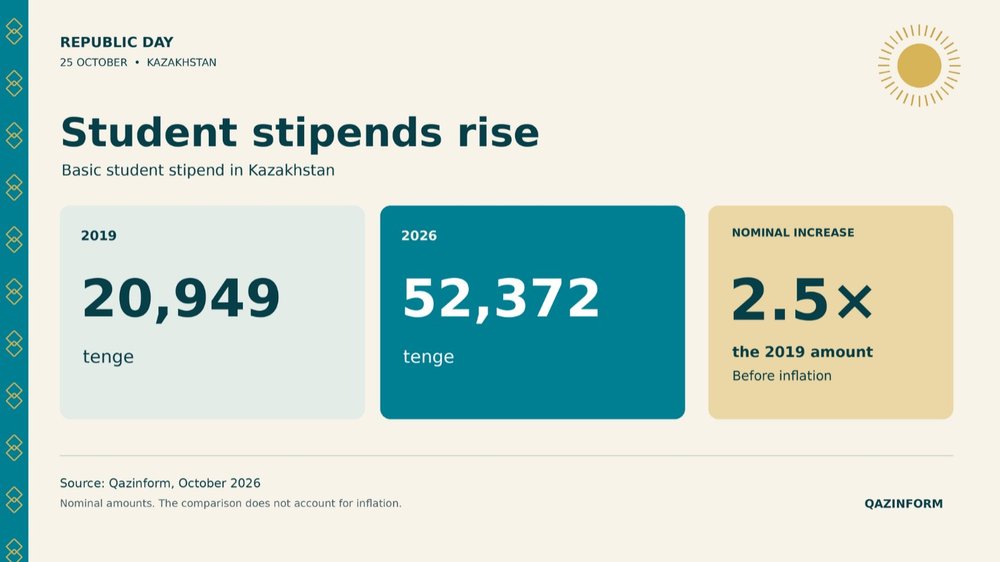
The basic student stipend rose from 20,949 tenge in 2019 to 52,372 tenge. That is roughly 2.5 times the earlier amount, before accounting for inflation.
Annual housing construction grows by half
Kazakhstan completed 13.1 million square meters of housing in 2019. By 2025, the annual total had reached 20.1 million.
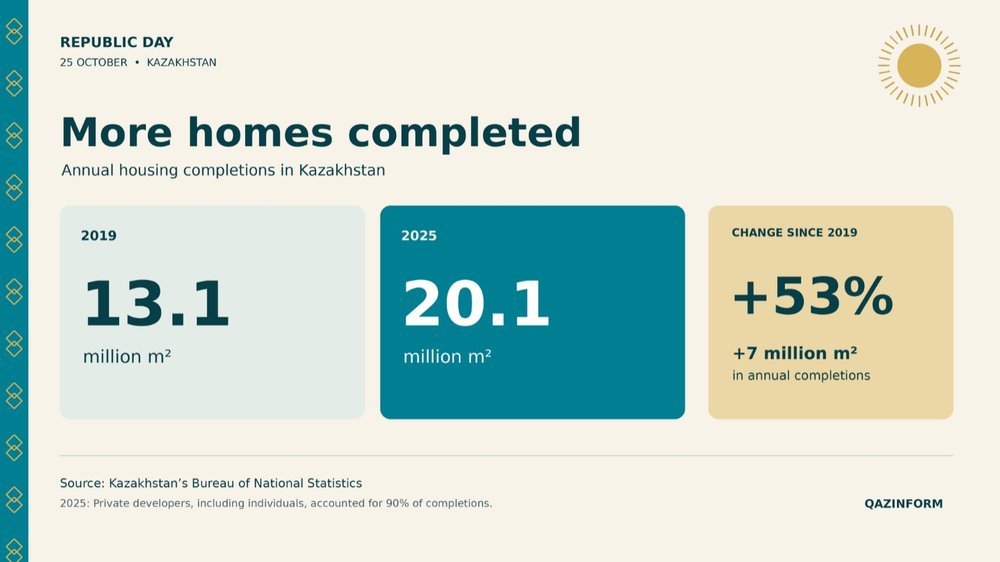
That means roughly 7 million additional square meters a year, an increase of 53%.
Private developers, including people building their own homes, accounted for 90% of completions in 2025. More construction adds to housing supply, though it does not necessarily bring lower prices.
A larger role for small businesses
Small and medium-sized enterprises generated 31.7% of Kazakhstan’s GDP in 2019. By 2025, their share had reached 40.9%.
The increase of 9.2 percentage points brought their contribution above two-fifths of the economy. At the start of 2026, the sector employed approximately 4.5 million people.
Water access expands
In 2019, water supply coverage stood at 97.2% in cities and 86.4% in rural areas. The Ministry of Industry and Construction has since reported access to water services in every settlement. This includes wells, modular treatment units and water deliveries, alongside centralized networks.
Renewables triple their share
Renewable sources provided 2.3% of Kazakhstan’s electricity in 2019. By 2025, their share had reached 7%, roughly three times as much.
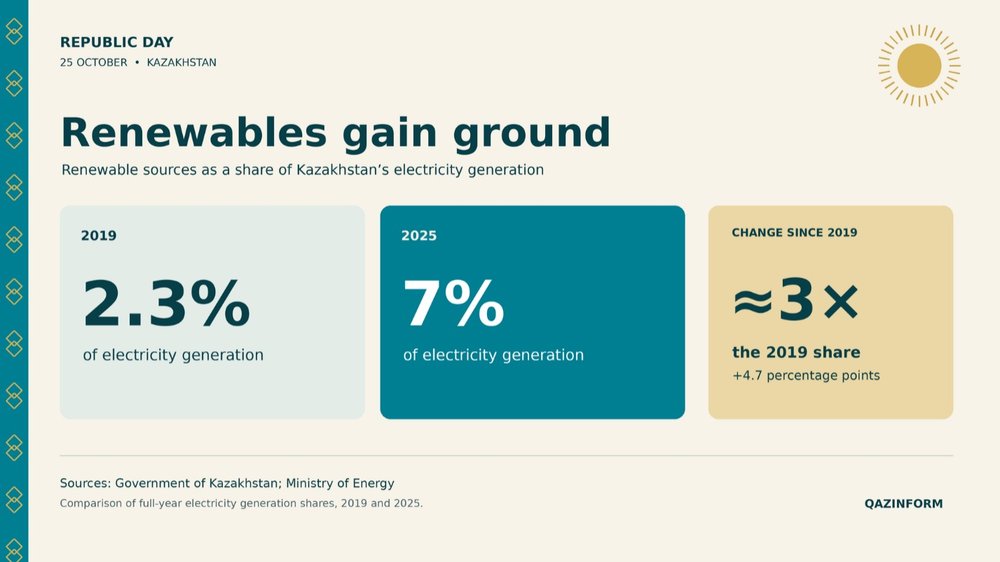
Their annual output grew from 2.4 billion to 8.62 billion kilowatt-hours over that period. Wind farms led renewable generation in 2025, followed by solar plants. Hydropower facilities counted in renewable energy statistics ranked third.
Earlier, Qazinform News Agency reported that President Kassym-Jomart Tokayev congratulated Kazakhstanis on Republic Day. He highlighted how the Declaration of State Sovereignty laid the foundation for Kazakhstan’s independence.
Share this article:

EU Reporter publishes articles from a variety of outside sources which express a wide range of viewpoints. The positions taken in these articles are not necessarily those of EU Reporter. Please see EU Reporter’s full Terms and Conditions of publication for more information EU Reporter embraces artificial intelligence as a tool to enhance journalistic quality, efficiency, and accessibility, while maintaining strict human editorial oversight, ethical standards, and transparency in all AI-assisted content. Please see EU Reporter’s full A.I. Policy for more information.



Albania could conclude EU accession talks by 2027, but must reverse reform slowdown

Europe and China can build a fairer trading relationship through cooperation

Household electricity prices ease in 1st half of 2026

Commission defends targeted 2027 work programme as focus shifts to delivery

EU household gas prices decrease in first half of 2026

European liberals must not sacrifice their principles by hosting a divisive figure like Reza Pahlavi

More than 200 businesses urge von der Leyen to rethink EU tobacco rules

Montenegro first in line for EU enlargement, accession treaty could be signed in June 2027

Azerbaijan’s Victory Day: November 8

How Russian Developers Manage Western Sanctions and why

Gender equality week: Women in leadership

MEPs push for continued engagement and concrete results on trade with China

EU Maritime Security Strategy: Joint report highlights progress

Eligibility to publish in Open Research Europe without fees expands to researchers in 11 countries

Commission launches public consultation on making products easier to repair

Commission takes new steps to prepare Europeans for growing crisis risks

Kazakhstan reforms under scrutiny at Brussels Press Club round table

Japan should face up to history and contribute more to regional peace

Ambassador calls for 'speeding up' of co-operation between EU and Kazakhstan

Timur Turlov at Smart Moves Summit 2025: How chess can transform global education

Shevtsova’s case: Out-of-court sanctions dismantling trust in Ukrainian cause

The future of European transport

Trump Vs Trueman

US 'no longer' an 'unconditional ally' for Europe - MEP
-
 Albania4 days ago
Albania could conclude EU accession talks by 2027, but must reverse reform slowdown
-
 China-EU5 days ago
Europe and China can build a fairer trading relationship through cooperation
-
 Electricity interconnectivity4 days ago
Household electricity prices ease in 1st half of 2026
-
 European Commission4 days ago
Commission defends targeted 2027 work programme as focus shifts to delivery