European Parliament
European liberals must not sacrifice their principles by hosting a divisive figure like Reza Pahlavi


As Europeans, we cherish freedom, human rights, democracy, and peace, principles forged through centuries of struggle against tyranny, dictatorship, and war. These values have long underpinned Europe's moral standing on the world stage, writes Jim Higgins.
For Europe's liberal political family, they are particularly fundamental.
The Charter of Values adopted by the Alliance of Liberals and Democrats for Europe (ALDE) in Brussels in 2024 explicitly commits European liberals to democracy, equality, pluralism, the rule of law, human rights, fundamental freedoms, and opposition to authoritarianism. It also affirms their commitment to supporting freedom and democracy beyond Europe's borders.
These are solemn commitments, not principles to be discarded for political expediency.
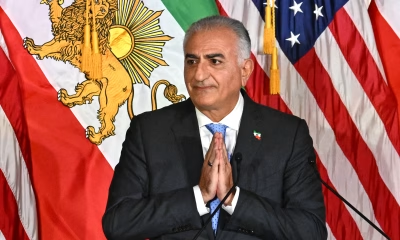
That is why reports that some liberal politicians in the European Parliament intend to host Reza Pahlavi, son of Iran's deposed Shah, raise serious questions. How can such an invitation be reconciled with the very values these politicians profess to uphold?
Consider the record.
Pahlavi has repeatedly advocated foreign military intervention against Iran, presenting it as a means of accelerating regime change. The consequences of military confrontation started eight months ago are already evident, yet he continues to promote this approach.
Equally troubling is his attitude toward his father's dictatorship. Mohammad Reza Shah's rule was marked by political imprisonment, repression, torture, and executions, with the notorious SAVAK secret police playing a central role. Ethnic minorities, including the Kurds, suffered discrimination and suppression of their political rights.
Rather than unequivocally repudiating this legacy, Reza Pahlavi has repeatedly praised his father's rule, including in 2026. He has gone as far as saying that he is proud of his heritage.
There is another fundamental issue: democratic legitimacy.
Pahlavi has no electoral mandate from the Iranian people. Investigations by several independent cybersecurity researchers, including the University of Toronto's Citizen Lab, have exposed coordinated online influence operations using fake accounts, artificial intelligence, and manipulated content to promote his image and exaggerate perceptions of popular support. His international media visibility cannot substitute for genuine democratic legitimacy.
Nor has he demonstrated a serious organization or credible political infrastructure inside Iran capable of leading a democratic transition.
More troubling still, Pahlavi for more than two decades has publicly acknowledged contacts with officers of the Islamic Revolutionary Guard Corps (IRGC) and the Basij militia.
The IRGC is a central instrument of repression in Iran and terrorist operations abroad. In February 2026, the European Union formally designated it a terrorist organization.
Iran's opposition is diverse, encompassing different political traditions, ethnic communities, and visions of the country's future. Elevating a controversial figure like Pahlavi risks marginalizing other voices and creating the misleading impression that Europe has already chosen Iran's next leader.
The controversy surrounding his European engagements should serve as a warning.
In Germany, the Friedrich Naumann Foundation's decision to have Pahlavi accept its 2026 Freedom Prize on behalf of the Iranian people has provoked widespread opposition. More than 90 prominent German figures, including former federal ministers, 16 members of the Bundestag, former diplomats, and leading legal figures, have objected to the decision. They have been joined by 306 Iranian associations worldwide as well as former political prisoners who suffered imprisonment and torture under the Shah's dictatorship.
In Belgium, attempts to arrange a parliamentary reception for Pahlavi encountered substantial opposition, and the proposed parliamentary invitation was dropped.
These objections cannot simply be dismissed as disagreements among Iranian exiles. They raise a fundamental question: Should European institutions confer symbolic legitimacy upon an unelected and divisive political figure?
There is also a historical parallel that Europe would be unwise to ignore.
Before the 2003 invasion of Iraq, Ahmad Chalabi, an Iraqi exile politician, cultivated influential supporters in Washington and vigorously promoted the case for war against Iraq. His political ambitions became closely associated with a disastrous military intervention whose consequences continue to haunt the region.
The parallels with Pahlavi's pursuit of Western political backing are troubling particularly now, as the drums of war grow louder and the prospect of another military confrontation involving Iran looms.
Europe should have learned from Iraq that foreign military intervention cannot manufacture democratic legitimacy. Nor can international recognition substitute for genuine popular support.
The Iranian people have already experienced two forms of dictatorship: hereditary monarchy and religious theocracy. Their future must not be reduced to a choice between a crown and a turban.
For European liberals, this is ultimately a question of credibility. Their commitment to democracy, human rights, and pluralism must extend to the Iranian people, whose right to determine their own future through free and fair elections should be paramount.
The liberal politicians involved should reconsider the invitation before it is too late. Their responsibility is to uphold their own principles and respect the Iranian people's struggle for freedom.
Europe must learn from its mistakes. Democratic principles matter most when political expediency by some politicians tempts us to abandon them.
Jim Higgins is an Irish politician who was an MEP from 2004 to 2014. During his ten years in the European Parliament, Higgins served as a Quaestor and member of the Parliament's Bureau.
Share this article:

EU Reporter publishes articles from a variety of outside sources which express a wide range of viewpoints. The positions taken in these articles are not necessarily those of EU Reporter. Please see EU Reporter’s full Terms and Conditions of publication for more information EU Reporter embraces artificial intelligence as a tool to enhance journalistic quality, efficiency, and accessibility, while maintaining strict human editorial oversight, ethical standards, and transparency in all AI-assisted content. Please see EU Reporter’s full A.I. Policy for more information.





Albania could conclude EU accession talks by 2027, but must reverse reform slowdown

Europe and China can build a fairer trading relationship through cooperation

Household electricity prices ease in 1st half of 2026

Commission defends targeted 2027 work programme as focus shifts to delivery

EU household gas prices decrease in first half of 2026

More than 200 businesses urge von der Leyen to rethink EU tobacco rules

Montenegro first in line for EU enlargement, accession treaty could be signed in June 2027

Kazakhstan’s AI ambitions open a new chapter in its economic ties with Europe

How Russian Developers Manage Western Sanctions and why

Gender equality week: Women in leadership

MEPs push for continued engagement and concrete results on trade with China

EU Maritime Security Strategy: Joint report highlights progress

Eligibility to publish in Open Research Europe without fees expands to researchers in 11 countries

Commission launches public consultation on making products easier to repair

Commission takes new steps to prepare Europeans for growing crisis risks

Secularism as a shield: Lessons from Baku, Tbilisi and Yerevan

Kazakhstan reforms under scrutiny at Brussels Press Club round table

Japan should face up to history and contribute more to regional peace

Ambassador calls for 'speeding up' of co-operation between EU and Kazakhstan

Timur Turlov at Smart Moves Summit 2025: How chess can transform global education

Shevtsova’s case: Out-of-court sanctions dismantling trust in Ukrainian cause

The future of European transport

Trump Vs Trueman

US 'no longer' an 'unconditional ally' for Europe - MEP
-
 Albania4 days ago
Albania could conclude EU accession talks by 2027, but must reverse reform slowdown
-
 China-EU5 days ago
Europe and China can build a fairer trading relationship through cooperation
-
 Electricity interconnectivity4 days ago
Household electricity prices ease in 1st half of 2026
-
 European Commission4 days ago
Commission defends targeted 2027 work programme as focus shifts to delivery