Belgium
Death toll rises to 170 in Germany and Belgium floods


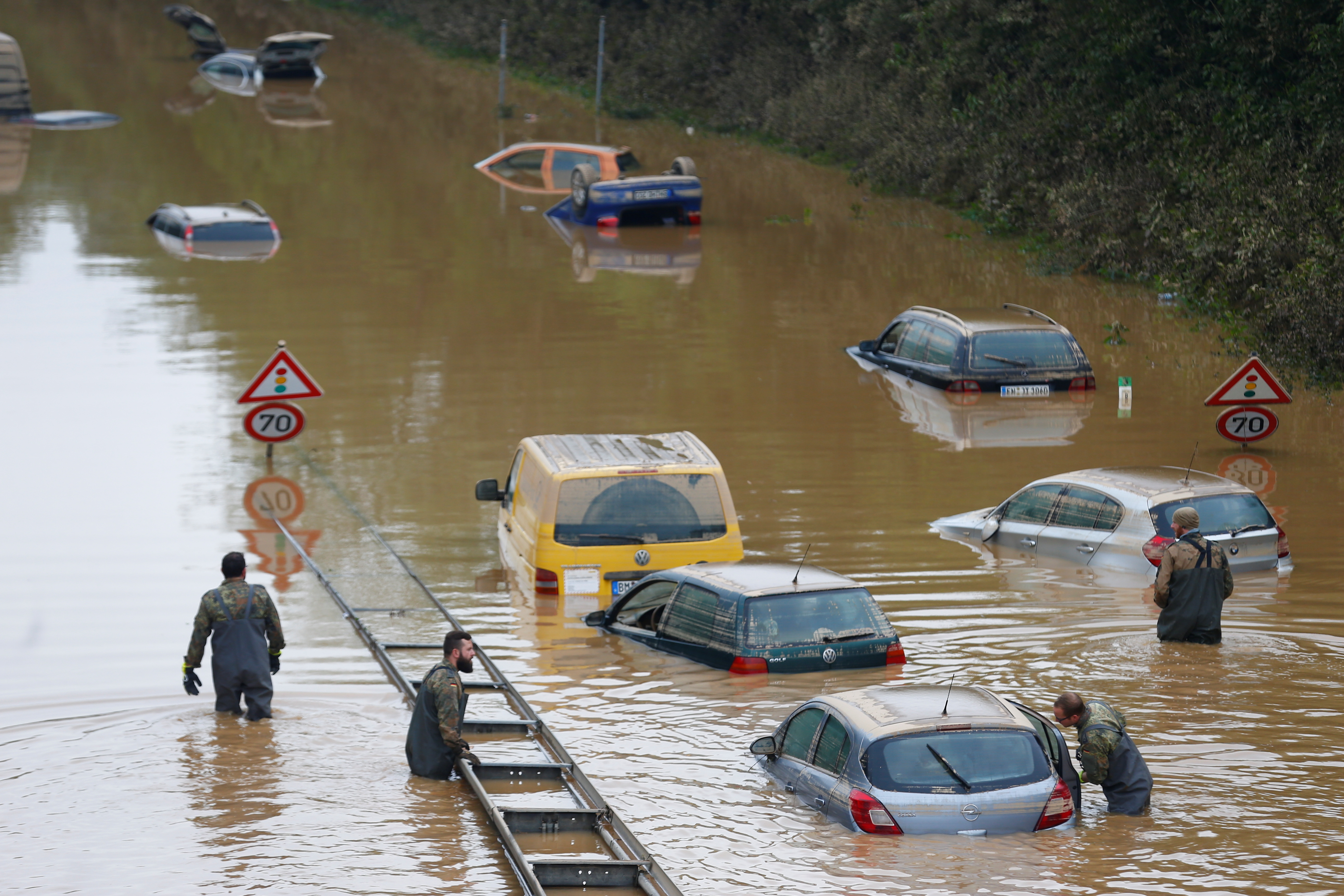
The death toll in devastating flooding in western Germany and Belgium rose to at least 170 on Saturday (17 July) after burst rivers and flash floods this week collapsed houses and ripped up roads and power lines, write Petra Wischgoll,
David Sahl, Matthias Inverardi in Duesseldorf, Philip Blenkinsop in Brussels, Christoph Steitz in Frankfurt and Bart Meijer in Amsterdam.
Some 143 people died in the flooding in Germany's worst natural disaster in more than half a century. That included about 98 in the Ahrweiler district south of Cologne, according to police.
Hundreds of people were still missing or unreachable as several areas were inaccessible due to high water levels while communication in some places was still down.
Residents and business owners struggled to pick up the pieces in battered towns.
"Everything is completely destroyed. You don't recognise the scenery," said Michael Lang, owner of a wine shop in the town of Bad Neuenahr-Ahrweiler in Ahrweiler, fighting back tears.
German President Frank-Walter Steinmeier visited Erftstadt in the state of North Rhine-Westphalia, where the disaster killed at least 45 people.
"We mourn with those that have lost friends, acquaintances, family members," he said. "Their fate is ripping our hearts apart."
Around 700 residents were evacuated late on Friday after a dam broke in the town of Wassenberg near Cologne, authorities said.
But Wassenberg mayor Marcel Maurer said water levels had been stabilising since the night. "It's too early to give the all-clear but we are cautiously optimistic," he said.
The Steinbachtal dam in western Germany, however, remained at risk of breaching, authorities said after some 4,500 people were evacuated from homes downstream.
Steinmeier said it would take weeks before the full damage, expected to require several billions of euros in reconstruction funds, could be assessed.
Armin Laschet, state premier of North Rhine-Westphalia and the ruling CDU party's candidate in September's general election, said he would speak to Finance Minister Olaf Scholz in the coming days about financial support.
Chancellor Angela Merkel was expected to travel on Sunday to Rhineland Palatinate, the state that is home to the devastated village of Schuld.
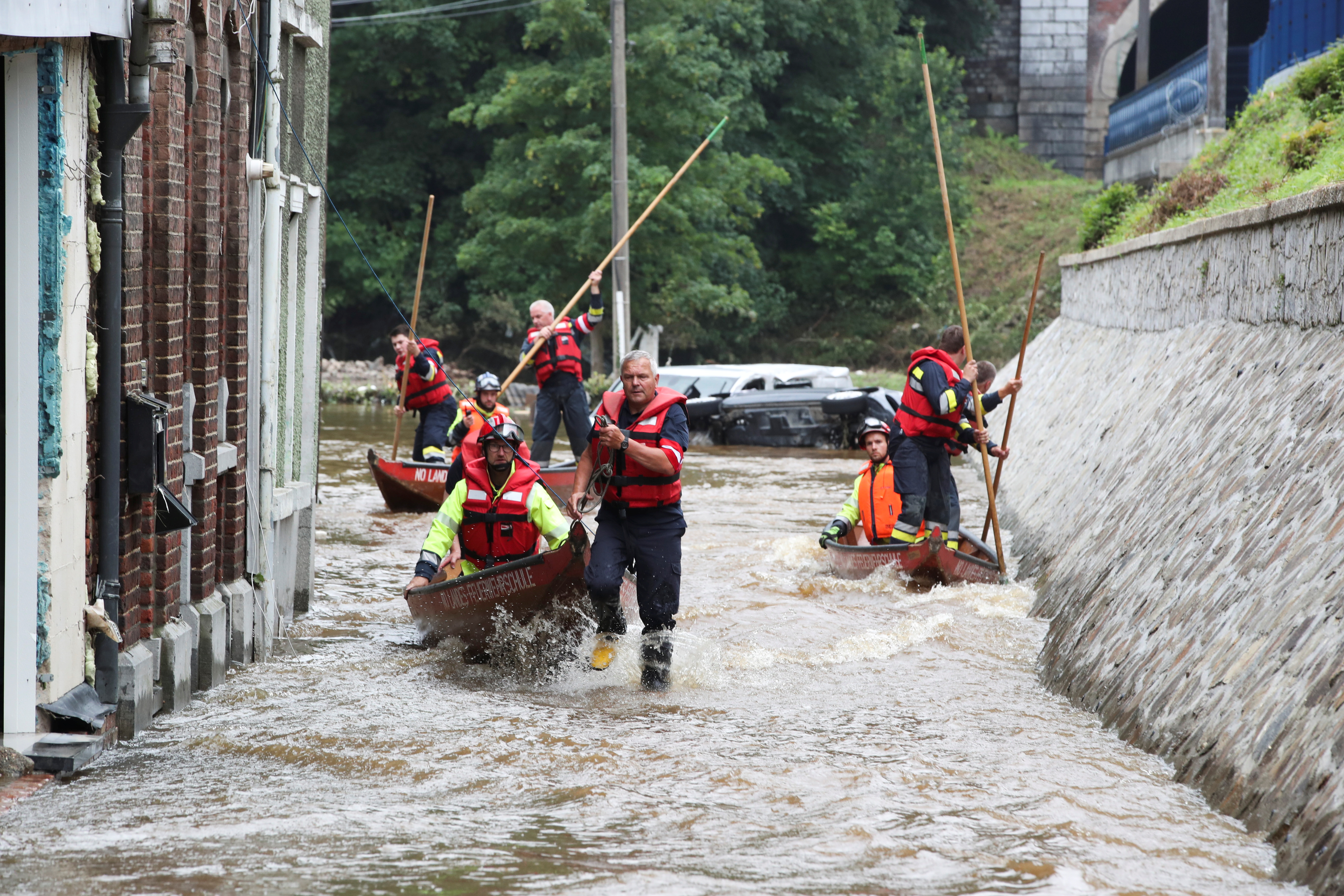
In Belgium, the death toll rose to 27, according to the national crisis centre, which is co-ordinating the relief operation there.
It added that 103 people were "missing or unreachable". Some were likely unreachable because they could not recharge mobile phones or were in hospital without identity papers, the centre said.
Over the past several days the floods, which have mostly hit the German states of Rhineland Palatinate and North Rhine-Westphalia and eastern Belgium, have cut off entire communities from power and communications.
RWE (RWEG.DE), Germany's largest power producer, said on Saturday its opencast mine in Inden and the Weisweiler coal-fired power plant were massively affected, adding that the plant was running at lower capacity after the situation stabilized.
In the southern Belgian provinces of Luxembourg and Namur, authorities rushed to supply drinking water to households.
Flood water levels slowly fell in the worst hit parts of Belgium, allowing residents to sort through damaged possessions. Prime Minister Alexander De Croo and European Commission President Ursula von der Leyen visited some areas on Saturday afternoon.
Belgian rail network operator Infrabel published plans of repairs to lines, some of which would be back in service only at the very end of August.
Emergency services in the Netherlands also remained on high alert as overflowing rivers threatened towns and villages throughout the southern province of Limburg.
Tens of thousands of residents in the region have been evacuated in the past two days, while soldiers, fire brigades and volunteers worked frantically throughout Friday night (16 July) to enforce dykes and prevent flooding.
The Dutch have so far escaped disaster on the scale of its neighbours, and as of Saturday morning no casualties had been reported.
Scientists have long said that climate change will lead to heavier downpours. But determining its role in these relentless rainfalls will take at least several weeks to research, scientists said on Friday.
Share this article:
EU Reporter publishes articles from a variety of outside sources which express a wide range of viewpoints. The positions taken in these articles are not necessarily those of EU Reporter. Please see EU Reporter’s full Terms and Conditions of publication for more information EU Reporter embraces artificial intelligence as a tool to enhance journalistic quality, efficiency, and accessibility, while maintaining strict human editorial oversight, ethical standards, and transparency in all AI-assisted content. Please see EU Reporter’s full A.I. Policy for more information.



Energy Union Task Force takes stock of oil and gas security of supply in the EU

AIFC to host Astana Finance Days 2026 in September

ALROSA Re-elects Supervisory Board with Minimal Changes

EU launches a Team Gaza Initiative to support early recovery in Gaza with an initial amount of nearly €900 million

Public consultation on Joint Undertakings, Art. 185 initiatives, and thematic priorities for European Partnerships under Horizon Europe 28-34

Poland sees new research and changes to policies on migrant integration

EU and South Africa kick off intergovernmental dialogue on Clean Trade and Investment Partnership

NESBp: Strengthening maritime spatial planning across the North Sea and Baltic Sea

Kazakhstan seeks regional AI leadership as economic partnership with China enters new phase

Starmer’s problem? 'He is not a politician'

Why a Brussels–Nicosia–Eastern Mediterranean strategic affairs platform would benefit the European Union

Albania's Vlora airport standoff tests investor confidence as EU accession clock ticks

ECR MEPs question the European Commission on cardiovascular health and diet promoting the Mediterranean diet as an alternative to ultra-processed foods as key to tackling obesity

Kazakhstan's fixed capital investment tops 9.5 trillion tenge in H1 2026

Commission adopts simpler rules for EU agri-food promotion policy

Commission approves €659 million German state aid for four new semiconductor facilities

Kazakhstan reforms under scrutiny at Brussels Press Club round table

Japan should face up to history and contribute more to regional peace

Ambassador calls for 'speeding up' of co-operation between EU and Kazakhstan

Timur Turlov at Smart Moves Summit 2025: How chess can transform global education

Shevtsova’s case: Out-of-court sanctions dismantling trust in Ukrainian cause

The future of European transport

Trump Vs Trueman

US 'no longer' an 'unconditional ally' for Europe - MEP
-
 Energy market5 days ago
Energy Union Task Force takes stock of oil and gas security of supply in the EU
-
 Kazakhstan5 days ago
AIFC to host Astana Finance Days 2026 in September
-
 Economy5 days ago
ALROSA Re-elects Supervisory Board with Minimal Changes
-
 Gaza Strip5 days ago
EU launches a Team Gaza Initiative to support early recovery in Gaza with an initial amount of nearly €900 million