Economy
Hospital pharmacists offer support for centralised authorisation of high-risk medical devices


The European Association of Hospital Pharmacists (EAHP) has today published a policy statement on the issue of medical device regulation in Europe. It is intended as a contribution to the current discussion between the European Parliament and European Commission on the subject of device assessment authorisation, vigilance and traceability. Medical devices are an essential part of the delivery of high quality health-care and their procurement and management in the European hospital setting is often under the authority of hospital pharmacists.
EAHP has reviewed the September 2012 proposals of the European Commission to update pan-European device regulation, and followed the scrutiny of the European Parliament on the subject. Subsequently EAHP’s members have passed policy to:
- Support central authorisation of high risk (class III) devices as a proportionate measure to ensure high level scrutiny of device safety;
- call for explicit co-ordination between future verification and traceability systems for devices, and the systems for medicines verification already in development as a result of the Falsified Medicines Directive; and,
- request harmonisation between the processes for vigilance reporting by health professionals in respect of medical devices and existing systems of pharmacovigilance.
EAHP is concerned about evidence that device approval standards have been inconsistently applied by Europe’s national level approval authorities (or ‘notified bodies’), as well as disparity in standards of assessment for high risk devices between the USA and Europe. While EAHP recognise that devices cannot necessarily be considered in the same manner as pharmaceutical products, the Association views that a distinctive case for centralised authorisation procedures for Class III devices exists (i.e. those devices that support or sustain human life).
Furthermore, EAHP promotes joined-up thinking on device and pharmaceutical regulation. With new traceability, verification and vigilance systems now being put in place across Europe for pharmaceuticals (Pharmacovigilance and Falsified Medicines Directives) there is a need to avoid unnecessary duplication and ensure interoperability wherever possible in respect of similar developments planned for device regulation.
EAHP President Dr Roberto Frontini said: “Good regulation can often be a difficult balancing act between protecting patient safety whilst also promoting innovation. In this sense I cannot see a case for centralised authorisation for all medical devices. Yet where a device fits within the category of Class III – high risk – another level of assured scrutiny is needed. From assessing the options, EAHP consider that centralised authorisation offers the best opportunity for a transparent, rigorous and well understood process. With discussions on the subject continuing EAHP will seek to ensure that the practice experience hospital pharmacists have with devices contributes positively to the final regulation.”
Share this article:
EU Reporter publishes articles from a variety of outside sources which express a wide range of viewpoints. The positions taken in these articles are not necessarily those of EU Reporter. Please see EU Reporter’s full Terms and Conditions of publication for more information EU Reporter embraces artificial intelligence as a tool to enhance journalistic quality, efficiency, and accessibility, while maintaining strict human editorial oversight, ethical standards, and transparency in all AI-assisted content. Please see EU Reporter’s full A.I. Policy for more information.



Kazakhstan seeks regional AI leadership as economic partnership with China enters new phase

Survey on an EU Blueprint for intellectual property licensing and spinoff creation

Setting a new benchmark in premium travel

Burnham as PM? 'Wait and see'

Statement by the Ministry of Foreign Affairs of the Republic of Kazakhstan

Rule of law report strengthens EU democracy and fundamental rights

Kazakhstan and Belgium: Building a Partnership for the Future

Kazakhstan: Central Election Committee reviews the results of the nomination of candidates for the deputies of Kurultai

The EU’s Forced-Labour Regulation Faces a Credibility Test

European Statistical Monitor: July edition

Commission publishes state aid guidance on carbon contracts for difference

Commission greenlights Estonia's fourth payment request for €135.5 million under NextGenerationEU

Drones, dominance, and the Iranian impasse: The West's strategic blind spot

Kazakhstan's fixed capital investment tops 9.5 trillion tenge in H1 2026

Commission registers two European Citizens' Initiatives on education and housing
Kazakhstan and Belgium: Building a Partnership for the Future

Kazakhstan reforms under scrutiny at Brussels Press Club round table

Japan should face up to history and contribute more to regional peace

Ambassador calls for 'speeding up' of co-operation between EU and Kazakhstan

Timur Turlov at Smart Moves Summit 2025: How chess can transform global education

Shevtsova’s case: Out-of-court sanctions dismantling trust in Ukrainian cause

The future of European transport

Trump Vs Trueman

US 'no longer' an 'unconditional ally' for Europe - MEP
-
 China4 days ago
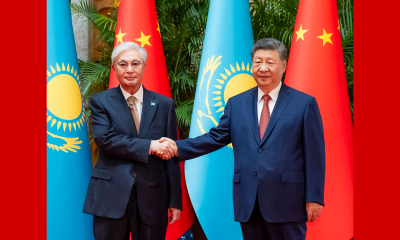
Kazakhstan seeks regional AI leadership as economic partnership with China enters new phase
-
 Intellectual Property Rights2 days ago
Survey on an EU Blueprint for intellectual property licensing and spinoff creation
-
 Aviation/airlines2 days ago
Setting a new benchmark in premium travel
-
 Labour2 days ago
Burnham as PM? 'Wait and see'