Kazakhstan
Kazakhstan: Central Election Committee reviews the results of the nomination of candidates for the deputies of Kurultai

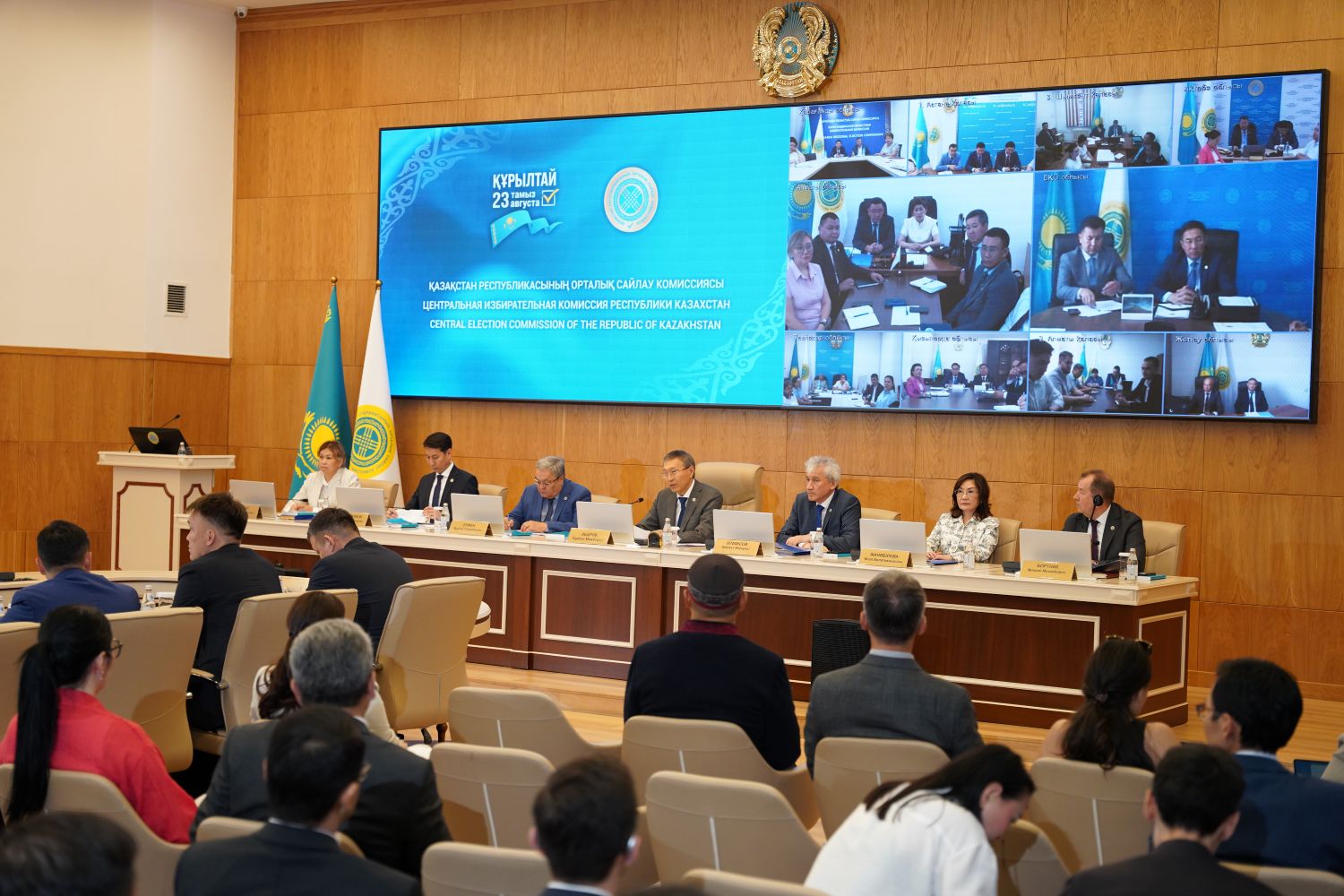
The second meeting of the Central Election Commission of the RK, held as part of the campaign for the election of deputies of the Kurultai of the Republic of Kazakhstan scheduled for 23 August 2026, took place today in Astana. The meeting was also attended by international observers, representatives of political parties, the Prosecutor General’s Office, the Ministries of Foreign Affairs, Finance, Internal Affairs, and Labour and Social Protection of the Population, members of the media, and members of the Working Groups on Ensuring the Electoral Rights of Persons with Disabilities operating under the Central and territorial election commissions. In addition, the chairpersons and members of the territorial election commissions of the capital, the regions and the cities of republican significance, as well as the heads of the offices of regional akims and the heads of regional departments of labour and social protection of the population, joined the meeting via videoconference.
In accordance with the agenda, the following matters were considered:
1. The results of the nomination of candidates for deputies of the Kurultai of the Republic of Kazakhstan in the election scheduled for 23 August 2026;
2. Certain matters concerning the protection of the electoral rights of citizens with disabilities in the election of deputies of the Kurultai of the Republic of Kazakhstan scheduled for 23 August 2026;
3. The accreditation of observers from foreign states and international organizations for the election of deputies of the Kurultai of the Republic of Kazakhstan scheduled for 23 August 2026.
Opening the meeting, the Chairman of the Central Election Commission emphasized that seven political parties had submitted the relevant documents to the CEC.
.jpeg)
“According to the information submitted to the CEC, seven political parties intend to participate in the election of deputies of the Kurultai. The party lists take into account the statutory quota of at least 30 per cent for women, young people and persons with disabilities. As you know, under the Calendar Plan, the registration period for party lists of candidates for deputies of the Kurultai will continue until 6:00 p.m. on 23 July. The documents submitted by all political parties have now been forwarded to the relevant authorised state bodies to verify whether the citizens included in the party lists comply with the requirements established by law,” Nurlan Abdirov stated.
The Secretary of the CEC outlined the requirements applicable to candidates included in party lists. Shavkhat Utemissov also recalled that the nomination of candidates for deputies of the Kurultai had concluded at 6:00 p.m. the previous day, 13 July 2026.
.jpeg)
“As of 6:00 p.m. on 13 July 2026, the Central Election Commission had received party lists from seven political parties: the Public Association ‘Democratic Party of Kazakhstan Ak Zhol’ - 63 candidates; the Republican Public Association ‘Auyl Party’ - 69 candidates; the Public Association ‘Political Party Adilet’ - 186 candidates; the Public Association ‘Kazakhstan Green Party Baitaq’ - 47 candidates; the Public Association ‘People’s Party of Kazakhstan’ - 72 candidates; the Republican Public Association ‘Nationwide Social Democratic Party’ - 33 candidates; and the Public Association ‘Respublica Party’ - 76 candidates,” Shavkhat Utemissov stated.
The Secretary of the CEC also explained the provisions of the Constitutional Law on Elections in the Republic of Kazakhstan and the rights of political parties duly registered in accordance with the procedure established by law.
The members of the CEC also discussed the protection of the electoral rights of citizens with disabilities. Commission member Lyazzat Suyindik emphasized the importance of fully equipping polling premises to ensure to ensure that polling premises are fully accessible to voters with disabilities.
“The Central Election Commission of the Republic of Kazakhstan is implementing a comprehensive set of measures to protect the electoral rights of citizens with disabilities. Since 2021, broadcasts of CEC meetings and all informational video materials have been accompanied by sign language interpretation. Since 2022, Braille ballot templates have been produced. All polling stations are provided with audio instructions explaining how to complete the ballot. Since 2025, with the support of the Public Association ‘Shyrak Association of Women with Disabilities’ and the OSCE Programme Office in Astana, a video course on the rights and needs of persons with disabilities has been developed and used for the training of all members of election commissions. Local executive bodies provide accessible taxi services. We also recommend that local executive bodies actively involve representatives of public associations of persons with disabilities in assessing the accessibility of electoral infrastructure,” Lyazzat Suyіndіk emphasized.
.jpeg)
In turn, CEC Chairman Nurlan Abdirov called on political parties to take into account the rights of people with visual, hearing and mobility impairments when preparing campaign events and materials.
“I am addressing the political parties participating in the election of deputies of the Kurultai of the Republic of Kazakhstan. The exercise of the constitutional right to vote must be ensured at every stage of the electoral process, including for persons with disabilities. I call on the parties to take these requirements into account. This includes ensuring unrestricted access to venues where meetings with voters are held, providing sign language interpretation at public events, and using campaign materials in accessible formats that enable people with disabilities to familiarise themselves fully with the parties’ election programmes. I am confident that all of us will actively provide comprehensive support in resolving matters related to the protection of the electoral rights of persons with disabilities,” Nurlan Abdirov said in his address to the parties.
It should be noted that, in accordance with the established requirements, entrances to buildings containing polling premises must be equipped with handrails, platforms, ramps and other necessary accessibility devices. Polling premises must be made as accessible as possible to citizens with disabilities and must either be located on the ground floors of buildings or be equipped with lifting mechanisms providing access to other floors.
Polling premises must contain various tactile signs and an enlarged secret voting booth designed to accommodate voters with mobility impairments, including wheelchair users. Each polling station must also have a specially equipped area containing a computer, headphones, additional lighting, magnifying glasses, a Braille ballot template and an audio version of the ballot.
The meeting also provided information on the number of international observers accredited in Kazakhstan for the election of deputies of the Kurultai. Deputy Chairman of the CEC Mukhtar Yerman noted that a decision to open international observation of the election of deputies of the Kurultai of the Republic of Kazakhstan had been adopted on 1 July of this year. The Ministry of Foreign Affairs and the Central Election Commission had sent the relevant invitations to a number of countries and international organizations to participate in observing the election.
“To date, the Central Election Commission has received nominations for the accreditation of 60 observers representing three international organizations and four foreign states. These include four representatives of the CIS Observer Mission, 19 representatives of the Interparliamentary Assembly of Member States of the CIS, 32 observers from the OSCE Office for Democratic Institutions and Human Rights Election Observation Mission, and two nominees from the Republic of Maldives, including the Vice-President of that country’s Election Commission. They also include the Ambassador of Palestine to Kazakhstan, who is the Dean of the Diplomatic Corps accredited in Astana; the Ambassador of Venezuela to Kazakhstan; and the Chargé d’Affaires of Hungary in Kazakhstan. The information on observers will be updated as further accreditation submissions are received,” Mukhtar Yerman stated.
.jpeg)
Following the meeting, the members of the Central Election Commission adopted the relevant resolutions and answered journalists’ questions during a media briefing.
.jpeg)
.jpeg)
Share this article:
EU Reporter publishes articles from a variety of outside sources which express a wide range of viewpoints. The positions taken in these articles are not necessarily those of EU Reporter. Please see EU Reporter’s full Terms and Conditions of publication for more information EU Reporter embraces artificial intelligence as a tool to enhance journalistic quality, efficiency, and accessibility, while maintaining strict human editorial oversight, ethical standards, and transparency in all AI-assisted content. Please see EU Reporter’s full A.I. Policy for more information.





ECR MEPs question the European Commission on cardiovascular health and diet promoting the Mediterranean diet as an alternative to ultra-processed foods as key to tackling obesity

Falling in love with the Maldives

Kurmuk gold project highlights Africa’s changing investment landscape

Albania's Vlora airport standoff tests investor confidence as EU accession clock ticks

EU steps up international support for Palestinians with major initiative for Gaza's early recovery and stronger international coordination

Commission adds exemptions to rules on removability of portable batteries

Iran’s regime in crisis: Negotiations, internal divisions and growing resistance

Natura 2000 Network offers opportunities for sustainable tourism across Europe

Kazakhstan and Belgium: Building a Partnership for the Future

New court ruling questions 'proportionality' of Mayor Erion Veliaj’s detention

Rome–Washington Axis: Italian Diplomat Zanardi Landi to Help Save Bosnia

Burnham as PM? 'Wait and see'

Ban on destruction of unsold clothes and shoes enters into application

Survey on an EU Blueprint for intellectual property licensing and spinoff creation

Rule of law report strengthens EU democracy and fundamental rights

EU launches Ukraine defence industrial partnership, Drone Deal and disburses €1 billion for drones *

Kazakhstan reforms under scrutiny at Brussels Press Club round table

Japan should face up to history and contribute more to regional peace

Ambassador calls for 'speeding up' of co-operation between EU and Kazakhstan

Timur Turlov at Smart Moves Summit 2025: How chess can transform global education

Shevtsova’s case: Out-of-court sanctions dismantling trust in Ukrainian cause

The future of European transport

Trump Vs Trueman

US 'no longer' an 'unconditional ally' for Europe - MEP
-
 Italy4 days ago
ECR MEPs question the European Commission on cardiovascular health and diet promoting the Mediterranean diet as an alternative to ultra-processed foods as key to tackling obesity
-
 Tourism5 days ago
Falling in love with the Maldives
-
 China5 days ago
Kurmuk gold project highlights Africa’s changing investment landscape
-
 Albania4 days ago
Albania's Vlora airport standoff tests investor confidence as EU accession clock ticks