China
Kazakhstan seeks regional AI leadership as economic partnership with China enters new phase

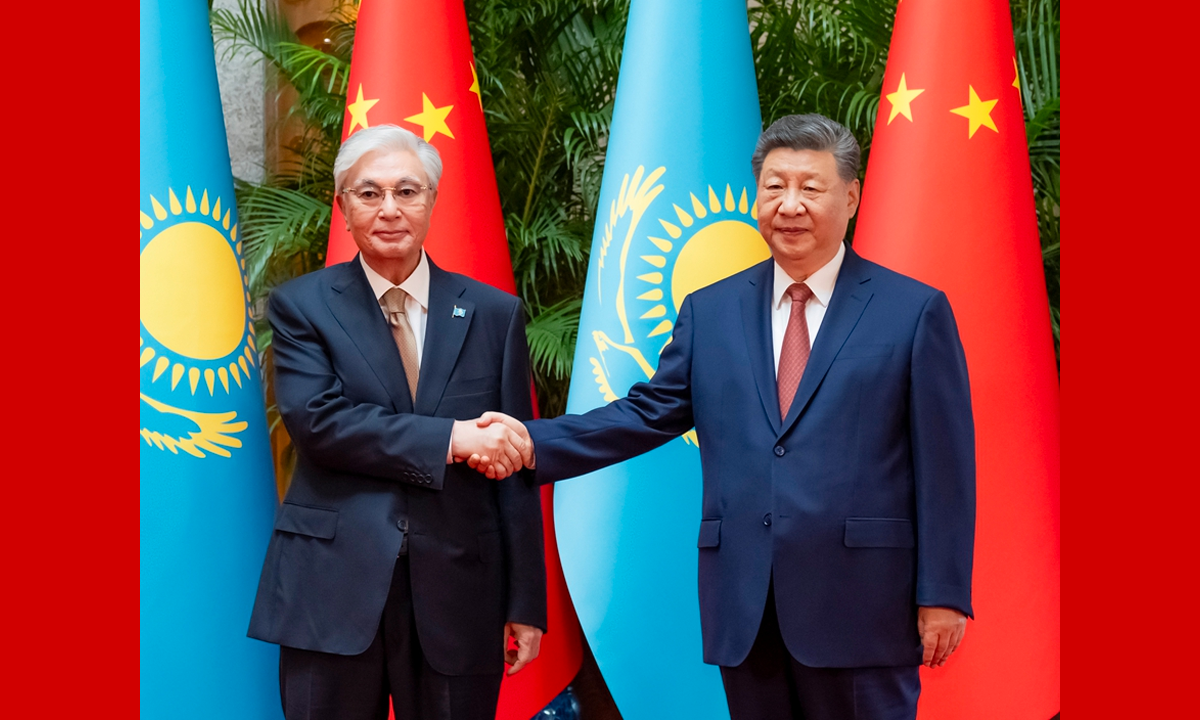
President Kassym-Jomart Tokayev has used a high-profile visit to Shanghai to advance Kazakhstan’s ambitions in artificial intelligence, electric vehicles and digital infrastructure, while securing a new economic cooperation roadmap with China extending to 2030.
Kazakhstan is seeking to position itself as Central Asia’s principal digital and technological hub, combining closer economic cooperation with China with a call for a more inclusive international system of artificial intelligence governance.
During a series of meetings and speeches in Shanghai on 16 and 17 July, President Kassym-Jomart Tokayev outlined an agenda that brings together AI regulation, digital trade, advanced manufacturing, transport infrastructure and green technology.
The visit culminated in Tokayev’s address to the opening of the 2026 World Artificial Intelligence Conference, where he argued that the benefits of AI should be available to countries at every stage of economic development.
“No country should remain merely a consumer of artificial intelligence,” Tokayev told the conference.
“Every nation must have the opportunity to develop its own human capital, digital infrastructure and institutional capacity.”
He said AI should remain under responsible human oversight and warned that technological development must not deepen existing global inequalities. Governance, he argued, must extend beyond software and algorithms to cover the complete technology ecosystem, including semiconductors, data centres, education, ethics and the protection of human dignity.
A bid to shape global AI governance
Tokayev’s proposals reflect Kazakhstan’s attempt to become not only a user of emerging technologies but also an active participant in setting the international rules governing them.
He welcomed plans to establish a World Organization for AI Cooperation and proposed that its inaugural meeting be held in Astana. Kazakhstan also offered to host the organisation’s regional office for Central Asia.
The initiative would strengthen the country’s claim to act as a diplomatic and institutional bridge between major powers while giving Central Asian countries a stronger voice in a debate currently dominated by the United States, China and the European Union.
Tokayev called for common standards for testing and certifying AI systems, closer coordination between national regulatory regimes and stronger action against cyberattacks, deepfakes and digital fraud.
The Kazakh leader also proposed creating an international network of AI schools, research centres and academic partnerships. The network would be intended to develop technical expertise while encouraging the responsible and ethical use of artificial intelligence.
He suggested that 2027 be declared the Year of Kazakhstan-China Joint AI Initiatives and proposed a Kazakhstan-China Digital Bridge to increase digital trade and connect the countries’ online economies more closely within the Belt and Road framework.
From natural resources to digital infrastructure
Kazakhstan has traditionally attracted foreign investment through its oil, gas, uranium and mineral resources. Tokayev’s Shanghai agenda suggests that Astana now wants technology, data and logistics to become equally important parts of the country’s economic identity.
The President highlighted Kazakhstan’s energy reserves, critical minerals, transport corridors and expanding digital infrastructure as foundations for its development as a regional technology centre.
He also pointed to a series of domestic initiatives, including the designation of 2026 as the Year of Artificial Intelligence and Digital Development, the introduction of AI legislation and a new Digital Code.
Among the flagship projects is Alatau, which is intended to become Central Asia’s first fully integrated digital city. The development is expected to operate under a special legal and regulatory framework designed to attract international technology companies, investors and skilled specialists.
Almaty is also due to host the United Nations Economic and Social Commission for Asia and the Pacific’s Asia-Pacific Digital Solutions Centre for Sustainable Development.
These initiatives fit within a wider strategy repeatedly set out by Tokayev, who has said that artificial intelligence should be incorporated into the real economy rather than treated as a standalone technology sector.
At a meeting of Kazakhstan’s AI Development Council earlier this year, he described AI as the emerging backbone of the global economy and called for its adoption across Kazakhstan’s public administration, industry and commercial sectors.
China partnership extended to 2030
The technology agenda was accompanied by a significant strengthening of Kazakhstan’s broader economic relationship with China.
During talks in Shanghai, Tokayev and Chinese President Xi Jinping agreed on a new trade and economic cooperation roadmap covering the period from 2027 to 2030.
The two leaders reaffirmed what they describe as an “eternal comprehensive strategic partnership”, pledging deeper cooperation in investment, trade, artificial intelligence, industrial development and regional security.
According to figures presented by Tokayev, bilateral trade reached a record $49 billion last year. Chinese investment in Kazakhstan has exceeded $30bn, while more than 8,500 companies with Chinese participation are operating in the country.
Joint projects already cover energy, gas processing, agriculture, mechanical engineering and industrial manufacturing. The new roadmap indicates that digital technology, advanced transport systems and new energy industries will assume a larger role in the next phase of the relationship.
Economic ties have been accompanied by an increase in tourism, educational exchanges and cultural cooperation. More than one million Chinese citizens reportedly visited Kazakhstan last year, while cultural centres and Chinese-supported vocational training institutions have been established in both countries.
Electric vehicles and advanced manufacturing
Tokayev’s meetings with leading Chinese companies gave a clearer indication of where future investment may be directed.
In talks with CATL, the world’s largest manufacturer of electric vehicle batteries, the President welcomed the company’s interest in developing a battery production facility in Kazakhstan.
Such a factory would be the first of its kind in Central Asia and could help Kazakhstan move beyond the extraction and export of raw materials into higher-value manufacturing.
CATL representatives also indicated that the company could support Kazakhstan’s objective of reaching carbon neutrality by 2060.
A major battery plant would give Kazakhstan a potentially important place in the rapidly expanding international supply chain for electric vehicles. Its mineral resources, industrial base and proximity to both Chinese and European markets could make it an attractive production location.
During a separate meeting with Xiaomi President Lu Weibing, Tokayev discussed the expansion of the Chinese electronics company’s operations in Kazakhstan and across Central Asia.
Xiaomi is considering a more structured regional distribution model and has indicated that it could help train Kazakh specialists to maintain and operate advanced AI systems.
The emphasis on professional training is important for Kazakhstan, which faces the challenge of ensuring that international investment produces local expertise and skilled employment rather than relying predominantly on imported technology and personnel.
Railways, ports and the Middle Corridor
Infrastructure and logistics formed another central part of the Shanghai discussions.
Tokayev reviewed the proposed Bakhty-Ayagoz railway with China Communications Construction Company. The planned route is expected to increase rail freight capacity between China and Kazakhstan and reduce congestion at existing border crossings.
The two sides also discussed establishing a joint venture to conduct dredging work in the Caspian Sea, potentially creating a regional navigation services centre for the wider Caspian basin.
At the same time, Kazakhstan is considering plans for a new multimodal logistics hub at the Port of Kuryk on the Caspian coast. The proposal includes a multifunctional port complex in the Mangystau region intended to increase freight capacity and support local employment and industrial development.
These projects have significance beyond bilateral Kazakhstan-China trade.
They form part of the expansion of the Trans-Caspian International Transport Route, commonly known as the Middle Corridor, which connects China and Central Asia with Europe through Kazakhstan, the Caspian Sea, the South Caucasus and Türkiye.
For the European Union, the corridor has become increasingly important as Brussels seeks more resilient and diversified trading routes between Europe and Asia.
Kazakhstan’s emerging digital and transport infrastructure could therefore serve both Chinese trade ambitions and European efforts to reduce dependence on a limited number of established supply chains.
Opportunities and strategic questions for Europe
Kazakhstan’s deepening technological partnership with China presents Europe with both opportunities and policy questions.
The EU has significant interests in Kazakhstan, particularly in critical raw materials, energy, transport connectivity and the development of the Middle Corridor. European institutions and businesses also have an interest in ensuring that the country’s future digital infrastructure remains open to international cooperation.
Astana continues to pursue a multi-vector foreign policy, maintaining relationships with China, Russia, the European Union, the United States and other international partners rather than aligning exclusively with a single geopolitical bloc.
Its closer relationship with Beijing does not therefore automatically exclude European participation. However, the speed and scale of Chinese investment mean that European businesses may face growing competition in areas including telecommunications, artificial intelligence, electric vehicles, batteries and transport construction.
There may also be scope for greater EU-Kazakhstan cooperation on AI governance.
Tokayev’s emphasis on human oversight, institutional responsibility, risk management and the protection of human dignity contains clear parallels with the principles behind the European Union’s regulatory approach.
However, important differences remain between the regulatory and political systems of the EU, China and Kazakhstan. The challenge for Astana will be to harmonise technical standards and attract investment without becoming dependent on one technology ecosystem or compromising its ability to cooperate with multiple international partners.
Kazakhstan’s strategy appears designed to avoid that outcome.
By combining Chinese investment with international organisations, UN-linked initiatives and calls for universal AI governance, the country is presenting itself as a regional connector rather than simply an extension of China’s digital economy.
Whether it can deliver on that ambition will depend on implementation: building the necessary infrastructure, educating a skilled workforce, ensuring transparent regulation and converting investment announcements into sustainable industrial projects.
What is already clear is that Kazakhstan intends to place itself at the centre of Central Asia’s next phase of development — where artificial intelligence, clean technology, advanced manufacturing and cross-continental connectivity increasingly converge.
Share this article:
EU Reporter publishes articles from a variety of outside sources which express a wide range of viewpoints. The positions taken in these articles are not necessarily those of EU Reporter. Please see EU Reporter’s full Terms and Conditions of publication for more information EU Reporter embraces artificial intelligence as a tool to enhance journalistic quality, efficiency, and accessibility, while maintaining strict human editorial oversight, ethical standards, and transparency in all AI-assisted content. Please see EU Reporter’s full A.I. Policy for more information.





Energy Union Task Force takes stock of oil and gas security of supply in the EU

AIFC to host Astana Finance Days 2026 in September

ALROSA Re-elects Supervisory Board with Minimal Changes

EU launches a Team Gaza Initiative to support early recovery in Gaza with an initial amount of nearly €900 million

Public consultation on Joint Undertakings, Art. 185 initiatives, and thematic priorities for European Partnerships under Horizon Europe 28-34

Poland sees new research and changes to policies on migrant integration

EU and South Africa kick off intergovernmental dialogue on Clean Trade and Investment Partnership

NESBp: Strengthening maritime spatial planning across the North Sea and Baltic Sea

Kazakhstan seeks regional AI leadership as economic partnership with China enters new phase

Starmer’s problem? 'He is not a politician'

Why a Brussels–Nicosia–Eastern Mediterranean strategic affairs platform would benefit the European Union

Albania's Vlora airport standoff tests investor confidence as EU accession clock ticks

ECR MEPs question the European Commission on cardiovascular health and diet promoting the Mediterranean diet as an alternative to ultra-processed foods as key to tackling obesity

Kazakhstan's fixed capital investment tops 9.5 trillion tenge in H1 2026

Commission adopts simpler rules for EU agri-food promotion policy

Commission approves €659 million German state aid for four new semiconductor facilities

Kazakhstan reforms under scrutiny at Brussels Press Club round table

Japan should face up to history and contribute more to regional peace

Ambassador calls for 'speeding up' of co-operation between EU and Kazakhstan

Timur Turlov at Smart Moves Summit 2025: How chess can transform global education

Shevtsova’s case: Out-of-court sanctions dismantling trust in Ukrainian cause

The future of European transport

Trump Vs Trueman

US 'no longer' an 'unconditional ally' for Europe - MEP
-
 Energy market4 days ago
Energy Union Task Force takes stock of oil and gas security of supply in the EU
-
 Kazakhstan4 days ago
AIFC to host Astana Finance Days 2026 in September
-
 Economy4 days ago
ALROSA Re-elects Supervisory Board with Minimal Changes
-
 Gaza Strip4 days ago
EU launches a Team Gaza Initiative to support early recovery in Gaza with an initial amount of nearly €900 million