Brexit
EU offers #Brexit transition, but UK must 'accept rules'

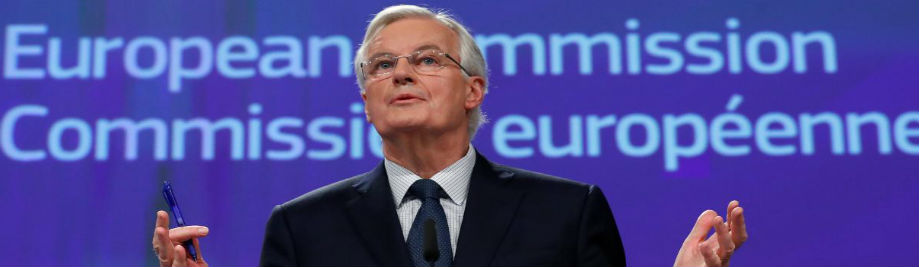
The European Union offered on Monday (29 January) to let Britain keep its membership benefits for 21 months after Brexit to help businesses adapt but it rejected the idea that London could block new EU laws during the transition, write Gabriela Baczynska and Alastair Macdonald.
Ministers from the 27 other states took just two minutes in Brussels to endorse new instructions to their negotiator Michel Barnier (pictured), who will launch talks soon with the aim of sealing a transition package within a couple of months.
The rapid sign-off was a fresh demonstration of the unity they showed in pushing embattled British Prime Minister Theresa May into agreeing outline divorce terms a month ago and a signal of how far they believe they hold the whip hand.
May’s spokesman welcomed the EU agreement, saying it was in line with Britain’s aims, though several differences remained.
One difference aired in recent days as May tries to hold rival wings of her party together has been a suggestion by Brexit Secretary David Davis that Britain should have a way to “resolve concerns” it had on new EU laws passed once it has no vote.
Pressed on how that might work, Barnier said the offer was principally in Britain’s interests and not open to significant negotiation: “The United Kingdom must acknowledge these rules of the game and accept them from the outset,” he told reporters. “Otherwise...there would be a kind of a la carte single market. That is not possible.”
Italy’s EU Affairs Minister Sandro Gozi, often sympathetic to Britain, was blunter: “If you leave, you leave.”
The pace of EU legislation is slow enough that little which might be decided in the 21 months could be forced on Britain before it had fully left the system on 31 December 2020.
By that time, both sides hope to be able to enact a free trade accord to keep goods and services flowing, albeit leaving Britain outside the EU single market and customs union.
Barnier said this timetable was still subject to May and her ministers agreeing a plan among themselves and presenting it to Brussels - and also depends on finalizing many issues on the divorce treaty.
While Britain agreed to pay tens of billions of euros into EU coffers on leaving and to give lifetime rights to Europeans living there, many issues have yet to be settled, including the power of the EU courts over the treaty and how the EU-UK border across the island of Ireland will be kept “invisible”.
Barnier said: “I want to remind you, without agreement on all the withdrawal issues, there is no transition.”
He also made clear that talks on the future relationship might start after an EU summit in late March - but only if May spells out what she wants in time for Brussels to put together its own responses. An outline trade package could then be agreed by the time the divorce and transition deal is ready in October.
Showing some willingness to be flexible, the EU ministers are open to extending the transition period if need be to reach a trade pact - though Barnier warned it could not be very long - and also voiced a will to endorse Britain concluding trade agreements with other countries before the transition ends.
Share this article:

EU Reporter publishes articles from a variety of outside sources which express a wide range of viewpoints. The positions taken in these articles are not necessarily those of EU Reporter. Please see EU Reporter’s full Terms and Conditions of publication for more information EU Reporter embraces artificial intelligence as a tool to enhance journalistic quality, efficiency, and accessibility, while maintaining strict human editorial oversight, ethical standards, and transparency in all AI-assisted content. Please see EU Reporter’s full A.I. Policy for more information.






Kazakhstan seeks regional AI leadership as economic partnership with China enters new phase

Setting a new benchmark in premium travel

Survey on an EU Blueprint for intellectual property licensing and spinoff creation

Statement by the Ministry of Foreign Affairs of the Republic of Kazakhstan

Rule of law report strengthens EU democracy and fundamental rights

Burnham as PM? 'Wait and see'

Kazakhstan and Belgium: Building a Partnership for the Future

Kazakhstan: Central Election Committee reviews the results of the nomination of candidates for the deputies of Kurultai

The EU’s Forced-Labour Regulation Faces a Credibility Test

European Statistical Monitor: July edition

Commission publishes state aid guidance on carbon contracts for difference

Commission greenlights Estonia's fourth payment request for €135.5 million under NextGenerationEU

Drones, dominance, and the Iranian impasse: The West's strategic blind spot

Kazakhstan's fixed capital investment tops 9.5 trillion tenge in H1 2026

Commission registers two European Citizens' Initiatives on education and housing
Kazakhstan and Belgium: Building a Partnership for the Future

Kazakhstan reforms under scrutiny at Brussels Press Club round table

Japan should face up to history and contribute more to regional peace

Ambassador calls for 'speeding up' of co-operation between EU and Kazakhstan

Timur Turlov at Smart Moves Summit 2025: How chess can transform global education

Shevtsova’s case: Out-of-court sanctions dismantling trust in Ukrainian cause

The future of European transport

Trump Vs Trueman

US 'no longer' an 'unconditional ally' for Europe - MEP
-
 China4 days ago
Kazakhstan seeks regional AI leadership as economic partnership with China enters new phase
-
 Aviation/airlines2 days ago
Setting a new benchmark in premium travel
-
 Intellectual Property Rights2 days ago
Survey on an EU Blueprint for intellectual property licensing and spinoff creation
-
 Kazakhstan3 days ago
Statement by the Ministry of Foreign Affairs of the Republic of Kazakhstan