EU
20 years of #Copernicus, the EU's leading provider of Earth observation data across the globe


Commissioners Elżbieta Bieńkowska (Internal Market, Industry, Entrepreneurship and SMEs) and Tibor Navracsics (responsible for the Commission's Joint Research Centre) are in Baveno, Italy, today and tomorrow to mark the 20th anniversary of Copernicus.
In 1998, a manifesto was signed in Baveno proposing to create a European environment monitoring programme. Today Copernicus is a symbol of Europe's space power. The seven satellites currently in orbit give access to tens of terabytes of free data every day which is used to help save lives at sea, improve our response to natural disasters such as earthquakes, hurricanes, forest fires or floods, and allow farmers to better manage their crops. Space is an enabler of the data and app economy.
That is why Commissioner Bieńkowska will announce the launch of the Copernicus Data and Information Access Services (DIAS) – industry-led platforms to increase data access by innovative start-ups and other users who will be able to discover, process and download data more easily and less costly. Commissioners Bieńkowska and Navracsics will then visit the Ispra site of the JRC, which supports the Copernicus programme and provides products and services to policy makers based on data generated by satellites. Copernicus covers six thematic areas: land monitoring, marine monitoring, atmosphere monitoring, climate change, emergency management response and security.
Under the €16 billion EU Space Programme beyond 2020, the Commission proposes to expand these existing services to meet emerging needs, such as CO2 monitoring and polar missions to help fight climate change. More information is available in a news item and two factsheets on the history and the benefits of Copernicus.
Share this article:
EU Reporter publishes articles from a variety of outside sources which express a wide range of viewpoints. The positions taken in these articles are not necessarily those of EU Reporter. Please see EU Reporter’s full Terms and Conditions of publication for more information EU Reporter embraces artificial intelligence as a tool to enhance journalistic quality, efficiency, and accessibility, while maintaining strict human editorial oversight, ethical standards, and transparency in all AI-assisted content. Please see EU Reporter’s full A.I. Policy for more information.



Kazakhstan seeks regional AI leadership as economic partnership with China enters new phase

Setting a new benchmark in premium travel

Survey on an EU Blueprint for intellectual property licensing and spinoff creation

Rule of law report strengthens EU democracy and fundamental rights

Burnham as PM? 'Wait and see'

Statement by the Ministry of Foreign Affairs of the Republic of Kazakhstan

Kazakhstan and Belgium: Building a Partnership for the Future

Kazakhstan: Central Election Committee reviews the results of the nomination of candidates for the deputies of Kurultai

Commission fines AliExpress €550 million for breaching the Digital Services Act

Astana Hub unveils infrastructure to support AI innovation in health care

The security environment of the South Caucasus amid changing geopolitical realities

Why the US is losing its legitimacy as a global superpower and the trust of the comity of nations

Commission launches EU-Ukraine Drone Alliance to boost drone and counter-drone technology

EU and Portugal team up to keep brightest tech talents at home

2026 Rule of Law Report strengthens Europe's prosperity, security and democratic resilience

Commission outlines measures to strengthen Europe's banking sector and support growth

Kazakhstan reforms under scrutiny at Brussels Press Club round table

Japan should face up to history and contribute more to regional peace

Ambassador calls for 'speeding up' of co-operation between EU and Kazakhstan

Timur Turlov at Smart Moves Summit 2025: How chess can transform global education

Shevtsova’s case: Out-of-court sanctions dismantling trust in Ukrainian cause

The future of European transport

Trump Vs Trueman

US 'no longer' an 'unconditional ally' for Europe - MEP
-
 China5 days ago
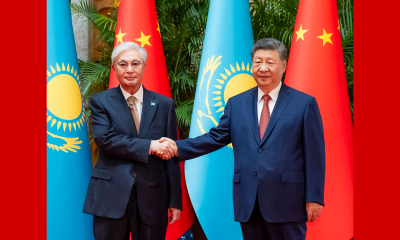
Kazakhstan seeks regional AI leadership as economic partnership with China enters new phase
-
 Aviation/airlines3 days ago
Setting a new benchmark in premium travel
-
 Intellectual Property Rights3 days ago
Survey on an EU Blueprint for intellectual property licensing and spinoff creation
-
 EU law3 days ago
Rule of law report strengthens EU democracy and fundamental rights