EU
Access to medicines and the EU health agenda


By European Alliance for Personalised Medicine (EAPM) Executive Director Denis Horgan
Access to medicines will be a particular issue in the European Parliament this year. Indeed, to start the ball rolling, the Parliamentary State Secretary for the European Affairs of Latvia, Zanda Kalniņa-Lukaševica, told a recent plenary that “access for patients to medicines that efficiently treat illness is an important issue that must be addressed both at national and EU level”.
”It involves several aspects,” she added, “namely: availability – meaning that new medicines are developed or existing products are adapted; also accessibility – bringing the products to patients who need them. It is also about affordability – ensuring that patients, health-care providers and governments can afford the products; and lastly, ensuring quality so that the medicinal products work as intended and are efficient and safe.”
Given that the EU celebrated, in January, 50 years since its inaugural pharmaceutical legislation – with a commemorative meeting due in September – it may seem surprising that access to medicines is still such a major issue. And while the European commissioner for health, Vytenis Andriukaitis, has rightly hailed the success of pharmacovigilance, or protection against falsified medicines, and the new clinical trials rules, issues still remain.
These include the need for harmonized implementation of funding for innovation at national level and access to markets. Europe celebrates a rich diversity in culture and languages yet relies upon similarities and shared goals. A basic tenet of the Union is access to good-quality care and, with an aging population, this is a key challenge, not just now but well into the future A healthy Europe means a wealthy Europe and yet there are so many barriers that need to be overcome to provide top-quality care for all, whatever their member state, cultural background or social class.
The European Alliance for Personalised Medicine, or EAPM, believes there is much work to be done. A healthier Europe will mean citizens spending much less time in hospitals undergoing treatment. It will also mean that patients will be more able (and likely) to stay in the workplace, generating wealth. Taking this further, more emphasis on a preventative approach will have an even-more positive impact on costs. Meanwhile, a focus on research into new medicines and treatments will create jobs – whether these jobs be in research itself, education, the manufacture of in-vitro products and data-sharing systems or even within the pharmaceutical industry.
If Europe is in the vanguard of developing new and better ways to keep citizens healthy, it will inevitably attract investment from outside the EU. Everyone working in the area of health is aware that much progress has been made scientifically in recent years, with breakthroughs in, for example, diagnostics and the treatment of rare diseases such as the myriad cancers afflicting our fellow citizens. New technologies are developing swiftly and coming more-and-more to the fore, while Big Data and The Cloud are not just buzzwords but are already having a massive impact on the availability and flow of information. But there are issues surrounding attempts to utilise these modern-day methods. There is clearly a need, for example, for an up-to-date incentives and rewards structure to push forward research, and Europe requires better education for clinicians in respect of these new methods. Connecting technologies bring about, in some case, interoperability issues and, in the case of Big Data, there are collection and sharing complications as well as important and fundamental questions concerning ethics and privacy.
Other issues include the fact that, at the moment, there are different standards of health care in different member states, inconsistent price structures between different economies within the EU, and problems in affordability when it comes to cross-border access for patients trying to get the right treatment at the right time. Meanwhile, because of a lack of collaboration and communication, we see a lot of duplication in research.
There is a lack of infrastructure for sharing data, a need for agreed quality standards on everything from data to biobank samples and, crucially, an out-of-date reimbursement system that does not adequately take into account the economics of developing new drugs. On top of this, the time required to get a newly developed medicine from bench-to-bedside is, in many cases, too long. These are all very real barriers to access for patients who need quick and efficacious assessment and treatment. We all know times have been tough. And austerity measures have, as usual, had a big impact on health care – which is always a primary target for money-saving governments in the face of fiscal difficulties. But scrimping on health is a false economy as outlined above. Yet cash is undeniably tight. So how can we ensure a healthier Europe when the amount of money in the economy is not a bottomless pit?
There is no doubt that, when it comes to health, the EU as a whole must tackle the ‘Big Problems’. It must do so together as the problems facing us cannot, in the main, be overcome by member states acting alone. After 20 years of a focus on health we need to move forward swiftly. In the view of the Alliance, personalised medicine is one of the key ways to achieve that forward motion. It is an innovative, fast-growing method of treating patients that uses as much available research, data and new technology as possible to provide better diagnostics and follow-up for citizens than a one-size-fits-all model. In a nutshell, personalised medicine uses genetic information to discern whether a particular drug or regime will work for a particular person and helps a clinician to quickly decide which treatment will be the most effective.
It will allow a more preventative approach in that gene technology will flag up the likelihood of a particular individual developing a particular disease and provide a good idea of how it will develop, thereby encouraging early intervention. Clearly, there is nothing to be gained and much to be lost by giving, for example, a cancer patient chemotherapy if there is a large chance that it will not work for him or her. This wastes time, it wastes money and, more importantly, it could waste a valuable life. There is much more value, in every regard, in knowing in advance what the best treatment will be for an individual patient.
One of the most important things that the European Commission needs to do, in tandem with the Parliament, to bring health in Europe up to speed, is to create a regulatory environment which allows early patient access to novel medicines and treatments. We can no longer rely on a one-size-fits-all model in a Europe of 500 million as it patently does not work. Of course, new targeted drugs and treatments require expensive research and development, but the current system for incentives and reimbursement needs a makeover. The EU is already achieving a great deal through public-private partnerships, such as IMI and IMI 2 but, as stated, more needs to be done. The next phase in the task of creating a healthier, wealthier Europe begins now – and a focus on access to medicines is an excellent use of Parliamentary time.
Share this article:
EU Reporter publishes articles from a variety of outside sources which express a wide range of viewpoints. The positions taken in these articles are not necessarily those of EU Reporter. Please see EU Reporter’s full Terms and Conditions of publication for more information EU Reporter embraces artificial intelligence as a tool to enhance journalistic quality, efficiency, and accessibility, while maintaining strict human editorial oversight, ethical standards, and transparency in all AI-assisted content. Please see EU Reporter’s full A.I. Policy for more information.



Kazakhstan seeks regional AI leadership as economic partnership with China enters new phase

Setting a new benchmark in premium travel

Survey on an EU Blueprint for intellectual property licensing and spinoff creation

Statement by the Ministry of Foreign Affairs of the Republic of Kazakhstan

Rule of law report strengthens EU democracy and fundamental rights

Burnham as PM? 'Wait and see'

Kazakhstan and Belgium: Building a Partnership for the Future

Kazakhstan: Central Election Committee reviews the results of the nomination of candidates for the deputies of Kurultai

The EU’s Forced-Labour Regulation Faces a Credibility Test

European Statistical Monitor: July edition

Commission publishes state aid guidance on carbon contracts for difference

Commission greenlights Estonia's fourth payment request for €135.5 million under NextGenerationEU

Drones, dominance, and the Iranian impasse: The West's strategic blind spot

Kazakhstan's fixed capital investment tops 9.5 trillion tenge in H1 2026

Commission registers two European Citizens' Initiatives on education and housing
Kazakhstan and Belgium: Building a Partnership for the Future

Kazakhstan reforms under scrutiny at Brussels Press Club round table

Japan should face up to history and contribute more to regional peace

Ambassador calls for 'speeding up' of co-operation between EU and Kazakhstan

Timur Turlov at Smart Moves Summit 2025: How chess can transform global education

Shevtsova’s case: Out-of-court sanctions dismantling trust in Ukrainian cause

The future of European transport

Trump Vs Trueman

US 'no longer' an 'unconditional ally' for Europe - MEP
-
 China4 days ago
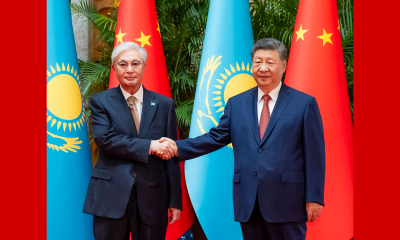
Kazakhstan seeks regional AI leadership as economic partnership with China enters new phase
-
 Aviation/airlines2 days ago
Setting a new benchmark in premium travel
-
 Intellectual Property Rights2 days ago
Survey on an EU Blueprint for intellectual property licensing and spinoff creation
-
 Kazakhstan3 days ago
Statement by the Ministry of Foreign Affairs of the Republic of Kazakhstan