China
How to prepare your first trip to #HongKong


A big city of 8 million people, Hong Kong is busy, modern, and multicultural. Around 60 million people visit Hong Kong every year and its airport is one of the biggest in the world, writes Daniel Moore.
Here you can expect world-class cuisine, head-spinning shopping, and a rich festival culture. Many foreigners come to Hong Kong for business reasons but decide to stay a few extra days to explore this unique city. Whether you book for 2 days or 2 weeks, there is always something to do in Hong Kong.
Arriving prepared is paramount for international travel so that you can ensure a smooth and hassle-free experience abroad. Foreign visitors will find below essential information and tips for planning an enjoyable trip to Hong Kong.
The best time to visit Hong Kong
With a warm subtropical climate, temperatures in Hong Kong are pleasant all year round. For this reason, it’s hard to find a proper peak season for the city, which enjoys a near-continuous influx of tourists.
However, the wet season (from June to August) makes summer a somewhat uncomfortable time to travel due to the high humidity.
Deciding when to go to Hong Kong, however, shouldn’t only depend on the weather. It’s worth checking out the many festivals and cultural events taking place in the city throughout the year to find the time that will best spark your interest.
Visa for Hong Kong: It’s not always needed
Of course, you will want to depart with your papers in order. Fortunately, Hong Kong has one of the most tourism-friendly visa policies in the world. Regulations are kept completely separate and independent from those of mainland China.
Visitors from 170 countries can enter Hong Kong visa-free for a limited amount of time — between 7 to 180 days, depending on the specific agreements between their government and the Hong Kong authorities. Others, like India, don’t need a visa but must fill out a Pre-Arrival Registration (PAR) before traveling. Click here to find out more.
Is English spoken in Hong Kong?
If exploring a foreign country is an exciting opportunity, it gets even better when you can communicate with locals to get advice and directions or make new friends.
English is an official language in Hong Kong so you can expect signs to be both in Cantonese (spoken by 96% of the population) and English. Menus and posters are also likely to be translated. It shouldn’t come as a surprise: after all, Hong Kong is a multicultural metropolis with a past as a British colony.
Hong Kongers are among the best English speakers in Asia, together with Singaporeans. Those employed in a customer-facing position like hotel staff and shop assistants are likely to be fully proficient. Visitors report that many taxi drivers don’t share the same English speaking skills, but will radio a colleague that can help if the need arises.
Although you’ll have no problem communicating, a little effort goes a long way. Try to memorize a few key phrases before leaving, like ‘hello’ or ‘thank you’.
Is it safe to travel in Hong Kong?
In 2019, Hong Kong has repeatedly been in the news because of the protests that have sparked in June and continued for months. However, local authorities assure that Hong Kong is open for business.
This is how tourists have been affected by the protests:
- Transport. Getting around Hong Kong is extremely easy. Thanks to the Airport Express train, it’s possible for visitors who have just landed to reach the city center in under 30 minutes. Uber is also available. Disruptions to public transport are usually extremely rare. However, some metro stations and lines have been closed in the past due to the protests and some buses have been vandalized.
- Police checks. Foreigners should note that it’s legal in Hong Kong for police officers to stop people in the street and ask for identification. Remain calm and remember to always bring your ID and visa (if applicable) with you.
- Quiet attractions. Because tourism has recently slowed down in the area (especially from mainland China), some of the most popular landmarks and attractions are now much quieter than usual.
Although tourists may find the occasional transport disruption inconvenient, the city remains overall ‘safe and open’, to quote the local government. Major tourist sites such as the Zoo, Botanical Gardens, theme parks, and monasteries continue to keep their doors open to the public.
In fact, the reduced number of visitors makes accommodation cheaper than usual, as it would happen during the normal low season.
Daniel Moore is an experienced content writer. He is associated with many renowned travel blogs as a guest author where he shares his valuable travel tips and experience with the audience.
Share this article:

EU Reporter publishes articles from a variety of outside sources which express a wide range of viewpoints. The positions taken in these articles are not necessarily those of EU Reporter. Please see EU Reporter’s full Terms and Conditions of publication for more information EU Reporter embraces artificial intelligence as a tool to enhance journalistic quality, efficiency, and accessibility, while maintaining strict human editorial oversight, ethical standards, and transparency in all AI-assisted content. Please see EU Reporter’s full A.I. Policy for more information.



Kazakhstan seeks regional AI leadership as economic partnership with China enters new phase

Setting a new benchmark in premium travel

Survey on an EU Blueprint for intellectual property licensing and spinoff creation

Rule of law report strengthens EU democracy and fundamental rights

Burnham as PM? 'Wait and see'

Statement by the Ministry of Foreign Affairs of the Republic of Kazakhstan

Kazakhstan and Belgium: Building a Partnership for the Future

Kazakhstan: Central Election Committee reviews the results of the nomination of candidates for the deputies of Kurultai

Commission fines AliExpress €550 million for breaching the Digital Services Act

Astana Hub unveils infrastructure to support AI innovation in health care

The security environment of the South Caucasus amid changing geopolitical realities

Why the US is losing its legitimacy as a global superpower and the trust of the comity of nations

Commission launches EU-Ukraine Drone Alliance to boost drone and counter-drone technology

EU and Portugal team up to keep brightest tech talents at home

2026 Rule of Law Report strengthens Europe's prosperity, security and democratic resilience

Commission outlines measures to strengthen Europe's banking sector and support growth

Kazakhstan reforms under scrutiny at Brussels Press Club round table

Japan should face up to history and contribute more to regional peace

Ambassador calls for 'speeding up' of co-operation between EU and Kazakhstan

Timur Turlov at Smart Moves Summit 2025: How chess can transform global education

Shevtsova’s case: Out-of-court sanctions dismantling trust in Ukrainian cause

The future of European transport

Trump Vs Trueman

US 'no longer' an 'unconditional ally' for Europe - MEP
-
 China5 days ago
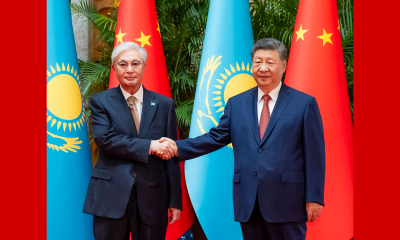
Kazakhstan seeks regional AI leadership as economic partnership with China enters new phase
-
 Aviation/airlines3 days ago
Setting a new benchmark in premium travel
-
 Intellectual Property Rights3 days ago
Survey on an EU Blueprint for intellectual property licensing and spinoff creation
-
 EU law3 days ago
Rule of law report strengthens EU democracy and fundamental rights