Economy
French judiciary launches 'preliminary investigation' into NSA spying

 The French national prosecutor’s office in Paris has opened a “preliminary investigation” into the National Security Agency’s (NSA) PRISM surveillance program, French media reported on 28 August.
The inquiry has been under way for more than a month, but it's only now being publicly disclosed through an anonymous judicial source who talked with Agence France Presse. The investigation began on 16 July to investigate the “illicit collection of personal data” of French citizens.
Two French human rights groups, the International Federation for Human Rights (FIDH) and the French Human Rights League (LDH), filed a complaint against “persons unknown”. However, they did name a slew of tech companies previously identified in the Snowden disclosures as “potential accomplices” of the NSA and the FBI. (Read the 11 July 2013 French-language legal complaint here as a PDF file.)
Earlier this month, the “Article 29 Data Protection Working Party” (the pan-European Union group of data protection officials) collectively wrote a letter (PDF) to the EU’s justice commissioner, Viviane Reding, expressing “alarm.”
The group’s leader, Jacob Kohnstamm, wrote: "The WP29 would however like to know when US authorities consider personal data to be inside the US, especially given the continuously increasing use of the Internet for processing personal data, where much information currently is stored in the cloud, without knowing the exact location of the datasets, and following the global scale of backbone networks and their inherent capability to convey a wide range of communication services.
"It needs to be determined whether data on communication networks that are only routed through the United States (data that are in transit) are also subject to collection for the aforementioned intelligence programs. To this end, WP29 has so far considered that European law does not apply to personal data that is only in transit in the European Union, following article 4(1)c directive 95/46/EC. Applying the same reasoning would suggest that US law should not apply to data that is only in transit on its territory."
The EU has not, as yet, given any indication as to what action, if any, the Union can take in the situation.
Share this article:
EU Reporter publishes articles from a variety of outside sources which express a wide range of viewpoints. The positions taken in these articles are not necessarily those of EU Reporter. Please see EU Reporter’s full Terms and Conditions of publication for more information EU Reporter embraces artificial intelligence as a tool to enhance journalistic quality, efficiency, and accessibility, while maintaining strict human editorial oversight, ethical standards, and transparency in all AI-assisted content. Please see EU Reporter’s full A.I. Policy for more information.



ECR MEPs question the European Commission on cardiovascular health and diet promoting the Mediterranean diet as an alternative to ultra-processed foods as key to tackling obesity

Albania's Vlora airport standoff tests investor confidence as EU accession clock ticks

Why a Brussels–Nicosia–Eastern Mediterranean strategic affairs platform would benefit the European Union

Kazakhstan seeks regional AI leadership as economic partnership with China enters new phase

Starmer’s problem? 'He is not a politician'

Kazakhstan's fixed capital investment tops 9.5 trillion tenge in H1 2026

Setting a new benchmark in premium travel

Survey on an EU Blueprint for intellectual property licensing and spinoff creation

The EU’s Forced-Labour Regulation Faces a Credibility Test

European Statistical Monitor: July edition

Commission publishes state aid guidance on carbon contracts for difference

Commission greenlights Estonia's fourth payment request for €135.5 million under NextGenerationEU

Drones, dominance, and the Iranian impasse: The West's strategic blind spot

Kazakhstan's fixed capital investment tops 9.5 trillion tenge in H1 2026

Commission registers two European Citizens' Initiatives on education and housing

Kazakhstan and Belgium: Building a Partnership for the Future

Kazakhstan reforms under scrutiny at Brussels Press Club round table

Japan should face up to history and contribute more to regional peace

Ambassador calls for 'speeding up' of co-operation between EU and Kazakhstan

Timur Turlov at Smart Moves Summit 2025: How chess can transform global education

Shevtsova’s case: Out-of-court sanctions dismantling trust in Ukrainian cause

The future of European transport

Trump Vs Trueman

US 'no longer' an 'unconditional ally' for Europe - MEP
-
 Italy5 days ago
ECR MEPs question the European Commission on cardiovascular health and diet promoting the Mediterranean diet as an alternative to ultra-processed foods as key to tackling obesity
-
 Albania5 days ago
Albania's Vlora airport standoff tests investor confidence as EU accession clock ticks
-
 Euro-Mediterranean relations5 days ago
Why a Brussels–Nicosia–Eastern Mediterranean strategic affairs platform would benefit the European Union
-
 China4 days ago
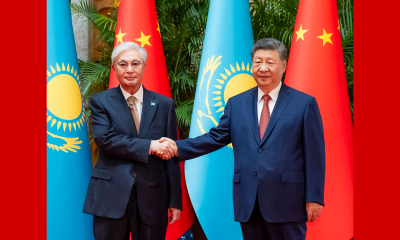
Kazakhstan seeks regional AI leadership as economic partnership with China enters new phase