EU
#CEP: Tech companies talk rights rather than responsibilities


The European Union recently upped the pressure on social media companies to do more to remove terrorist material from their platforms. Growing frustrated with the continued presence of dangerous content online, the EU Commission called on tech firms to remove this radicalizing material within one hour of being notified of its existence. “We still need to react faster against terrorist propaganda and other illegal content which is a serious threat to our citizens’ security, safety and fundamental rights,” Digital Commissioner Andrus Ansip said, writes Counter Extremism Project (CEP) Executive Director David Ibsen (pictured).
Europe continues to be justifiably alarmed after seeing so many of its citizens become victims of terrorists who continue to be inspired and trained through materials readily available online. The response from EDiMA—the European trade association representing tech giants like Google/YouTube, Facebook, and Twitter—to the EU Commission’s latest voluntary standard was disappointing but predictable. The tech industry’s response revealed the widening chasm between the powerful for-profit technology companies and those dedicated to protecting the public, and why many see regulation of this industry as inevitable.
Rather than acknowledging the harm that radicalizing extremist materials have perpetrated, accepting responsibility, and pledging to dedicate the requisite resources to guarantee and measure the permanent removal of prohibited extremist content, the tech industry and EDiMA instead stressed the need to “balance the responsibility to protect users while upholding fundamental rights.” This rhetoric is of course patently absurd, and represents tech’s attempt to distract from policy discussions about public safety and security and spin them into nebulous, unserious suggestions designed to prevent meaningful reforms.
It is bizarre for the tech industry to declare itself a protector of “fundamental rights” writ large. These for-profit companies, through EDiMA, argue that the one-hour takedown period could be detrimental to tech’s ability to somehow uphold the “fundamental rights” of its users. But the companies’ rhetoric remains vague how they define these rights, whether or not they—as private corporations—are in a position to define those rights, and who’s rights they claim to be protecting. It strains credulity to believe that tech companies, for profit entities whose business model is based on selling advertising gleaned from user data, could be more committed to protecting rights than governments and elected officials.
Moreover, as the saying goes, actions speak louder than words. And as much as the tech industry would like us to believe otherwise, their track record on this issue is lacking. Tech companies may tout their support for free speech, for example, but they are regularly removing content all the time—including expressly legal content—based on rules enshrined in their Terms of Service.
The general public and lawmakers should not let tech’s clever rhetoric obscure the obvious issues—their continued failure to tackle extremism online in an effective manner. We must compare tech’s speech with tech’s actions. If technology companies are truly interested in the rights and freedoms beyond their own, in the interest of transparency, maybe they could list them explicitly. That way, the public can evaluate whether their rights are being protected or constrained by the whims of Terms of Service enforcement actions.
Returning to the freedom of expression example, if expressing oneself on social media platforms is truly a fundamental right, then surely the social media companies are the world’s greatest violator of users’ fundamental rights as it is they that remove copious amounts of users’ posted content all the time with little or no notification—essentially at the whims of a corporate leader.
Tech companies want us to believe they are working hard to make the world a better place. Their frequent media statements are replete with sincere apologies and vows to “do better” in the aftermath of each successive terrorist attack, and often detail their purported progress in combatting hateful material on their platforms.
The unvarnished truth is that any progress made by technology companies to take down extremist content has been due to the threat of reputational harm, lost ad revenue, and the prospect of regulation. We saw it in March of last year, when Google profusely apologized and made changes after advertisements were discovered alongside extremist content on YouTube. Troubled by what they see online, the Incorporated Society of British Advertisers has called for an independent body to regulate content on social media platforms based on a common set of standards. Unilever recently went a step further, warning tech firms that retaining their advertising depended on tech companies controlling the proliferation of extremist material, fake news, child exploitation, racism, and sexism.
Following revelations about Facebook and the misuse of user data, it is increasingly difficult to believe that big tech companies care very much about terrorist and extremist content, hate speech, child pornography, fake news, or other disturbing issues infecting their platforms. As EDiMA’s response to a very measured set of recommendations from the EU Commission clearly revealed, absent significantly more pressure from consumers, advertisers, and lawmakers, tech companies plan to continue to resist industry-wide standards for removing extremist content or deploying existing technology capable of detecting and preventing the re-upload of that same material.
Instead, the big tech companies will continue to talk about rights, rather than responsibilities, when their behavior is called into question. As long as they’re allowed to get away with it.
David Ibsen serves as executive director for the Counter Extremism Project (CEP), a not-for-profit, non-partisan, international policy organization formed to combat the growing threat from extremist ideologies.
Share this article:

EU Reporter publishes articles from a variety of outside sources which express a wide range of viewpoints. The positions taken in these articles are not necessarily those of EU Reporter. Please see EU Reporter’s full Terms and Conditions of publication for more information EU Reporter embraces artificial intelligence as a tool to enhance journalistic quality, efficiency, and accessibility, while maintaining strict human editorial oversight, ethical standards, and transparency in all AI-assisted content. Please see EU Reporter’s full A.I. Policy for more information.



ECR MEPs question the European Commission on cardiovascular health and diet promoting the Mediterranean diet as an alternative to ultra-processed foods as key to tackling obesity

Albania's Vlora airport standoff tests investor confidence as EU accession clock ticks

Why a Brussels–Nicosia–Eastern Mediterranean strategic affairs platform would benefit the European Union

Kazakhstan seeks regional AI leadership as economic partnership with China enters new phase

Commission adopts simpler rules for EU agri-food promotion policy

Starmer’s problem? 'He is not a politician'

Kazakhstan's fixed capital investment tops 9.5 trillion tenge in H1 2026

Setting a new benchmark in premium travel

The EU’s Forced-Labour Regulation Faces a Credibility Test

European Statistical Monitor: July edition

Commission publishes state aid guidance on carbon contracts for difference

Commission greenlights Estonia's fourth payment request for €135.5 million under NextGenerationEU

Drones, dominance, and the Iranian impasse: The West's strategic blind spot

Kazakhstan's fixed capital investment tops 9.5 trillion tenge in H1 2026

Commission registers two European Citizens' Initiatives on education and housing

Kazakhstan and Belgium: Building a Partnership for the Future

Kazakhstan reforms under scrutiny at Brussels Press Club round table

Japan should face up to history and contribute more to regional peace

Ambassador calls for 'speeding up' of co-operation between EU and Kazakhstan

Timur Turlov at Smart Moves Summit 2025: How chess can transform global education

Shevtsova’s case: Out-of-court sanctions dismantling trust in Ukrainian cause

The future of European transport

Trump Vs Trueman

US 'no longer' an 'unconditional ally' for Europe - MEP
-
 Italy5 days ago
ECR MEPs question the European Commission on cardiovascular health and diet promoting the Mediterranean diet as an alternative to ultra-processed foods as key to tackling obesity
-
 Albania5 days ago
Albania's Vlora airport standoff tests investor confidence as EU accession clock ticks
-
 Euro-Mediterranean relations5 days ago
Why a Brussels–Nicosia–Eastern Mediterranean strategic affairs platform would benefit the European Union
-
 China4 days ago
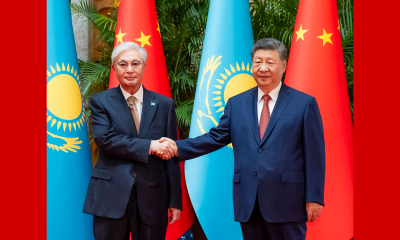
Kazakhstan seeks regional AI leadership as economic partnership with China enters new phase