EU
EU draft health document has stakeholders gathering to respond


By European Alliance for Personalised Medicine (EAPM) Executive Director Denis Horgan
Earlier this week, the European Commission and its independent Expert Panel on effective ways of investing in health launched a public consultation on its preliminary opinion, with results due in from stakeholders by 16 December.
The opinion ‘explores the implications of Disruptive Innovation for health and health care in Europe’.
One Brussels-based multi-stakeholder organization, the European Alliance for Personalised Medicine (EAPM), will meet two days prior to that in order to decide upon a response.
EAPM has already contributed to a similar document that was released in November. The consultation on the preliminary opinion on ‘Access to health services in the European Union’, on effective ways of investing in health, received a lukewarm reception from the Alliance, which submitted a response detailing what it believes is missing from the draft, or should be strengthened.
The group, whose members include patients, physicians, scientists, academics, researchers, industry representatives and policy experts, filed an eight-page submission with dozens of key comments.
During that consultation, EAPM took the opportunity to emphasize that patient access to innovative personalised medicine remains sub-optimal and varies dramatically between EU member states.
It wrote: “The fact that a new medicine or innovative product usually takes more than a decade to get from bench-to-bedside is not only clearly undesirable but is arguably unacceptable in the 21st century.”
The Alliance will now meet again to specifically tackle this week’s Commission draft.
The latest draft states: “Disruptive Innovation is a type of innovation that creates new networks and players that tend to displace existing structures and actors. It constitutes a real paradigm shift in the organization of health care.
“Disruptive Innovation has the potential to reduce costs and complexity whilst simultaneously providing patients with improved access to healthcare resulting in better health and patient empowerment.”
It adds that: “The preliminary opinion defines and classifies Disruptive Innovation, identifies drivers and barriers for its implementation, and assesses its relevance in the EU by listing some case studies.
“Disruptive Innovation as a healthcare concept has been developed in the US and mostly discussed there. This opinion studies how the concept can be applied in the European context.”
The comments by EAPM and other stakeholders will be reflected in the final opinion, where relevant, and this is expected to be adopted by the end of February 2016.
Meanwhile, the Luxembourg Council Conclusions on personalised medicine, into which EAPM offered significant input, are due to be published next Monday (7 December).
The Conclusions are expected to invite Member States to develop or strengthen, if necessary, public health communication strategies…to increase public awareness as regards both the benefits and risks of personalised medicine, as well as the citizens’ role and rights (e.g. sharing their data), thus supporting appropriate access to innovative diagnostic methods and better-targeted treatment.
The Luxembourg document is also expected to urge Member States to: put in place information and education strategies for patients, based on relevant and understandable information; provide education, training and continuous professional development to health professionals, and; foster co-operation on the collection, sharing, management and appropriate standardisation of data necessary for effective research, in accordance with data protection legislation.
According to the Alliance, the above are all highly welcome developments although it remains particularly concerned about a draft section on Health Technology Assessment.
In the last few weeks, as well as working with Commission and Council drafts, EAPM has highlighted the need for quick and solid action on killer diseases such as lung, prostate and pancreatic cancers, plus diabetes and more, including the issuing of two White Papers.
Share this article:
EU Reporter publishes articles from a variety of outside sources which express a wide range of viewpoints. The positions taken in these articles are not necessarily those of EU Reporter. Please see EU Reporter’s full Terms and Conditions of publication for more information EU Reporter embraces artificial intelligence as a tool to enhance journalistic quality, efficiency, and accessibility, while maintaining strict human editorial oversight, ethical standards, and transparency in all AI-assisted content. Please see EU Reporter’s full A.I. Policy for more information.



Kazakhstan seeks regional AI leadership as economic partnership with China enters new phase

Survey on an EU Blueprint for intellectual property licensing and spinoff creation

Setting a new benchmark in premium travel

Rule of law report strengthens EU democracy and fundamental rights

Burnham as PM? 'Wait and see'

Statement by the Ministry of Foreign Affairs of the Republic of Kazakhstan

Kazakhstan and Belgium: Building a Partnership for the Future

Kazakhstan: Central Election Committee reviews the results of the nomination of candidates for the deputies of Kurultai

The EU’s Forced-Labour Regulation Faces a Credibility Test

European Statistical Monitor: July edition

Commission publishes state aid guidance on carbon contracts for difference

Commission greenlights Estonia's fourth payment request for €135.5 million under NextGenerationEU

Drones, dominance, and the Iranian impasse: The West's strategic blind spot

Kazakhstan's fixed capital investment tops 9.5 trillion tenge in H1 2026

Commission registers two European Citizens' Initiatives on education and housing
Kazakhstan and Belgium: Building a Partnership for the Future

Kazakhstan reforms under scrutiny at Brussels Press Club round table

Japan should face up to history and contribute more to regional peace

Ambassador calls for 'speeding up' of co-operation between EU and Kazakhstan

Timur Turlov at Smart Moves Summit 2025: How chess can transform global education

Shevtsova’s case: Out-of-court sanctions dismantling trust in Ukrainian cause

The future of European transport

Trump Vs Trueman

US 'no longer' an 'unconditional ally' for Europe - MEP
-
 China4 days ago
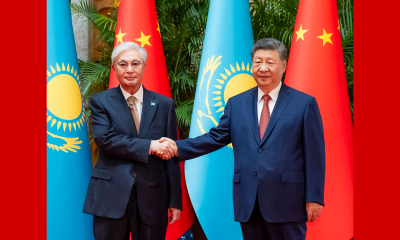
Kazakhstan seeks regional AI leadership as economic partnership with China enters new phase
-
 Intellectual Property Rights2 days ago
Survey on an EU Blueprint for intellectual property licensing and spinoff creation
-
 Aviation/airlines2 days ago
Setting a new benchmark in premium travel
-
 EU law2 days ago
Rule of law report strengthens EU democracy and fundamental rights