Employment
Parliament approves aid for redundant Finnish shipyard and French abattoir workers

 Proposals to provide EU funding to help find or create new jobs for workers made redundant by shipbuilders STX Finland Oy and the GAD abattoir in France were approved by the European Parliament on Tuesday (25 November). The EU should provide European Globalisation Adjustment Fund (EGF) aid worth €2.35 million, which is expected to be approved by the Council of Ministers on the same day.
 The €1.43 million EGF aid is intended mainly to help workers to transfer to new jobs, start their own businesses or to attend training.
GAD in France: €0.92 million for 760 workers The French abattoir and meat processing firm GAD was forced to lay off 760 workers when pig meat sales plummeted across the EU. Overall, pig meat consumption fell from 43 kg per person in 2007 to 39 kg in 2013. Consumer demand was depressed by pork price rises, due to a doubling of the cost of pig feed, and to household spending cuts due to the crisis. As a consequence, GAD, once a profitable company, made a €65 million loss from 2010 to 2013.
The €0.92 million in EGF aid, approved by 593 to 80, with 16 abstentions, is to pay a consultancy team is to advise redundant workers. Budget Committee MEPs called on the French authorities to propose a wider range of measures to help workers find jobs.
Background
The European Globalisation Adjustment Fund was set up to provide additional support for workers made redundant as a result of major structural changes in world trade patterns due to globalization or the financial crisis and to help them find new jobs. Between 2014 and 2020, the annual ceiling of the fund is €150 million.
Redundant workers are offered measures such as support for business start-ups, job-search assistance, occupational guidance and various kinds of training. In most cases, national authorities have already started taking measures and have their costs reimbursed by the EU when their applications are finally approved.
Share this article:
EU Reporter publishes articles from a variety of outside sources which express a wide range of viewpoints. The positions taken in these articles are not necessarily those of EU Reporter. Please see EU Reporter’s full Terms and Conditions of publication for more information EU Reporter embraces artificial intelligence as a tool to enhance journalistic quality, efficiency, and accessibility, while maintaining strict human editorial oversight, ethical standards, and transparency in all AI-assisted content. Please see EU Reporter’s full A.I. Policy for more information.



Albania's Vlora airport standoff tests investor confidence as EU accession clock ticks

Why a Brussels–Nicosia–Eastern Mediterranean strategic affairs platform would benefit the European Union

Kazakhstan seeks regional AI leadership as economic partnership with China enters new phase

Starmer’s problem? 'He is not a politician'

Survey on an EU Blueprint for intellectual property licensing and spinoff creation

Setting a new benchmark in premium travel

Rule of law report strengthens EU democracy and fundamental rights

Burnham as PM? 'Wait and see'

The EU’s Forced-Labour Regulation Faces a Credibility Test

European Statistical Monitor: July edition

Commission publishes state aid guidance on carbon contracts for difference

Commission greenlights Estonia's fourth payment request for €135.5 million under NextGenerationEU

Drones, dominance, and the Iranian impasse: The West's strategic blind spot

Kazakhstan's fixed capital investment tops 9.5 trillion tenge in H1 2026

Commission registers two European Citizens' Initiatives on education and housing

Kazakhstan and Belgium: Building a Partnership for the Future

Kazakhstan reforms under scrutiny at Brussels Press Club round table

Japan should face up to history and contribute more to regional peace

Ambassador calls for 'speeding up' of co-operation between EU and Kazakhstan

Timur Turlov at Smart Moves Summit 2025: How chess can transform global education

Shevtsova’s case: Out-of-court sanctions dismantling trust in Ukrainian cause

The future of European transport

Trump Vs Trueman

US 'no longer' an 'unconditional ally' for Europe - MEP
-
 Albania5 days ago
Albania's Vlora airport standoff tests investor confidence as EU accession clock ticks
-
 Euro-Mediterranean relations5 days ago
Why a Brussels–Nicosia–Eastern Mediterranean strategic affairs platform would benefit the European Union
-
 China4 days ago
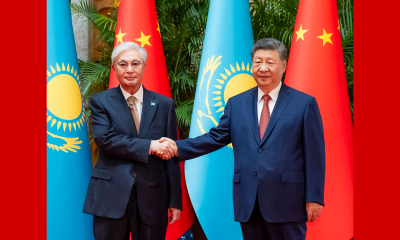
Kazakhstan seeks regional AI leadership as economic partnership with China enters new phase
-
 UK5 days ago
Starmer’s problem? 'He is not a politician'