Frontpage
Concrete results in 1st Taipei - Manila preparatory fishing talks


The first preparatory meeting on fisheries cooperation between the ROC and the Philippines was held June 14 in Manila, with both sides guaranteeing to avoid the use of armed force or violence in the implementation of fisheries laws.
The meeting follows on the ROC government’s four demands to the Philippines after its government vessel made an armed attack May 9 on a Taiwan fishing boat, the Guang Da Xing No. 28, killing fisherman Hong Shi-cheng. One of the demands, for the speedy arrangement of negotiations on fishery matters, was designed to prevent similar incidents from recurring.
The two sides agreed in the meeting to share their respective maritime law enforcement procedures, establish means for notifying each other without delay whenever law enforcement actions are taken against vessels and crews of the other party, and develop a mechanism for the prompt release of detained fishing vessels and their crews, consistent with international practice.
It was further concluded that both parties would meet again in the near future to discuss provisional arrangements on fisheries cooperation, including management and conservation schemes for fishery operations. In upcoming talks the two sides will refer to the substantive content of the Taiwan-Japan fishery agreement to help resolve the longstanding fisheries dispute between Taiwan and the Philippines.
Summary conclusions from the meeting were signed by Samson T.L. Chang, acting head of mission for the Taipei Economic and Cultural Office in Manila, and Antonio I. Basilio, resident representative of the Manila Economic and Cultural Office in Taipei, and witnessed by Tsay Tzu-yaw, deputy director-general of the Fisheries Agency, ROC Council of Agriculture, and Asis G. Perez, director of the Philippine Bureau of Fisheries and Aquatic Resources.
Colin Stevens
Share this article:
EU Reporter publishes articles from a variety of outside sources which express a wide range of viewpoints. The positions taken in these articles are not necessarily those of EU Reporter. Please see EU Reporter’s full Terms and Conditions of publication for more information EU Reporter embraces artificial intelligence as a tool to enhance journalistic quality, efficiency, and accessibility, while maintaining strict human editorial oversight, ethical standards, and transparency in all AI-assisted content. Please see EU Reporter’s full A.I. Policy for more information.



Kazakhstan seeks regional AI leadership as economic partnership with China enters new phase

Setting a new benchmark in premium travel

Survey on an EU Blueprint for intellectual property licensing and spinoff creation

Statement by the Ministry of Foreign Affairs of the Republic of Kazakhstan

Rule of law report strengthens EU democracy and fundamental rights

Burnham as PM? 'Wait and see'

Kazakhstan and Belgium: Building a Partnership for the Future

Kazakhstan: Central Election Committee reviews the results of the nomination of candidates for the deputies of Kurultai

The EU’s Forced-Labour Regulation Faces a Credibility Test

European Statistical Monitor: July edition

Commission publishes state aid guidance on carbon contracts for difference

Commission greenlights Estonia's fourth payment request for €135.5 million under NextGenerationEU

Drones, dominance, and the Iranian impasse: The West's strategic blind spot

Kazakhstan's fixed capital investment tops 9.5 trillion tenge in H1 2026

Commission registers two European Citizens' Initiatives on education and housing
Kazakhstan and Belgium: Building a Partnership for the Future

Kazakhstan reforms under scrutiny at Brussels Press Club round table

Japan should face up to history and contribute more to regional peace

Ambassador calls for 'speeding up' of co-operation between EU and Kazakhstan

Timur Turlov at Smart Moves Summit 2025: How chess can transform global education

Shevtsova’s case: Out-of-court sanctions dismantling trust in Ukrainian cause

The future of European transport

Trump Vs Trueman

US 'no longer' an 'unconditional ally' for Europe - MEP
-
 China4 days ago
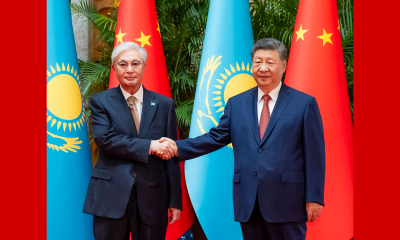
Kazakhstan seeks regional AI leadership as economic partnership with China enters new phase
-
 Aviation/airlines2 days ago
Setting a new benchmark in premium travel
-
 Intellectual Property Rights2 days ago
Survey on an EU Blueprint for intellectual property licensing and spinoff creation
-
 Kazakhstan3 days ago
Statement by the Ministry of Foreign Affairs of the Republic of Kazakhstan