Digital economy
How digitalized have the EU’s enterprises become?


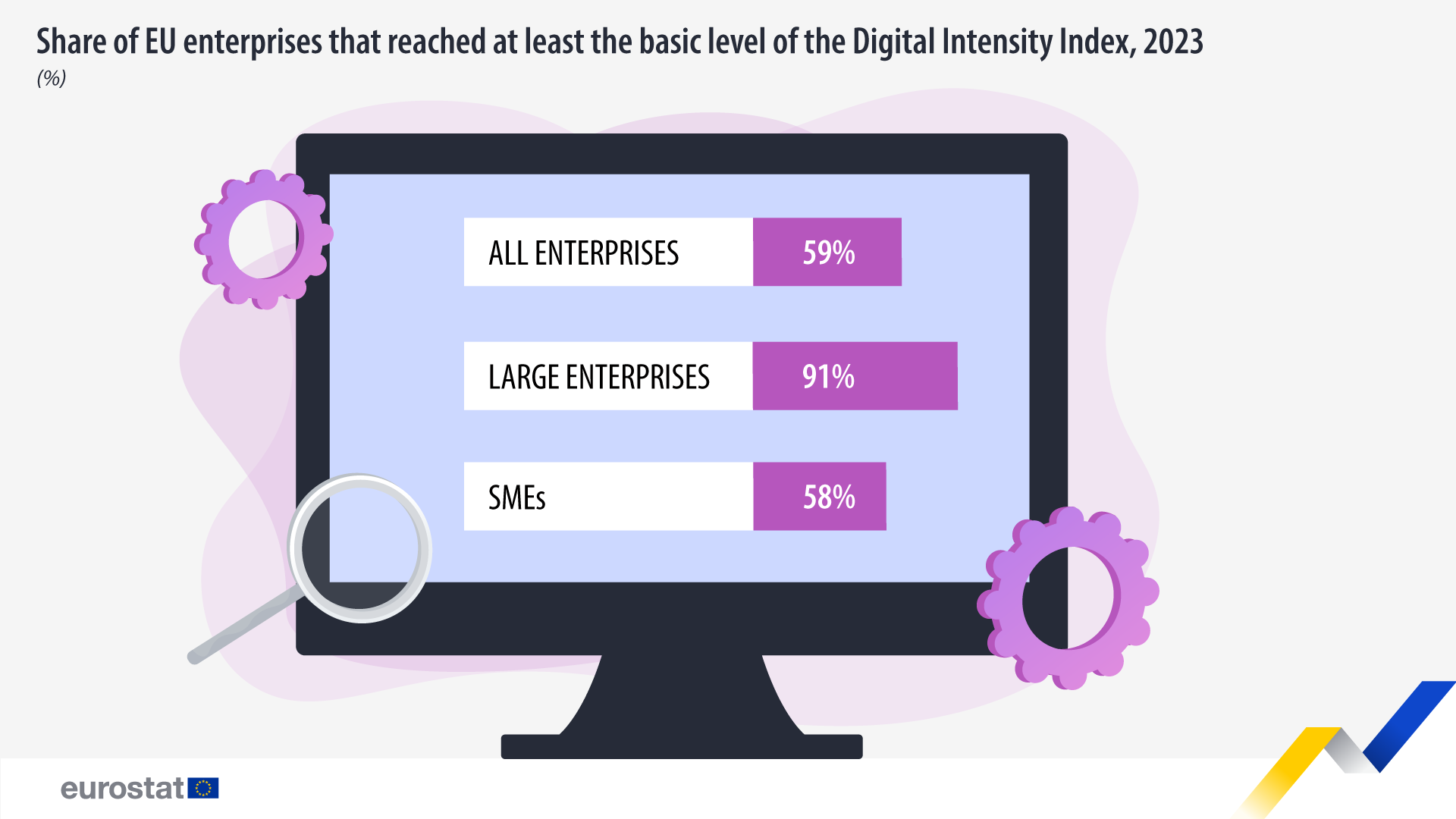
In 2023, 59% of EU enterprises reached at least basic level of digital intensity. Of the small and medium-sized enterprises (SMEs), 58% reached at least basic level of digital intensity last year, while the share for large enterprises was 91%.
‘At least basic level of digital intensity’ - measured by the Digital Intensity Index (DII) - entails the use of at least four of 12 selected digital technologies, such as AI technology, social media, cloud computing, Customer Relationship Management (CRM) or having e-commerce sales accounting for at least 1% of total turnover.
Source dataset: isoc_e_dii
At least basic level includes businesses with a low, high and very high level of the Digital Intensity Index (DII), excluding the very low level.
According to one of the targets of the Digital Decade, more than 90% of EU SMEs should reach at least a basic level of digital intensity by 2030. This means that last year, the SMEs in the EU were 32 percentage points (pp) away from the ambition set for 2030 in the Digital Decade.
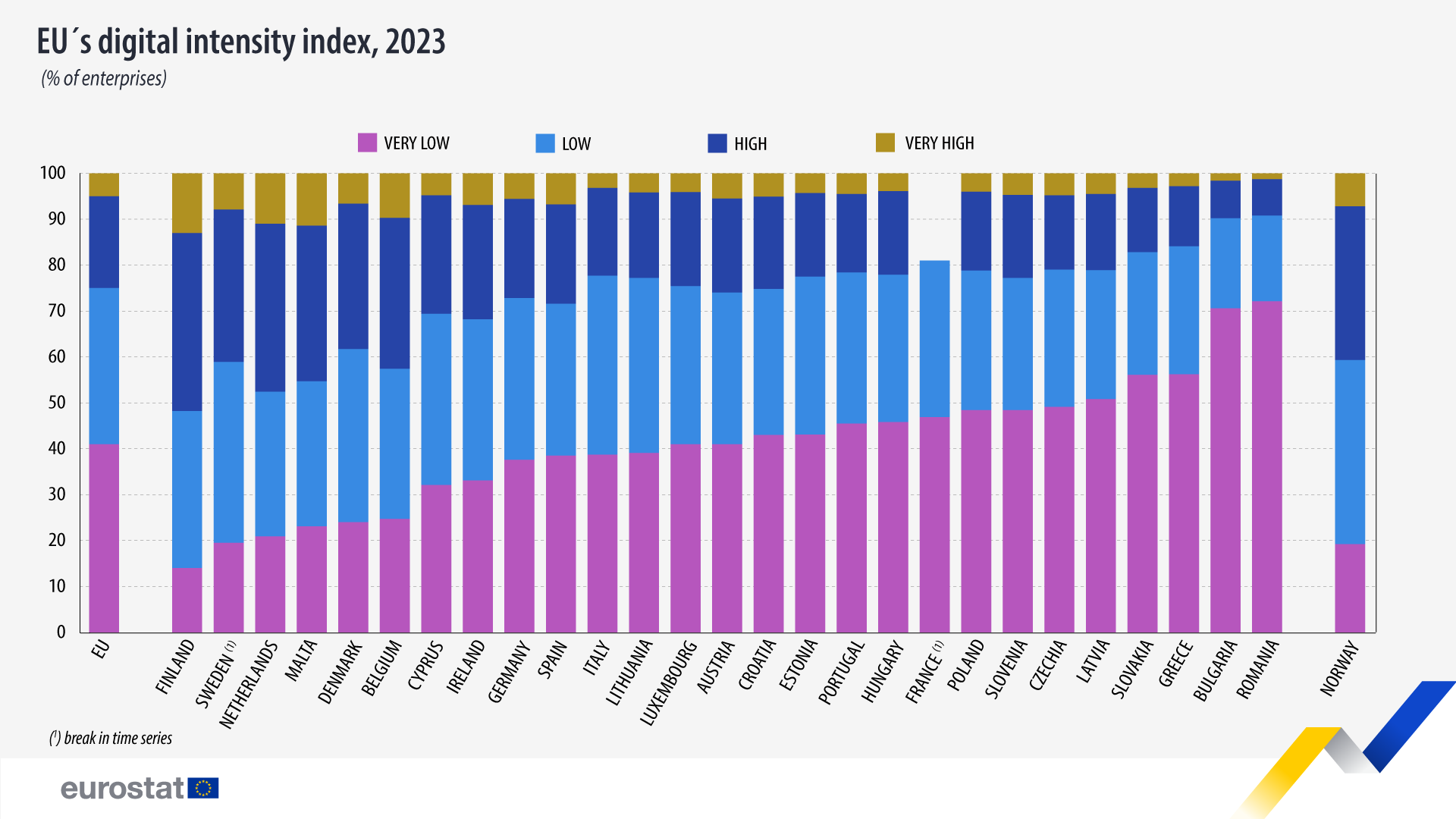
4.4% of EU SMEs reached a very high level of digital intensity while 19.6% reached a high level. Most SMEs recorded low (33.8%) or very low (42.3%) digital intensity levels.
Source dataset: isoc_e_dii
The biggest proportion of enterprises reaching a very high level of the DII was in Finland (13.0%), Malta (11.4%) and the Netherlands (11.0%).
Meanwhile, the countries with the most enterprises characterised by a very low digital intensity were Romania (72.1%), Bulgaria (70.6%) and Greece (56.2%).
For more information
- Statistics Explained article on Towards Europe’s Digital Decade targets
- What’s New article on the Digital Decade
- Thematic section on digital economy and society
- Database on digital economy and society
- Europe’s Digital Decade website
Methodological notes
- The Digital Intensity Index (DII) is a composite indicator, derived from the survey on ICT usage and e-commerce in enterprises. With each of the 12 included variables having a score of 1 point, the DII distinguishes four levels of digital intensity for each enterprise: count of 0 to 3 points entails a very low level of digital intensity, 4 to 6 – low, 7 to 9 – high and 10 to 12 points – very high DII. The DII composition varies between different survey years, depending on the questions included in the survey, hence the comparability over time may be limited.
- The data in this article are based on the annual survey on ICT usage and e-commerce in enterprises and refer to enterprises with at least 10 employees or self-employed persons in NACE Rev. 2 sections C to J, L to N and group 95.1. Further information related to the survey can be found in the methodology.
- Small enterprises have 10-49 employees or self-employed persons, medium enterprises have 50-249 employees or self-employed persons and large enterprises have 250 or more employees or self-employed persons.
- France and Sweden: Break in time series
- France: Data for high and very high digital intensity not available due to low reliability
Share this article:
EU Reporter publishes articles from a variety of outside sources which express a wide range of viewpoints. The positions taken in these articles are not necessarily those of EU Reporter. Please see EU Reporter’s full Terms and Conditions of publication for more information EU Reporter embraces artificial intelligence as a tool to enhance journalistic quality, efficiency, and accessibility, while maintaining strict human editorial oversight, ethical standards, and transparency in all AI-assisted content. Please see EU Reporter’s full A.I. Policy for more information.



ECR MEPs question the European Commission on cardiovascular health and diet promoting the Mediterranean diet as an alternative to ultra-processed foods as key to tackling obesity

Albania's Vlora airport standoff tests investor confidence as EU accession clock ticks

Iran’s regime in crisis: Negotiations, internal divisions and growing resistance

Commission approves €659 million German state aid for four new semiconductor facilities

Why a Brussels–Nicosia–Eastern Mediterranean strategic affairs platform would benefit the European Union

Kazakhstan seeks regional AI leadership as economic partnership with China enters new phase

EU law on nitrates pollution remains effective, with scope for smarter implementation

European Commission rewards spurious PA textbook reforms

The EU’s Forced-Labour Regulation Faces a Credibility Test

European Statistical Monitor: July edition

Commission publishes state aid guidance on carbon contracts for difference

Commission greenlights Estonia's fourth payment request for €135.5 million under NextGenerationEU

Drones, dominance, and the Iranian impasse: The West's strategic blind spot

Kazakhstan's fixed capital investment tops 9.5 trillion tenge in H1 2026

Commission registers two European Citizens' Initiatives on education and housing

Kazakhstan and Belgium: Building a Partnership for the Future

Kazakhstan reforms under scrutiny at Brussels Press Club round table

Japan should face up to history and contribute more to regional peace

Ambassador calls for 'speeding up' of co-operation between EU and Kazakhstan

Timur Turlov at Smart Moves Summit 2025: How chess can transform global education

Shevtsova’s case: Out-of-court sanctions dismantling trust in Ukrainian cause

The future of European transport

Trump Vs Trueman

US 'no longer' an 'unconditional ally' for Europe - MEP
-
 Italy4 days ago
ECR MEPs question the European Commission on cardiovascular health and diet promoting the Mediterranean diet as an alternative to ultra-processed foods as key to tackling obesity
-
 Albania4 days ago
Albania's Vlora airport standoff tests investor confidence as EU accession clock ticks
-
 Iran5 days ago
Iran’s regime in crisis: Negotiations, internal divisions and growing resistance
-
 Germany5 days ago
Commission approves €659 million German state aid for four new semiconductor facilities