EU
EU-funded scientist among #NobelPrize winners in Physics


The Nobel Prize in Physics for 2018 has been awarded with one half to Arthur Ashkin and the other half jointly to Gérard Mourou and Donna Strickland for their ground-breaking work in laser physics. In 1985 Gérard Mourou and Donna Strickland have paved the way towards the shortest and most intense laser pulses ever created by mankind. Such high-intensity lasers are today used for both industrial and medical applications, including the millions of annual corrective eye surgeries. Carlos Moedas, Commissioner for Research, Science and Innovation, said: "I warmly congratulate Arthur Ashkin, Gérard Mourou and Donna Strickland on their achievement. I am proud to say that EU funding has supported one of this year's Nobel Prize laureates to help perfect laser physics. Their discoveries will help us all to stay at the cutting edge of scientific frontiers." Gérard Mourou has later in his career received EU funding under the previous research and innovation programme. The pioneer of ultrafast lasers was supported from 2012 to 2015 with €500,000 for the ambitious international project ICAN (International Coherent Amplification Network) that unifies laser and high-energy physics. The goal of the project was the development of a new laser system composed of thousands of fibre lasers. Such a system can transform nuclear waste, which today can 'survive' for thousands of years, into materials with much shorter live spans, ultimately alleviating the problem of nuclear waste management. Mourou was also the initiator and co-ordinator of the Extreme Light Infrastructure (ELI), which is part of the European ESFRI Road Map. More information is available in a news item and the press release of the Royal Swedish Academy of Sciences.
Share this article:
EU Reporter publishes articles from a variety of outside sources which express a wide range of viewpoints. The positions taken in these articles are not necessarily those of EU Reporter. Please see EU Reporter’s full Terms and Conditions of publication for more information EU Reporter embraces artificial intelligence as a tool to enhance journalistic quality, efficiency, and accessibility, while maintaining strict human editorial oversight, ethical standards, and transparency in all AI-assisted content. Please see EU Reporter’s full A.I. Policy for more information.





Kazakhstan seeks regional AI leadership as economic partnership with China enters new phase

Survey on an EU Blueprint for intellectual property licensing and spinoff creation

Setting a new benchmark in premium travel

Rule of law report strengthens EU democracy and fundamental rights

Burnham as PM? 'Wait and see'

Statement by the Ministry of Foreign Affairs of the Republic of Kazakhstan

Kazakhstan and Belgium: Building a Partnership for the Future

Kazakhstan: Central Election Committee reviews the results of the nomination of candidates for the deputies of Kurultai

Commission launches EU-Ukraine Drone Alliance to boost drone and counter-drone technology

EU and Portugal team up to keep brightest tech talents at home

2026 Rule of Law Report strengthens Europe's prosperity, security and democratic resilience

Commission outlines measures to strengthen Europe's banking sector and support growth

Kazakhstan draws $19 billion in greenfield investment, leading Central Asia

New Digital Product Passport (DPP) web page launched
The EU’s Forced-Labour Regulation Faces a Credibility Test

European Statistical Monitor: July edition

Kazakhstan reforms under scrutiny at Brussels Press Club round table

Japan should face up to history and contribute more to regional peace

Ambassador calls for 'speeding up' of co-operation between EU and Kazakhstan

Timur Turlov at Smart Moves Summit 2025: How chess can transform global education

Shevtsova’s case: Out-of-court sanctions dismantling trust in Ukrainian cause

The future of European transport

Trump Vs Trueman

US 'no longer' an 'unconditional ally' for Europe - MEP
-
 China4 days ago
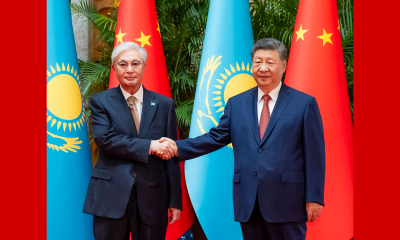
Kazakhstan seeks regional AI leadership as economic partnership with China enters new phase
-
 Aviation/airlines3 days ago
Setting a new benchmark in premium travel
-
 Intellectual Property Rights3 days ago
Survey on an EU Blueprint for intellectual property licensing and spinoff creation
-
 EU law3 days ago
Rule of law report strengthens EU democracy and fundamental rights