Employment
Improving the role of #EmployeeFinancialParticipation in creating jobs and reactivating unemployed people

 MEP's have voted in favour of an ALDE report to improve and better regulate the role of the Employee Financial Participation (EFP) schemes, that offer direct benefits beyond basic remuneration to workers — through profit sharing, individual employee share ownership and employee stock ownership plans — and constitutes one form of employee participation in companies.
 This ALDE Report aims to stimulate the development of EFP schemes by raising awareness on their potential for both workers and employers, with regards to growth and social protection, along with underlining the existing obstacles to these schemes, which the Commission and the member states shall help to overcome. Even if in 2018 exist 10 million employee shareholders in the EU, and 20 MS have some kind of regulation, there are severe geographical imbalances to address.
MEP Renate Weber, ALDE rapporteur on this file, said: “Employee-share ownership has a potential to stabilize the European economy as a whole. This report aims at creating a momentum again for EFP by emphasizing the potential of these schemes for both workers and their employers, with respect to more sustainable governance, better business continuity and access to capital for SMEs, better social dialogue and quality of work, more fidelity and less absenteeism, more motivation, efficiency and better skills development which could lead to less unemployment and redundancies.”
The financial participation of employees can lead to a broad range of positive economic and social effects, including the stimulation of job creation and the reactivation of unemployed people.
Share this article:
EU Reporter publishes articles from a variety of outside sources which express a wide range of viewpoints. The positions taken in these articles are not necessarily those of EU Reporter. Please see EU Reporter’s full Terms and Conditions of publication for more information EU Reporter embraces artificial intelligence as a tool to enhance journalistic quality, efficiency, and accessibility, while maintaining strict human editorial oversight, ethical standards, and transparency in all AI-assisted content. Please see EU Reporter’s full A.I. Policy for more information.







ECR MEPs question the European Commission on cardiovascular health and diet promoting the Mediterranean diet as an alternative to ultra-processed foods as key to tackling obesity

Albania's Vlora airport standoff tests investor confidence as EU accession clock ticks

Why a Brussels–Nicosia–Eastern Mediterranean strategic affairs platform would benefit the European Union

Kazakhstan seeks regional AI leadership as economic partnership with China enters new phase

Starmer’s problem? 'He is not a politician'

Setting a new benchmark in premium travel

Survey on an EU Blueprint for intellectual property licensing and spinoff creation

Statement by the Ministry of Foreign Affairs of the Republic of Kazakhstan

The EU’s Forced-Labour Regulation Faces a Credibility Test

European Statistical Monitor: July edition

Commission publishes state aid guidance on carbon contracts for difference

Commission greenlights Estonia's fourth payment request for €135.5 million under NextGenerationEU

Drones, dominance, and the Iranian impasse: The West's strategic blind spot

Kazakhstan's fixed capital investment tops 9.5 trillion tenge in H1 2026

Commission registers two European Citizens' Initiatives on education and housing

Kazakhstan and Belgium: Building a Partnership for the Future

Kazakhstan reforms under scrutiny at Brussels Press Club round table

Japan should face up to history and contribute more to regional peace

Ambassador calls for 'speeding up' of co-operation between EU and Kazakhstan

Timur Turlov at Smart Moves Summit 2025: How chess can transform global education

Shevtsova’s case: Out-of-court sanctions dismantling trust in Ukrainian cause

The future of European transport

Trump Vs Trueman

US 'no longer' an 'unconditional ally' for Europe - MEP
-
 Italy5 days ago
ECR MEPs question the European Commission on cardiovascular health and diet promoting the Mediterranean diet as an alternative to ultra-processed foods as key to tackling obesity
-
 Albania5 days ago
Albania's Vlora airport standoff tests investor confidence as EU accession clock ticks
-
 Euro-Mediterranean relations5 days ago
Why a Brussels–Nicosia–Eastern Mediterranean strategic affairs platform would benefit the European Union
-
 China4 days ago
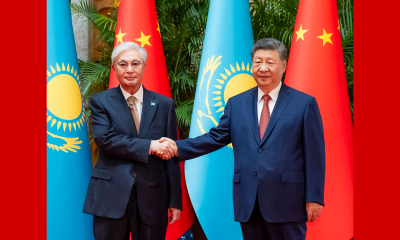
Kazakhstan seeks regional AI leadership as economic partnership with China enters new phase