Iran
Outrage of Iranian exiles and opposition of MEPs to inviting Reza Pahlavi to the European Parliament

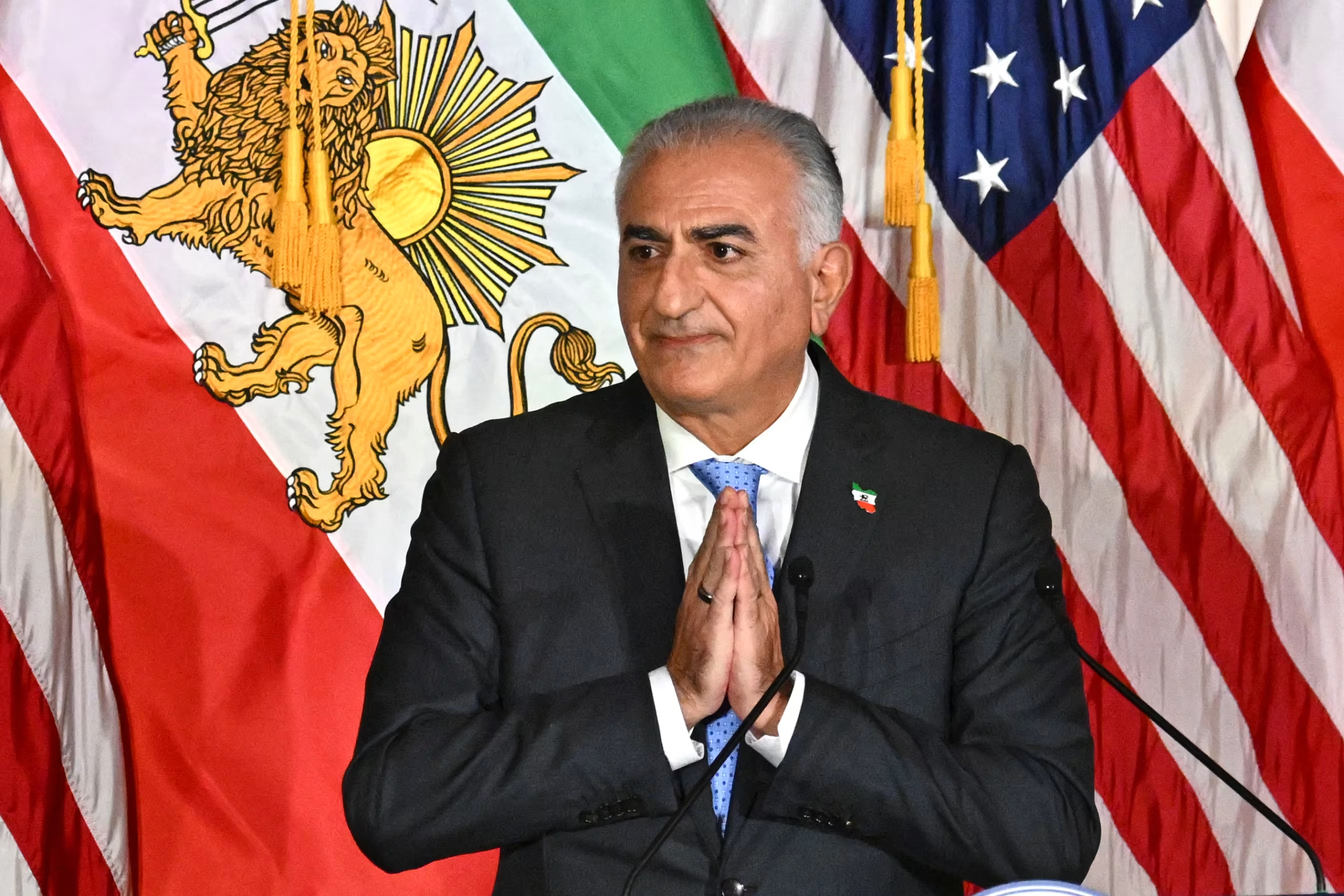
As the crisis over Iran deepens and European capitals search for a response, a small number of members of the European Parliament are once again trying to hand a platform to Reza Pahlavi, the son of Iran's deposed last monarch. The effort has angered both the majority members of the chamber and the Iranian diaspora.
According to reports from several sources, a non-elected body within the Foreign Affairs Committee sent a note to the coordinators of the various political groups in the committee, expressing its desire to invite Reza Pahlavi to a committee meeting on 24 or 25 June. The note emphasized that if no response was received within a short period of time, it would be taken as agreement with the decision.
According to one MEP, who requested anonymity, this approach is undemocratic under any circumstances. However, in the current situation, when the European Parliament has already decisively rejected inviting Pahlavi once and has on several occasions removed proposals to invite him to Parliament from draft resolutions, such a move is conspiratorial in nature and turns Parliament into a plaything of those with money and power. He added that this action becomes even more unjustifiable when the destructive role played by Pahlavi within the Iranian opposition has been widely highlighted in reputable media outlets in Europe, the United Kingdom, and the United States.
During the Strasbourg plenary session in May, some members of the ECR Group attempted to dedicate a paragraph in a resolution adopted by Parliament condemning political executions to inviting Pahlavi. This effort was removed due to opposition from the other political groups and even a significant section of the ECR Group itself.
An Iranian activist who spent many years in Iranian prisons and was released in 2015 said: “The people of Iran expect Parliament to play an active role against the political executions that are now taking place in Iran almost daily. But inviting the Shah’s son will only blur these concerns through political games, create division, and provide opportunities for exploitation by the mullahs.”
He added: “Inviting Reza Pahlavi together with several other individuals under the pretext that he would not be singled out as a prominent figure does not solve the problem either, because the issue is not whether he appears ‘alone’ but rather Pahlavi’s political agenda. His program is a roadmap toward totalitarianism and, because of its divisive nature, weakens the Iranian opposition.”
In January 2026, the idea of inviting Reza Pahlavi was presented as an amendment to a European Parliament resolution and was overwhelmingly defeated by 387 votes against and 132 votes in favor.
Iran’s last Shah was known for one-party rule, the suppression of opponents by SAVAK, the feared secret police, and widespread and systematic corruption. He was overthrown by a mass revolution in February 1979.
Reza Pahlavi, who openly and systematically supports foreign war and the resumption of military attacks against Iran, told Sweden’s SVT television on 12 April 2026: “I am proud of my legacy, my family history, and everything they have done.”
Masood Masjoody, an Iranian mathematician in Canada who had previously supported the Shah’s son but later developed serious disagreements with him and began exposing the conduct of Pahlavi and his supporters, was murdered in early February 2026. In an investigative report published on 16 April, the Associated Press wrote: “The two people charged with Masjoody killing had opposed the Iranian government in online posts and supported the monarchist movement.” AP added: “Days after Masjoody disappeared, 10 other outspoken diaspora figures, most of them critics of the monarchist campaign or the war with Iran, were tagged in an ominous message on the social platform X.” “Soon you’ll have to find the corpses of many,” it warned.
In a report published on 19 April, the website of Dutch public broadcaster NOS wrote that many members of the diaspora “are being intimidated and threatened; …these threats do not come only from ‘the long arm of Tehran,’ but supporters of Reza Pahlavi are also involved in this... So far, at least 20 Iranians (in the Netherlands) have filed formal complaints with the police... Online videos show shopkeepers and restaurant owners being forced through threats of violence to display portraits of the Crown Prince.”
What has angered Iranians even more is that, according to Deutsche Welle on 10 May 2026, a demonstration was held in Regensburg near Munich at the call of Reza Pahlavi. “An image from this gathering, in which several participants appeared in coordinated rows wearing white T-shirts bearing the symbol of SAVAK—the Shah’s feared secret service—triggered a wave of reactions... Earlier, the presence of individuals dressed in black on the streets of London under the direction of a person known as one of the organizers of pro-monarchy rallies attracted attention, and many considered it reminiscent of the street presence of groups with ‘extremist and fascist’ tendencies.”
According to Deutsche Welle, Nejat Bahrami, an associate of the Shah’s son, said that this parade “should not be considered anything strange, negative, or frightening.” He stated that they, like the security services of Europe and the United States, “protect democracy, security, and the well-being of the people.”
However, various Iranian experts expressed deep concern about this display to Deutsche Welle. Kazem Kordvani, a sociologist, said: “What they are doing is sanctifying SAVAK, and that means sanctifying torture and repression.” He added that SAVAK is “a symbol of absolute evil” and stated: “You absolutely cannot find a single instance throughout all these years in which Mr. Pahlavi has condemned SAVAK or the violence and torture inflicted on political activists, even if they were in the wrong.” He further added: “The dispute between this current (Pahlavi) and the Islamic government is that their violence is bad and our violence is good... their killings are bad and our killings are good.”
On 25 February 2026, Reza Pahlavi described Iranian Kurds as “separatists” and promised that if he came to power, he would suppress them with the army. This issue angered Iranian Kurds, particularly because the Shah and his father had severely suppressed them and subjected them to genocide during the twentieth century.
According to several Iranians in Europe, Reza Pahlavi is a divisive factor within the opposition and granting him a platform is a clear insult to the people of Iran, who are exhausted by the religious dictatorship and have no desire whatsoever to return to a monarchical dictatorship.
Sam, an Iranian based in Europe who is active on issues related to European policy toward Iran, emphasized: “Pahlavi never had any real place among Iranians from the outset. Now the hollow nature of the publicity campaign built around him has also been exposed. None of the victims of the recent wave of executions in Iran had even the slightest connection to him.
It is unclear why the European Parliament’s Foreign Affairs Committee wants to bet on a losing horse. This bears no resemblance to the reality on the ground in Iran,” he added.
Share this article:
EU Reporter publishes articles from a variety of outside sources which express a wide range of viewpoints. The positions taken in these articles are not necessarily those of EU Reporter. Please see EU Reporter’s full Terms and Conditions of publication for more information EU Reporter embraces artificial intelligence as a tool to enhance journalistic quality, efficiency, and accessibility, while maintaining strict human editorial oversight, ethical standards, and transparency in all AI-assisted content. Please see EU Reporter’s full A.I. Policy for more information.



ECR MEPs question the European Commission on cardiovascular health and diet promoting the Mediterranean diet as an alternative to ultra-processed foods as key to tackling obesity

Albania's Vlora airport standoff tests investor confidence as EU accession clock ticks

Commission approves €659 million German state aid for four new semiconductor facilities

Why a Brussels–Nicosia–Eastern Mediterranean strategic affairs platform would benefit the European Union

Kazakhstan seeks regional AI leadership as economic partnership with China enters new phase

Commission adopts simpler rules for EU agri-food promotion policy

Starmer’s problem? 'He is not a politician'

Kazakhstan's fixed capital investment tops 9.5 trillion tenge in H1 2026

The EU’s Forced-Labour Regulation Faces a Credibility Test

European Statistical Monitor: July edition

Commission publishes state aid guidance on carbon contracts for difference

Commission greenlights Estonia's fourth payment request for €135.5 million under NextGenerationEU

Drones, dominance, and the Iranian impasse: The West's strategic blind spot

Kazakhstan's fixed capital investment tops 9.5 trillion tenge in H1 2026

Commission registers two European Citizens' Initiatives on education and housing

Kazakhstan and Belgium: Building a Partnership for the Future

Kazakhstan reforms under scrutiny at Brussels Press Club round table

Japan should face up to history and contribute more to regional peace

Ambassador calls for 'speeding up' of co-operation between EU and Kazakhstan

Timur Turlov at Smart Moves Summit 2025: How chess can transform global education

Shevtsova’s case: Out-of-court sanctions dismantling trust in Ukrainian cause

The future of European transport

Trump Vs Trueman

US 'no longer' an 'unconditional ally' for Europe - MEP
-
 Italy5 days ago
ECR MEPs question the European Commission on cardiovascular health and diet promoting the Mediterranean diet as an alternative to ultra-processed foods as key to tackling obesity
-
 Albania5 days ago
Albania's Vlora airport standoff tests investor confidence as EU accession clock ticks
-
 Germany5 days ago
Commission approves €659 million German state aid for four new semiconductor facilities
-
 Euro-Mediterranean relations5 days ago
Why a Brussels–Nicosia–Eastern Mediterranean strategic affairs platform would benefit the European Union