Russia
Putin orders FSB to step up surveillance of Russians and borders

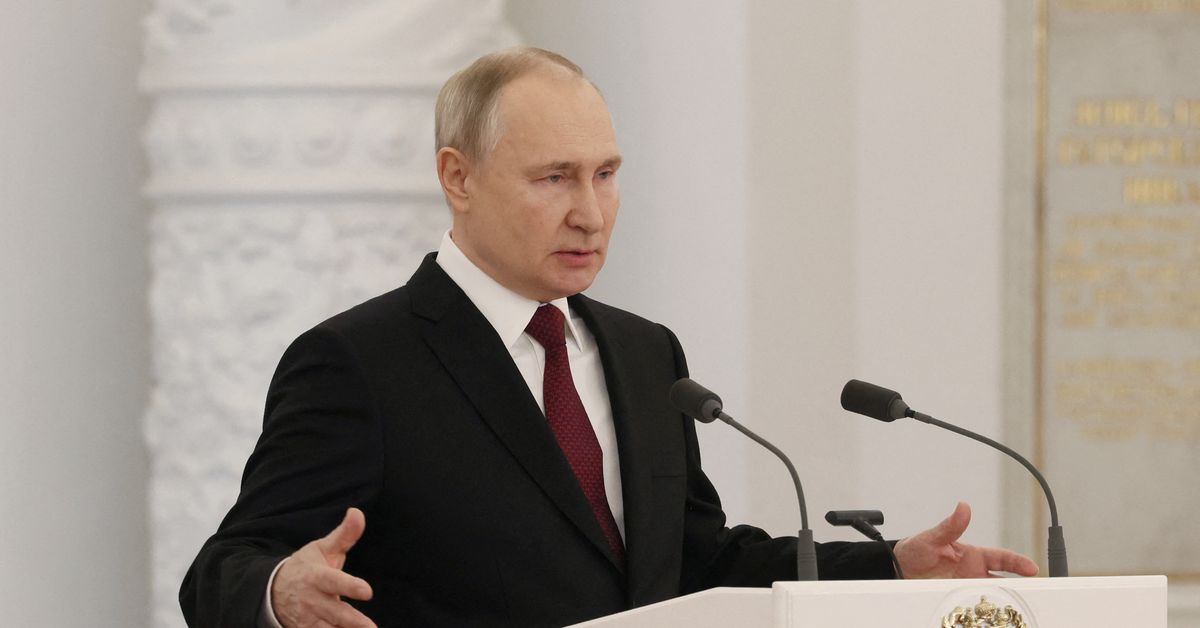
Monday's (19 December) order by President Vladimir Putin to the Federal Security Services was to increase surveillance of Russian society, borders and societies in order to protect the country from threats from abroad and foreign traitors.
Putin spoke ahead of Tuesday's Security Services Day, which is widely celebrated in Russia. He stated that the "emergence of new dangers" makes it more urgent to increase intelligence activity.
Putin said: "Work must be intensified through border services and Federal Security Service (FSB).
"Any attempt to breach it (the border), must be stopped quickly and effectively with all forces and means available, including mobile action units or special forces."
Putin directed the FSB "to maximize their operational, technical, and personnel potential" in order to tighten control over the society.
The FSB is the main successor of the Soviet-era KGB. Moscow's invasion of Ukraine involved a wide range security services.
According to a transcript of Putin's speech, which was translated by Reuters and provided by the Kremlin, Putin said: "Maximum composure and concentration of forces are now required by counterintelligence agencies including military intelligence.
"It is essential to severely suppress foreign special services' actions, quickly identify traitors and spies, and saboteurs."
Alexander Bortnikov (aligned with Putin) will lead the FSB. He will increase surveillance of mass gatherings, strategic facilities, and energy infrastructure.
Demonstrations and dissent in Russia have been quickly quelled since the beginning of the war. In September, more than 1,300 were detained at protests against Putin's 300,000.
Putin admitted that the invasion of Ukraine was not going as planned. He said that the situation in Ukraine's areas that Moscow annexed in September is "very difficult". And he ordered the FSB "safety" for those living in the regions.
Putin promised them more "modern equipment, weapons" and said that it was their duty to "ensure their security to the highest level, respect their rights and freedoms."
The Russian invasion of Ukraine is now in its 10th month. There is no stopping it. This conflict is Europe's most severe since World War Two. It has claimed the lives of tens of thousands, driven millions of people from their homes and left cities in ruins.
Moscow describes its invasion as a "special operation" meant to demilitarize and denazify its neighbor. Kyiv and its West allies call it an unprovoked aggression war to seize land.
Share this article:
EU Reporter publishes articles from a variety of outside sources which express a wide range of viewpoints. The positions taken in these articles are not necessarily those of EU Reporter. Please see EU Reporter’s full Terms and Conditions of publication for more information EU Reporter embraces artificial intelligence as a tool to enhance journalistic quality, efficiency, and accessibility, while maintaining strict human editorial oversight, ethical standards, and transparency in all AI-assisted content. Please see EU Reporter’s full A.I. Policy for more information.





ECR MEPs question the European Commission on cardiovascular health and diet promoting the Mediterranean diet as an alternative to ultra-processed foods as key to tackling obesity

Albania's Vlora airport standoff tests investor confidence as EU accession clock ticks

Iran’s regime in crisis: Negotiations, internal divisions and growing resistance

Commission approves €659 million German state aid for four new semiconductor facilities

Why a Brussels–Nicosia–Eastern Mediterranean strategic affairs platform would benefit the European Union

Kazakhstan seeks regional AI leadership as economic partnership with China enters new phase

EU law on nitrates pollution remains effective, with scope for smarter implementation

Commission adopts simpler rules for EU agri-food promotion policy

The EU’s Forced-Labour Regulation Faces a Credibility Test

European Statistical Monitor: July edition

Commission publishes state aid guidance on carbon contracts for difference

Commission greenlights Estonia's fourth payment request for €135.5 million under NextGenerationEU

Drones, dominance, and the Iranian impasse: The West's strategic blind spot

Kazakhstan's fixed capital investment tops 9.5 trillion tenge in H1 2026

Commission registers two European Citizens' Initiatives on education and housing

Kazakhstan and Belgium: Building a Partnership for the Future

Kazakhstan reforms under scrutiny at Brussels Press Club round table

Japan should face up to history and contribute more to regional peace

Ambassador calls for 'speeding up' of co-operation between EU and Kazakhstan

Timur Turlov at Smart Moves Summit 2025: How chess can transform global education

Shevtsova’s case: Out-of-court sanctions dismantling trust in Ukrainian cause

The future of European transport

Trump Vs Trueman

US 'no longer' an 'unconditional ally' for Europe - MEP
-
 Italy5 days ago
ECR MEPs question the European Commission on cardiovascular health and diet promoting the Mediterranean diet as an alternative to ultra-processed foods as key to tackling obesity
-
 Albania5 days ago
Albania's Vlora airport standoff tests investor confidence as EU accession clock ticks
-
 Iran5 days ago
Iran’s regime in crisis: Negotiations, internal divisions and growing resistance
-
 Germany5 days ago
Commission approves €659 million German state aid for four new semiconductor facilities