Sport
1.55 million people employed in sport in 2023


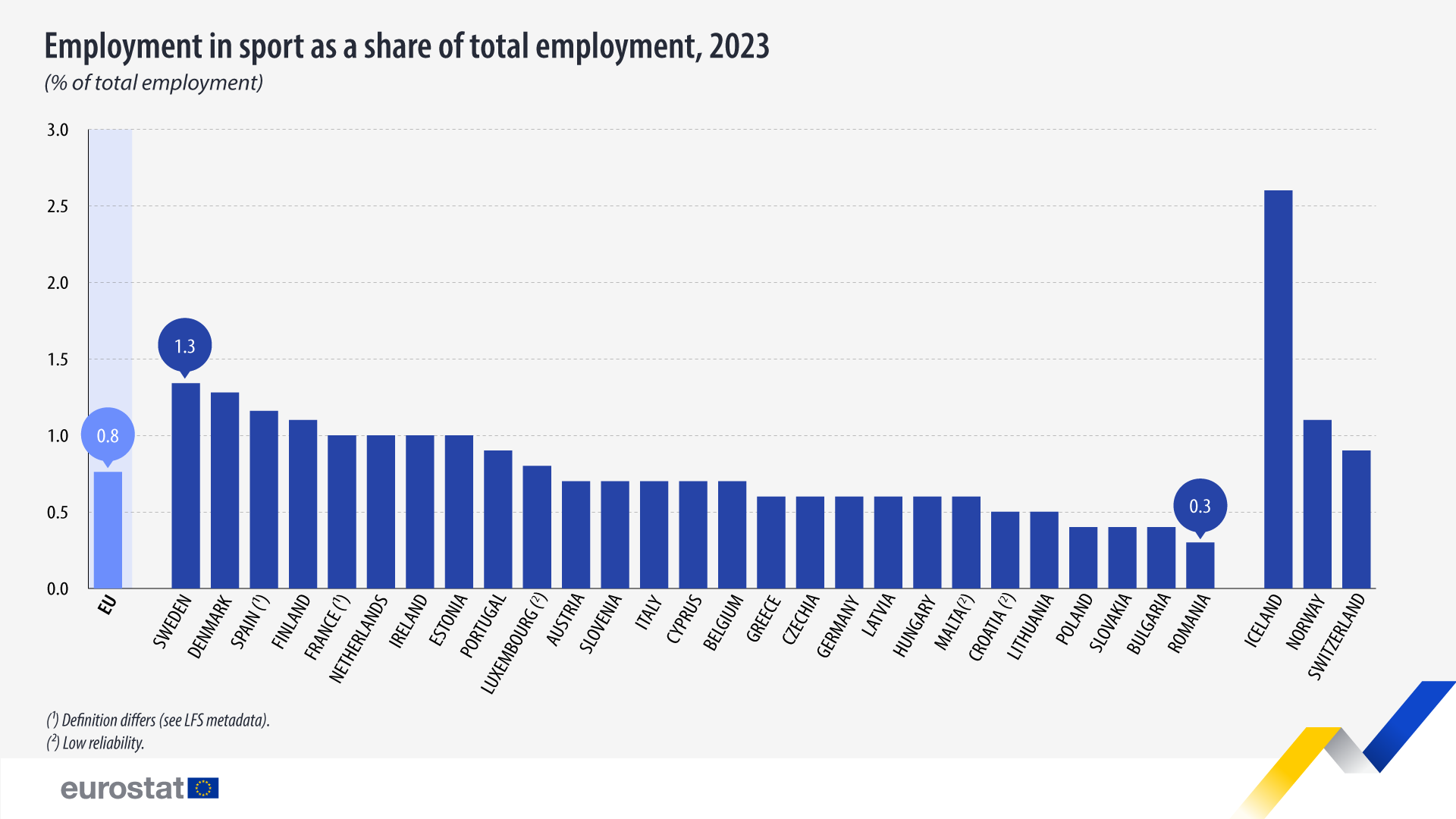
In 2023, 1.55 million people were employed in the sports sector in the EU, representing 0.76% of total employment. Compared with 2022 (1.51 million), the number of people employed in the sports sector increased by 2.2%.
Among the EU countries, Sweden had the highest share of people working in the field of sports (1.33% of total employment), followed by Denmark (1.25%) and Spain (1.16%).
In contrast, the lowest shares of people employed in the sports sector were registered in Romania (0.28% of total employment), Bulgaria (0.37%) and Slovakia (0.40%).
Source dataset: sprt_emp_sex
Over one-third of sports workers under the age of 30
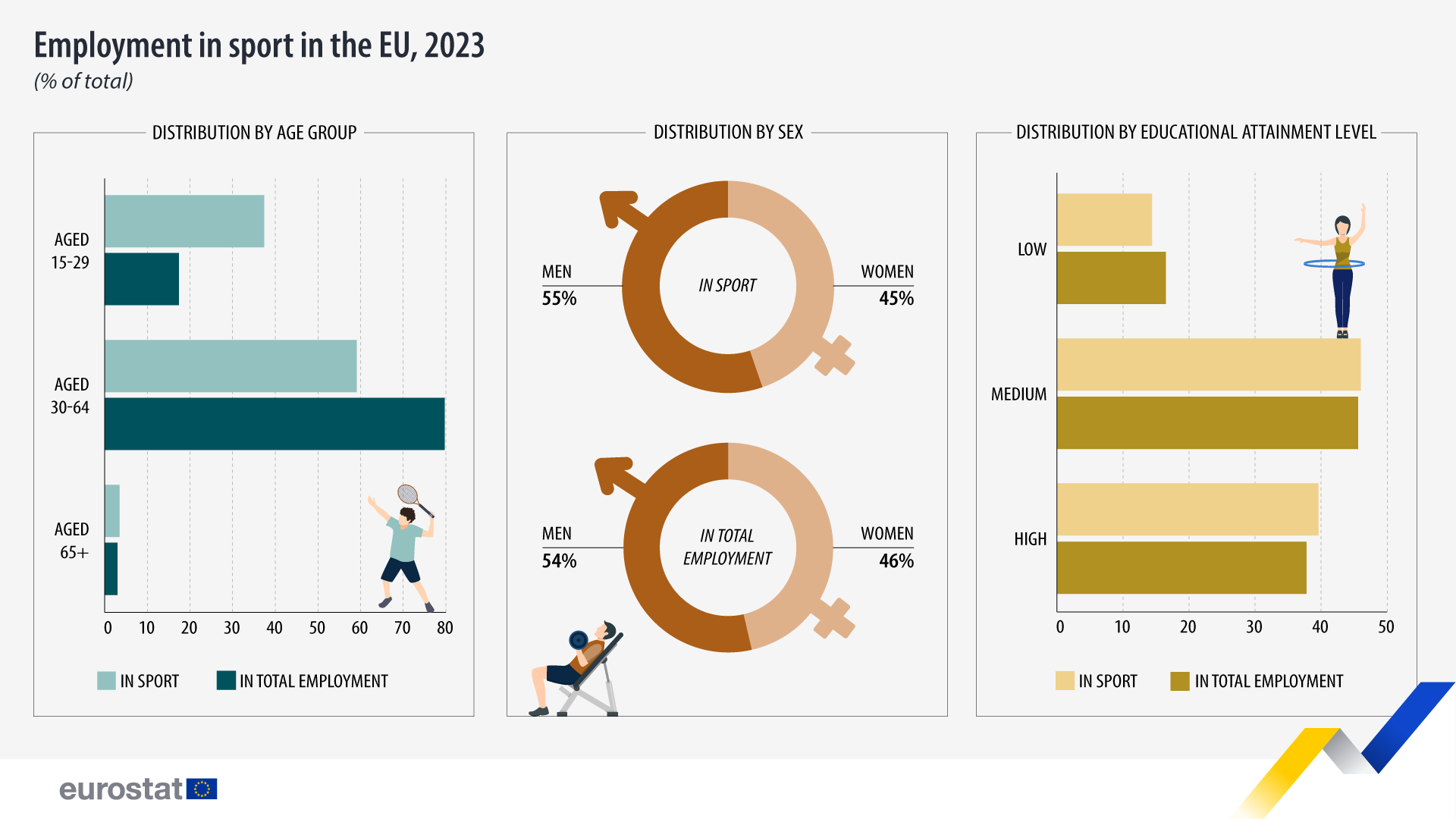
Employment in the sports sector differs from total employment in terms of age composition. More than one-third (37.4%) of people employed in sport were aged 15 29, which is more than twice the share reported in overall employment (17.4%) for the same age group in 2023.
The majority of those employed in sport were aged 30-64, accounting for 59.1% of all sport workers, which was 20.6 percentage points (pp) less than the share of the same age group in the total employment (79.7%). People aged 65+ accounted for 3.5% in the sports sector and 3.0% in total employment.
Source datasets: sprt_emp_age, sprt_emp_sex, sprt_emp_edu
More men were employed in the sports sector than women (55.2% and 44.8%, respectively), leading to a slightly larger gender employment gap of the population employed in this sector compared with overall employment (53.6% and 46.4%, respectively).
In terms of educational attainment level, sports workers exhibited characteristics similar to those in the total employment. Nearly half (45.9%) of those employed in sport had a medium level of education (International standard classification of education (ISCED), levels 3-4), 0.3 pp more than in total employment.
Those with higher (tertiary) education (ISCED levels 5-8) made up 39.6% of sport workers, which was 1.8 pp higher in sport than in total employment.
People with lower education (ISCED levels 0-2), accounted for 14.4% of employment in sport (2.1 pp lower than in total employment).
This article is published to mark the opening of the 2024 Summer Olympic Games.
For more information
Methodological notes
- Employment in sport includes sport-related occupations in the sports sector e.g., professional athletes, professional coaches in fitness centres, non-sport occupations in the sports sector, e.g., receptionists in fitness centres, and sport-related jobs outside the sports sector, e.g., school sport instructors.
- The sport sector includes economic activities and occupations such as in sport teams and clubs, trainers, independent athletes, fitness centres and activities for the promotion and management of sport events.
- New methodology from 2021 for EU Labour Force Survey.
- Luxembourg, Croatia and Malta: low reliability for 2023.
- France and Spain: 2021-2023 definition differs (see Labour Force Survey methodology metadata).
Share this article:
EU Reporter publishes articles from a variety of outside sources which express a wide range of viewpoints. The positions taken in these articles are not necessarily those of EU Reporter. Please see EU Reporter’s full Terms and Conditions of publication for more information EU Reporter embraces artificial intelligence as a tool to enhance journalistic quality, efficiency, and accessibility, while maintaining strict human editorial oversight, ethical standards, and transparency in all AI-assisted content. Please see EU Reporter’s full A.I. Policy for more information.



ECR MEPs question the European Commission on cardiovascular health and diet promoting the Mediterranean diet as an alternative to ultra-processed foods as key to tackling obesity

Albania's Vlora airport standoff tests investor confidence as EU accession clock ticks

Iran’s regime in crisis: Negotiations, internal divisions and growing resistance

Why a Brussels–Nicosia–Eastern Mediterranean strategic affairs platform would benefit the European Union

Commission approves €659 million German state aid for four new semiconductor facilities

Kazakhstan seeks regional AI leadership as economic partnership with China enters new phase

EU law on nitrates pollution remains effective, with scope for smarter implementation

Commission adopts simpler rules for EU agri-food promotion policy

The EU’s Forced-Labour Regulation Faces a Credibility Test

European Statistical Monitor: July edition

Commission publishes state aid guidance on carbon contracts for difference

Commission greenlights Estonia's fourth payment request for €135.5 million under NextGenerationEU

Drones, dominance, and the Iranian impasse: The West's strategic blind spot

Kazakhstan's fixed capital investment tops 9.5 trillion tenge in H1 2026

Commission registers two European Citizens' Initiatives on education and housing

Kazakhstan and Belgium: Building a Partnership for the Future

Kazakhstan reforms under scrutiny at Brussels Press Club round table

Japan should face up to history and contribute more to regional peace

Ambassador calls for 'speeding up' of co-operation between EU and Kazakhstan

Timur Turlov at Smart Moves Summit 2025: How chess can transform global education

Shevtsova’s case: Out-of-court sanctions dismantling trust in Ukrainian cause

The future of European transport

Trump Vs Trueman

US 'no longer' an 'unconditional ally' for Europe - MEP
-
 Italy4 days ago
ECR MEPs question the European Commission on cardiovascular health and diet promoting the Mediterranean diet as an alternative to ultra-processed foods as key to tackling obesity
-
 Albania4 days ago
Albania's Vlora airport standoff tests investor confidence as EU accession clock ticks
-
 Iran5 days ago
Iran’s regime in crisis: Negotiations, internal divisions and growing resistance
-
 Euro-Mediterranean relations4 days ago
Why a Brussels–Nicosia–Eastern Mediterranean strategic affairs platform would benefit the European Union