Climate change
What will happen to European forests as the world gets warmer?

- In 50 years, forests, as we know them, might disappear from parts of the world due to climate change.
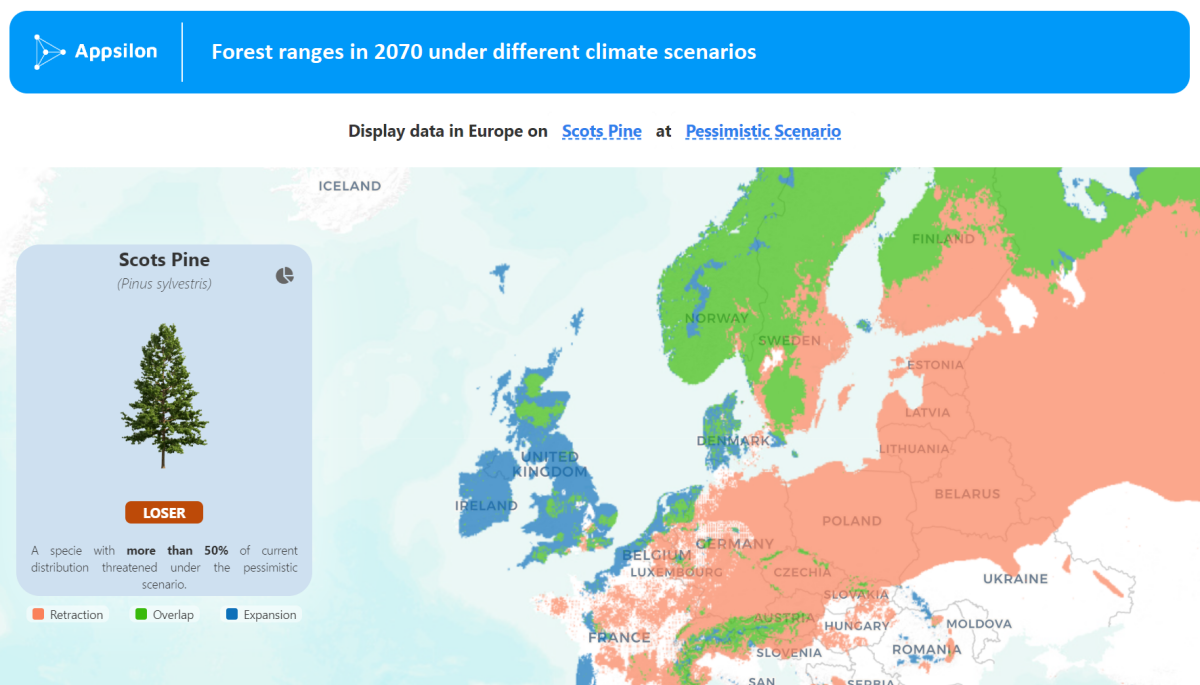
- Appsilon, a data analytics company, built Future Forests – a data visualization app to show how different climate scenarios will affect European forests. It provides a sobering look into the future, where parts of the continent become unsuitable for some major tree species.
- The forest migration process, depicted in the app, might have serious consequences for nature conservation and forest management, affecting both local ecosystems and economies.
Trees are on the move. Rising temperatures and decreasing precipitation cause shifts in plant distributions worldwide. Appsilon, a data science company, created Future Forests – a data visualization dashboard – showing what tree migration might look like in the next 50 years. It is based on a study by Polish scientists, who analyzed projected ranges and threat levels for 12 European forest tree species under three different climate change scenarios.
Click here to see the future of European forests.
“A picture is worth a thousand words. That’s why data visualization is such a powerful tool. We wanted to depict the study's results to draw people’s attention to forest migration as one of the lesser-known impacts of climate change. The shift in the distribution of tree species doesn’t sound that bad. But seeing most of Europe highlighted in red because of the complete disappearance of silver birch from our continent? This is when alarm bells start to ring,” said Filip Stachura, CEO of Appsilon.
How big is the threat?
“Our study has shown that all the analyzed species would face a significant decrease in suitable habitat area. This would mean the end of the forest as we know them in a significant part of Europe. The ecological consequences of such changes would be serious for both forest management and nature conservation. It could mean that some edible plants and fungi become rare. For example, the transition from coniferous to broadleaved forests can decrease blueberry fruit production by half and lingonberry can almost disappear," said Professor Marcin Dyderski from the Institute of Dendrology, Polish Academy of Sciences.
Appsilon’s app, based on the study by prof. Dyderski et al., allows its users to look into the future of forests in three different climate change scenarios – optimistic, moderate, and pessimistic ones. Depending on how they respond, the trees were labeled as winners, which will thrive and expand under the new circumstances, losers, whose habitat will decrease by more than 50%, and aliens – North American species planted in forests, which might expand or contract their ranges.
“Trees have the potential to be our superpower in the fight against the climate crisis. Their carbon-sequestering capabilities can help reduce emissions and draw the existing carbon out of the atmosphere. But trees are also the victims of climate change. Our app provides a look into the dire future. But there is still time to act to change it. And that’s what we focus on,” said Andrzej Białaś, Data for Good Lead at Appsilon.
About Appsilon
Appsilon provides innovative data analytics and machine learning solutions for Fortune 500 companies, NGOs, and non-profit organizations. The company’s core purpose is to advance technology to preserve and improve life on Earth. Committed to positively impacting the world, Appsilon’s team routinely contributes their time and skills to Data for Good projects, offering many of its services at significantly reduced rates or pro-bono.
About the Institute of Dendrology, PAS
The Institute of Dendrology, Polish Academy of Sciences, in Kórnik is a scientific unit that carries out interdisciplinary research on the biology of woody plants at all levels of their organization. The Institute conducts research in two scientific disciplines: biological sciences and forest sciences. Research directions pursued at the Institute include: biogeography and systematics, physiology and ecophysiology, molecular biology, seed biology, biochemistry, genetics, proteomics, ecology, bioindication, phytoremediation, mycology and mycorrhiza, selection, breeding, and propagation of woody plants, entomology, and biology of invasive species.
Share this article:
EU Reporter publishes articles from a variety of outside sources which express a wide range of viewpoints. The positions taken in these articles are not necessarily those of EU Reporter. Please see EU Reporter’s full Terms and Conditions of publication for more information EU Reporter embraces artificial intelligence as a tool to enhance journalistic quality, efficiency, and accessibility, while maintaining strict human editorial oversight, ethical standards, and transparency in all AI-assisted content. Please see EU Reporter’s full A.I. Policy for more information.



Shoot the messenger: How Europe learned to silence its own warnings

New migration and asylum rules enter into application: What is changing?

The Earth is accumulating heat at an accelerating rate: Global warming reached 1.37°C in 2025

EU and Republic of Korea bolster strategic partnership with new areas of cooperation

When Brussels messes up: The people always pay

EU finance ministers back EIB Group strategy for a stronger, more secure Europe in a more stable world

Commission proposes €540 million in financial relief and other supports for farmers facing fertiliser crisis

European Sustainable Energy Week 2026: That’s a wrap

In focus: Improving the energy performance of buildings

Finland and Sweden prepare procurement of Arctic mobility vehicles developed under the European Defence Fund-supported FAMOUS project

Signals from the front and the future of Ukraine

Who are Europe’s next gender equality champions? Applications are now open

Electric car sales surge as high oil prices drive shift away from fossil fuels

2026 could be decisive for the future of Europe’s hypersonic shield

A new chapter for Europe and Africa begins in Nairobi

Commission approves €8 million Croatian state aid for fishing companies facing increased fuel prices

Kazakhstan reforms under scrutiny at Brussels Press Club round table

Japan should face up to history and contribute more to regional peace

Ambassador calls for 'speeding up' of co-operation between EU and Kazakhstan

Timur Turlov at Smart Moves Summit 2025: How chess can transform global education

Shevtsova’s case: Out-of-court sanctions dismantling trust in Ukrainian cause

The future of European transport

Trump Vs Trueman

US 'no longer' an 'unconditional ally' for Europe - MEP
-
 Defence4 days ago
Shoot the messenger: How Europe learned to silence its own warnings
-
 Asylum policy3 days ago
New migration and asylum rules enter into application: What is changing?
-
 Climate change3 days ago
The Earth is accumulating heat at an accelerating rate: Global warming reached 1.37°C in 2025
-
 South Korea3 days ago
EU and Republic of Korea bolster strategic partnership with new areas of cooperation