Fact Check
Separating fact from fiction: The BRICS currency debate


The city of Kazan in Russia hosted the 16th BRICS summit, that saw new member states being admitted into the alternative grouping. Despite all the promise to challenging the neo liberal geo politics world over, BRICS has at most failed to capitulate the US Dollar dominance of the global economy. Russia’s continued isolation due to its aggression and invasion of Ukraine has resulted in its reliance on BRICS and the member states that make up the organisation. Hardly a month after the conference, Donald Trump’s victory in the US election led to all sorts of political deviations as the world reconfigured to the return of Trump, and BRICS is no exception, write Yossabel Chetty and Ellison Shumba.
The BRICS currency debate
Between 18 November and 17 December 2024, the word BRICS appeared in online news and social media (where trackable) 901,000 times. Over this time, the daily mention volume of this acronym sat between 10,000 and 24,000 mentions per day.
On 01 December 2024, there was an unprecedented spike in the volume of conversation that made use of the word with trackable online mentions reaching 238 147 – roughly ten times larger than the second highest peak in conversation over this time period.
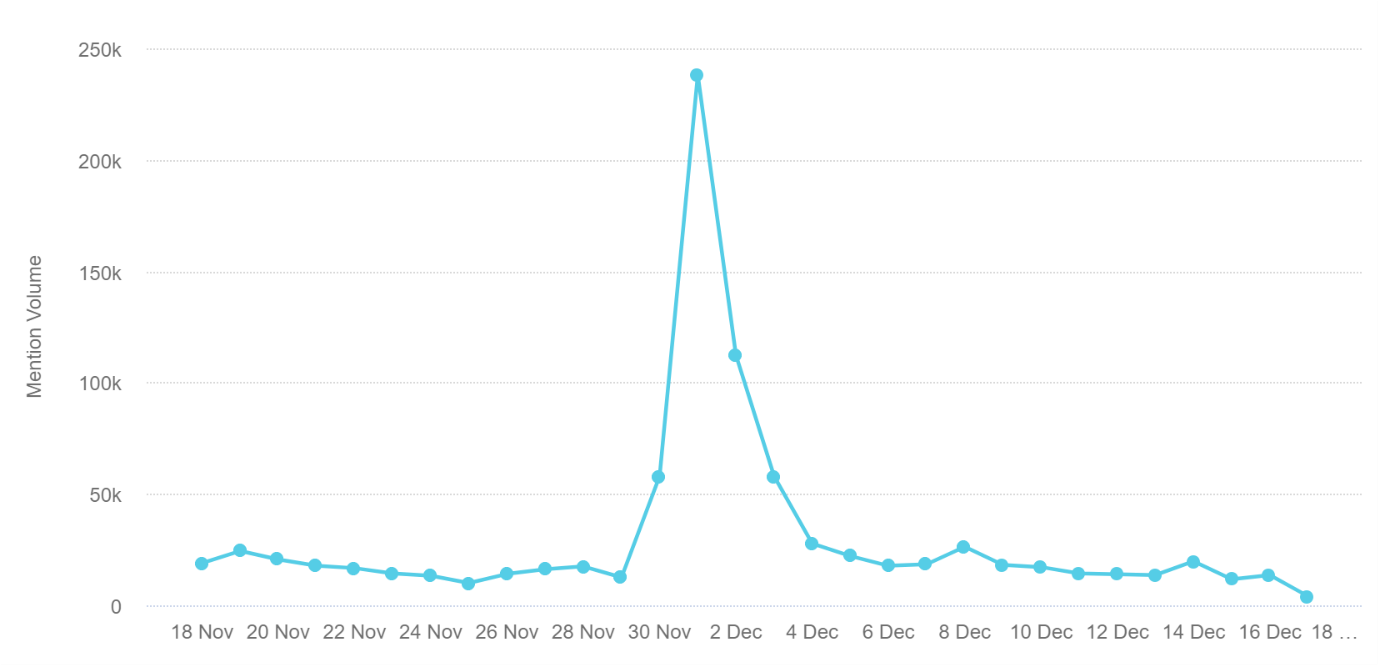
Figure 1: Time series analysis of posts containing the word BRICS between 18 November – 17 December
Driving the remarkable increase was no surprise. On 01 December 2024 @realDonaldTrump, the official account of former and soon to be president, Donald Trump, created a post that read “We require a commitment from these Countries that they will neither create a new BRICS Currency, nor back any other Currency to replace the mighty U.S. Dollar or, they will face 100% Tariffs, and should expect to say goodbye to selling into the wonderful U.S. Economy”. This post was retweeted close to 100 000 times and was viewed more than 110.5 million times. This large number of views could be attributable to Trump’s 96.1 million followership on X or to the grey check mark that appears next to his name, one that is usually reserved for government officials or official government accounts.
When asked for comment, Kremlins spokesperson Dmitry Peskov fired back that there is already a trend to move away from a dollar backed foreign trade landscape and that if the US forces countries to use the dollar, it would only help this trend grow further. In an X post, Clayson Monyela, the head of public diplomacy in the South African Department of International Relations and Corporation (DIRCO), said that there were no plans to introduce a BRICS currency but “trading among member states using own currencies”. The same post has a video of the South African Minister of Finance, Enock Gondongwana explaining the same. Monyela’s post seems to reflect the South African government’s position as his sentiments were further echoed by DIRCO spokesperson Chrispin Phiri. Phiri shared an interview with Godongwana, in which the Minister is asked by a journalist what the agenda is behind a BRICS currency, to which he replied “is there any document of the BRICS which talks about the BRICS currency?”. Phiri went on to explain on the same day as Donald Trump posted about the BRICS currency that recent misreporting has led to incorrect narratives about a BRICS currency.
In another X post, Monyela while responding to a post by the SABC international correspondent, Sherwin Bryce-Pease, noted that the talk about a BRICS currency was due to misinformation. The post stated, “Incorrect reporting led to this false narrative running wild. #BRICS is NOT planning to create a new currency”. Although Monyela and Phiri refuted the idea of a BRICS currency, Zimbabwean investigative journalist Hopewell Chin’ono shared a Reuters news article in which the Brazilian president, Luiz Inacio Lula da Silva, discussed this idea. Lula as he is affectionately known, proposed this idea at the BRICS summit hosted by South Africa in 2023. A Reuters report, citing Putin’s video-link speech at the summit in 2023, shows that Russia supported this idea of a common currency. However, according to this news article, India objected to the idea of a common currency within the BRICS community. The same story notes that South Africa said the idea of a BRICS currency was not on the agenda. This therefore draws the question: What is the fact, or what is fiction, concerning the BRICS currency? Could it be just that its mere speculation resulting in disinformation?
Fear and disinformation
Perhaps among BRICS there is a sudden fear that with a Trump presidency the dollar may strengthen as witnessed by the surge in the US stock market after the Trump victory. We argue that the fear of tariffs and US economic sabotage result in retraction over creating a BRICS currency. In a current affairs discussion on legacy outlet, SABC news, Trump is seen as weaponizing the dollar using tariffs and sanctions to maintain the US global trade dominance. For example, the discussion notes that these tactics have been used before to bully and punish countries such as Russia, Venezuela and Iran. This discussion states that these bullying tactics is the one that has created resentment towards the dollar and that BRICS countries are trying to find ways to limit their dependence on the dollar. While to a certain extent this may be perceived as fact, on the other hand BRICS has China, the second largest economy, and new members such as the UAE. With power in numbers, BRICS has the potential to challenge the USD dominance. Past mentions of a BRICS currency by some leaders such as Lula have likely assisted the misinformed narrative to gain traction, but if indeed this was on the agenda during the 2023 summit in South Africa, that would mean that Pretoria is the one changing the narrative. This analogy then draws attention to the importance BRICS presents to the global economy in challenging US dollar domination. Time will tell whether BRICS would eventually create its own currency, in the meantime we await the return of Trump 2.0.
Yossabel Chetty is the head of research and data analytics at the Centre for Analytics and Behavioural Change, a section 18a non-profit organization based in South Africa.
Ellison Elliot Shumba is currently a PhD candidate in the School of Communications and Media Studies at the University of Johannesburg.
Share this article:

EU Reporter publishes articles from a variety of outside sources which express a wide range of viewpoints. The positions taken in these articles are not necessarily those of EU Reporter. Please see EU Reporter’s full Terms and Conditions of publication for more information EU Reporter embraces artificial intelligence as a tool to enhance journalistic quality, efficiency, and accessibility, while maintaining strict human editorial oversight, ethical standards, and transparency in all AI-assisted content. Please see EU Reporter’s full A.I. Policy for more information.



Astana's congress of world religions: A global platform for dialogue in an age of division

Solana company partners with Kazakhstan on $6B Alatau Crypto Megacity

Protect children from online sexual abuse: Call for urgent negotiations and permanent solution

Will the Gulf monarchies rise above internecine disputes in the interest of collective security?

Kyrgyzstan launches Tamchy SFIT: A new international jurisdiction as a gateway to Eurasia

Kazakhstan’s dombyra: The two-stringed instrument that carries the soul of the steppe

Europe must double down on nuclear progress to achieve its long-term ambitions

International Plastic Bag Free Day – from single use to reuse

Rise of political Islamism: Concerns seize centre of debate

How hair extensions can transform your look naturally

Deposits to Swiss banks from Bangladeshi nationals nearly tops all time peak

EU agricultural markets remain robust despite uncertainties and rising input costs

Commission report highlights achievements of EU rules on animal health

EU deploys wildfire support to face multiple fires across Portugal and France

Europe’s job market is shifting, and EURES is ready to lead the way into 2030

From a remote island to shelves around the world: The story of Azorean canned fish

Kazakhstan reforms under scrutiny at Brussels Press Club round table

Japan should face up to history and contribute more to regional peace

Ambassador calls for 'speeding up' of co-operation between EU and Kazakhstan

Timur Turlov at Smart Moves Summit 2025: How chess can transform global education

Shevtsova’s case: Out-of-court sanctions dismantling trust in Ukrainian cause

The future of European transport

Trump Vs Trueman

US 'no longer' an 'unconditional ally' for Europe - MEP
-
 Kazakhstan3 days ago
Astana's congress of world religions: A global platform for dialogue in an age of division
-
 Kazakhstan3 days ago
Solana company partners with Kazakhstan on $6B Alatau Crypto Megacity
-
 Child sexual abuse3 days ago
Protect children from online sexual abuse: Call for urgent negotiations and permanent solution
-
 Iran3 days ago
Will the Gulf monarchies rise above internecine disputes in the interest of collective security?