European Commission
Happy European Statistics Day!


Statistics have been a part of the European project since the start, with the creation of the statistics division of the Coal and Steel Community (ESCS) in 1953. 70 years have passed since then, and now Eurostat is widely known as the provider of objective data on Europe. To commemorate statistics, today we celebrate European Statistics Day, initiated to promote the value of official statistics in making informed decisions and holding public debates.
2023 is the European Year of Skills, and we want to focus on how the EU is doing in this regard, on how EU people are striving to increase their skills to fetch higher quality jobs. For example, in 2022, 11.9% of the EU people between 25-42 years old participated in lifelong learning programmes, up by 1.5 percentage points (pp) since 2017; 61% of the students in upper secondary general education were studying 2 or more languages, indicating an increase of 1.6 pp since 2016; and 42% of the people between 25 and 34 years old had a tertiary educational level of attainment (+4.4 pp since 2017).
In terms of digital skills, in 2021, 53.9% of EU people aged 16-74 had at least basic digital skills, and in 2022, ICT specialists represented 4.6% of total employment (+0.9 pp since 2017).

Source datasets: trng_lfse_01, edat_lfse_03, isoc_sks_itspt, educ_uoe_lang02 and isoc_sk_dskl_i21
To celebrate European Statistics Day, we invite you to dive into Eurostat’s products and discover all we have to offer.
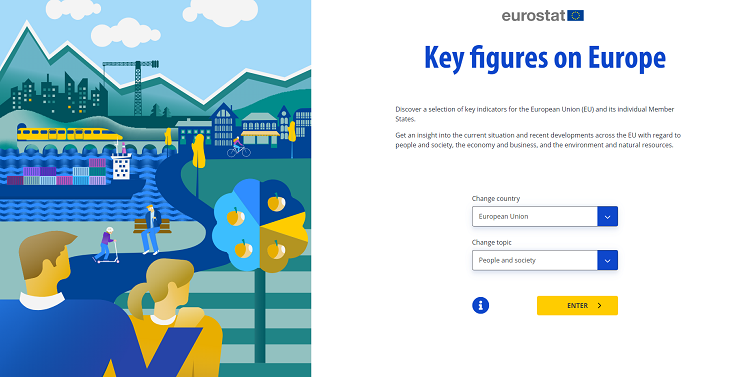
Check out the visualization tool ‘Key figures on Europe’
The visualisation tool ‘Key figures on Europe 2023’, with data for the EU, individual EU members and EFTA countries, offers a quick and interactive overview of key aspects of the EU and your country and allows you to compare it with other EU countries. The different visualisation tools allow you to dig into selected statistics focusing on people & society, economy & business, and environment & natural resources.
The Key figures on Europe visualization tool is available in English, while the publication itself is also available in German and French.
Inflation explained to kids
Recently, Eurostat released a short animation on inflation for children, explaining what causes inflation, and the link between supply and demand.
Targeted to children aged 9-12, the animation is a useful tool for teachers. The video has an English voiceover and subtitles in all official EU languages and Luxembourgish and is available on YouTube and the European Commission Audiovisual Service.
Webinar on job skills statistics
On 27 October, from 11 to 12 CEST, Eurostat will be organizing a webinar on job skills statistics.
Add the event to your calendar by clicking below, and join us.
Add to Calendar Add to Google Calendar Add to Yahoo! Calendar
More information
- Visualization tool Key figures on Europe
- Publication Key figures on Europe
- Webinar on job skills statistics
- Podcast on statistical literacy
Methodological notes
- Educational attainment levels are classified according to the International Standard Classification of Education (ISCED).
If you have any queries, please visit contact us page.
Share this article:
EU Reporter publishes articles from a variety of outside sources which express a wide range of viewpoints. The positions taken in these articles are not necessarily those of EU Reporter. Please see EU Reporter’s full Terms and Conditions of publication for more information EU Reporter embraces artificial intelligence as a tool to enhance journalistic quality, efficiency, and accessibility, while maintaining strict human editorial oversight, ethical standards, and transparency in all AI-assisted content. Please see EU Reporter’s full A.I. Policy for more information.



Why China and Russia did not come to the aid of Iran? Yes, they did!

Lebanon, Hezbollah and the price of caution

Why right-wing populism remains popular 10 years post-Brexit

Going down a treat...that's top chef Dev Biswal

Improving energy efficiency of buildings to reduce bills and save energy

DG Translation in a city near you: June events

Stepping out...to get the UK back in European Union

Europe's broken promise, 300 million times over

EU and Moldova strengthen cooperation on jobs, skills and social rights

EU agri-food trade surplus expands in February 2026

Commission disburses €7.2 billion to Poland under NextGenerationEU

Africa CDC urges protection for Ebola aid workers

High-Speed Drama Shatters Monaco’s Tranquil Façade

Mobile liver testing rolls into Brussels

Commission accelerates transition away from animal testing in chemical safety assessments

Commission proposes new authorization for mobile satellite services for EU's resilience and competitiveness

Kazakhstan reforms under scrutiny at Brussels Press Club round table

Japan should face up to history and contribute more to regional peace

Ambassador calls for 'speeding up' of co-operation between EU and Kazakhstan

Timur Turlov at Smart Moves Summit 2025: How chess can transform global education

Shevtsova’s case: Out-of-court sanctions dismantling trust in Ukrainian cause

The future of European transport

Trump Vs Trueman