Child protection
New indicators on childcare participation and intensity


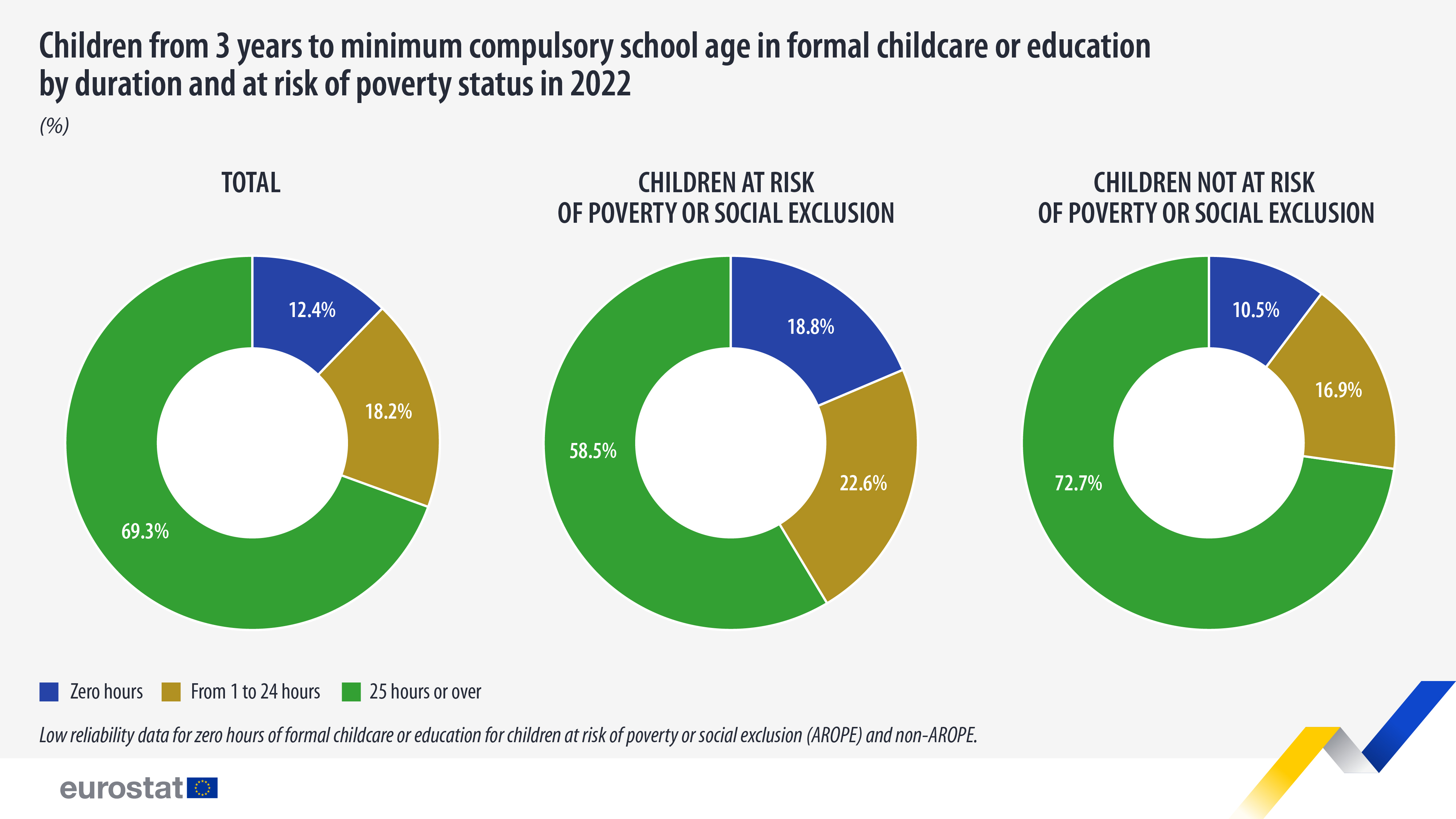
In 2022, 69.3% of children aged from 3 years to the minimum compulsory school age in the EU participated in formal childcare or education for at least 25 hours per week. Within this age group, 12.4% of children were not involved in formal childcare (zero hours), while 18.2% participated in formal childcare for up to 24 hours per week.
Children at risk of poverty and social exclusion (AROPE) of the same age group showed lower rates of participation in formal childcare or education. Specifically, 58.5% participated in formal childcare or education for at least 25 hours per week, as opposed to 72.7% of children not at risk. Moreover, 18.8% of the children at risk did not participate in formal childcare (10.5% of non-AROPE children) and 22.6% participated in formal childcare up to 24 hours a week (16.9% of non-AROPE children).
This data is available through a new indicator for measuring ‘Children in formal childcare or education by age group and duration’ published by Eurostat.
Source dataset: ilc_caindform25
More information
- Statistics Explained article on living conditions in Europe - childcare arrangements
- Thematic section on income and living conditions
- Database on income and living conditions
Methodological notes
- Following the Council Recommendation of 8 December 2022 on early childhood education and care: the Barcelona Targets for 2030 (2022/C 484/01), Eurostat has defined a new indicator for measuring ‘Children in formal childcare or education by age group and duration’, setting the threshold for the number of hours in formal childcare or education at 25 hours per week, and breaking the indicator down by the at risk of poverty or social exclusion status (ilc_caindform25) and by income quintile (ilc_caindform25q). In addition, together with the three age groups already available in the former indicator (ilc_caindformal), an additional age group has been added for children aged 1 or 2 years old. Furthermore, the variances and confidence intervals for each particular breakdown are available in a dedicated CIRCBC folder.
- Methodological information on at risk of poverty or social exclusion can be found here.
Share this article:
EU Reporter publishes articles from a variety of outside sources which express a wide range of viewpoints. The positions taken in these articles are not necessarily those of EU Reporter. Please see EU Reporter’s full Terms and Conditions of publication for more information EU Reporter embraces artificial intelligence as a tool to enhance journalistic quality, efficiency, and accessibility, while maintaining strict human editorial oversight, ethical standards, and transparency in all AI-assisted content. Please see EU Reporter’s full A.I. Policy for more information.



Why China and Russia did not come to the aid of Iran? Yes, they did!

Why right-wing populism remains popular 10 years post-Brexit

Going down a treat...that's top chef Dev Biswal

Lebanon, Hezbollah and the price of caution

Improving energy efficiency of buildings to reduce bills and save energy

DG Translation in a city near you: June events

Energy use in the industry sector continues to decline

Europe's broken promise, 300 million times over

Commission disburses €7.2 billion to Poland under NextGenerationEU

Africa CDC urges protection for Ebola aid workers

High-Speed Drama Shatters Monaco’s Tranquil Façade

Mobile liver testing rolls into Brussels

Commission accelerates transition away from animal testing in chemical safety assessments

Commission proposes new authorization for mobile satellite services for EU's resilience and competitiveness

Defending values, driving reform, delivering impact: New measures to strengthen EU humanitarian action

Europe must not turn its back on rural women’s empowerment

Kazakhstan reforms under scrutiny at Brussels Press Club round table

Japan should face up to history and contribute more to regional peace

Ambassador calls for 'speeding up' of co-operation between EU and Kazakhstan

Timur Turlov at Smart Moves Summit 2025: How chess can transform global education

Shevtsova’s case: Out-of-court sanctions dismantling trust in Ukrainian cause

The future of European transport

Trump Vs Trueman