EU
#ConsularProtection - Commission welcomes member states' vote on new #EUEmergencyTravelDocument


The European Commission has welcomed the final approval by ministers from the member states for the Commission's proposal to create a modern EU Emergency Travel Document.
Since 1996, EU citizens who have their passports stolen or lose them while travelling abroad can obtain emergency travel documents from embassies or consulates of EU member states other than their own. Lost or stolen passports make up more than 60% of the cases of consular assistance provided to EU citizens. However, the old format did not meet modern security standards such as up-to-date printing techniques or protection against copying by means of security holograms.
As a result, some member states stopped using them. Justice, Consumers and Gender Equality Commissioner Věra Jourová said: “Losing your passport or having it stolen while travelling abroad is a distressing experience. The new rules adopted today will make sure that EU citizens can quickly receive a secure and widely accepted EU Emergency Travel Document from any member state, allowing them to return home safely.This is a practical example of the benefits of EU citizenship and solidarity.”
The new EU Emergency Travel Document will be based on the format and security features of the Schengen visa sticker. Its user-friendly format will include a space for any necessary transit visa and they should be issued within seven working days (with some exceptions). Member states have to transpose the new rules into their national laws within two years after the Commission has adopted the remaining technical rules on the design and security requirements. More information on EU citizens' right to consular protection can be found online.
Share this article:
EU Reporter publishes articles from a variety of outside sources which express a wide range of viewpoints. The positions taken in these articles are not necessarily those of EU Reporter. Please see EU Reporter’s full Terms and Conditions of publication for more information EU Reporter embraces artificial intelligence as a tool to enhance journalistic quality, efficiency, and accessibility, while maintaining strict human editorial oversight, ethical standards, and transparency in all AI-assisted content. Please see EU Reporter’s full A.I. Policy for more information.



Shoot the messenger: How Europe learned to silence its own warnings

The Earth is accumulating heat at an accelerating rate: Global warming reached 1.37°C in 2025

New migration and asylum rules enter into application: What is changing?

EU and Republic of Korea bolster strategic partnership with new areas of cooperation

When Brussels messes up: The people always pay

EU finance ministers back EIB Group strategy for a stronger, more secure Europe in a more stable world

Commission proposes €540 million in financial relief and other supports for farmers facing fertiliser crisis

European Sustainable Energy Week 2026: That’s a wrap

In focus: Improving the energy performance of buildings

Finland and Sweden prepare procurement of Arctic mobility vehicles developed under the European Defence Fund-supported FAMOUS project

Signals from the front and the future of Ukraine

Who are Europe’s next gender equality champions? Applications are now open

Electric car sales surge as high oil prices drive shift away from fossil fuels

2026 could be decisive for the future of Europe’s hypersonic shield

A new chapter for Europe and Africa begins in Nairobi

Commission approves €8 million Croatian state aid for fishing companies facing increased fuel prices

Kazakhstan reforms under scrutiny at Brussels Press Club round table

Japan should face up to history and contribute more to regional peace

Ambassador calls for 'speeding up' of co-operation between EU and Kazakhstan

Timur Turlov at Smart Moves Summit 2025: How chess can transform global education

Shevtsova’s case: Out-of-court sanctions dismantling trust in Ukrainian cause

The future of European transport

Trump Vs Trueman

US 'no longer' an 'unconditional ally' for Europe - MEP
-
 Defence4 days ago
Shoot the messenger: How Europe learned to silence its own warnings
-
 Climate change3 days ago
The Earth is accumulating heat at an accelerating rate: Global warming reached 1.37°C in 2025
-
 Asylum policy3 days ago
New migration and asylum rules enter into application: What is changing?
-
 South Korea3 days ago
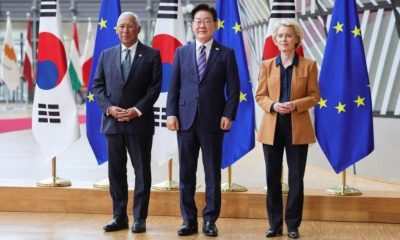
EU and Republic of Korea bolster strategic partnership with new areas of cooperation