Communication
Time spent on work-related communication: An EU overview


Data by economic activity (NACE Rev. 2) at the EU level show that around 55% or slightly more people employed in the ‘financial and insurance activities’, ‘education’, and ‘accommodation and food service activities’ spend at least half their working time interacting with others. On the other hand, over 40% of people employed in ‘mining and quarrying’, ‘activities of households as employers’, and ‘agriculture, forestry and fishing’ declared that they spent little or none of their working time on social interactions.
This information comes from the data release based on the 2022 EU-LFS module on job skills published by Eurostat. This article presents a handful of findings from the more detailed Statistics Explained article on employment statistics – focus on communication skills.
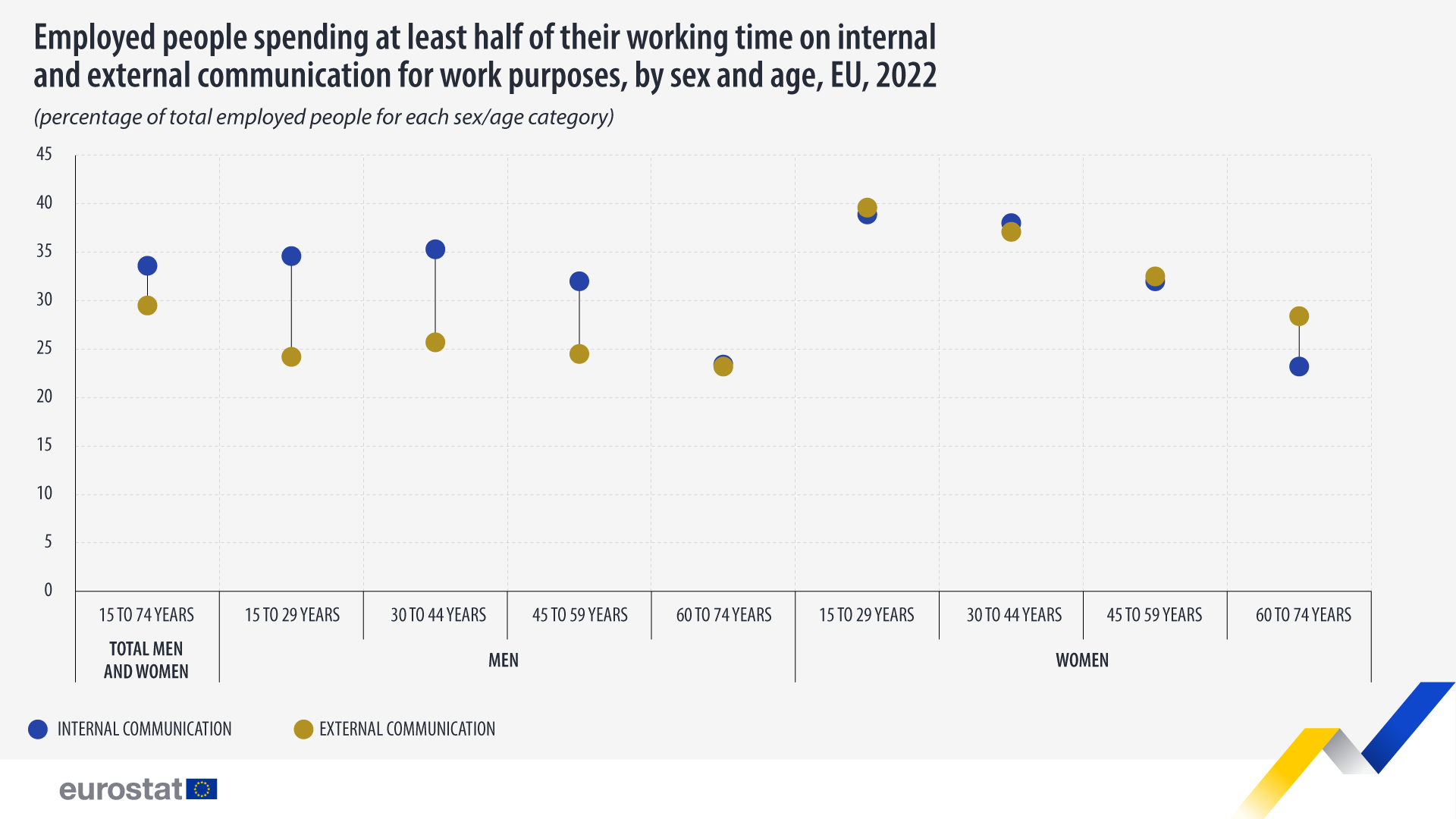
Communication can be internal, within the business or organisation, involving colleagues or managers, and external, to outside customers, suppliers, patients, or pupils. In the EU, 33.6% of employed people aged 15-74 years reported dedicating at least 50% of their working time to internal communication and 29.5% reported that they dedicated at least half of their time to external communication.
Source datasets: lfso_22dmsc03 and lfso_22dmsc04
Looking at the situation by sex, women reported similar shares of internal and external communication for at least half of the working time. The exceptions were those aged 60 to 74, which registered a gap of 5.2 percentage points (pp) between both categories in favour of external communication.
In contrast, men in all age groups, except those aged 60-74, had substantially higher percentages for internal communication compared with external communication. In the 15-29 age group, 34.6% of employed men dedicated at least half of their working time to internal communication, while 24.2% reported spending at least 50% of their working time on external communication. In the 30-44 age group, these shares were 35.3% vs. 25.7%, and in the 45-59 age group, it varied between 32.0% for communication within the company and 24.5% for external communication.
In general, a higher percentage of employed women, compared with men, allocated at least half of their working time to communication. The most significant difference between men and women was observed in the age group of 15-29 years, specifically in external communication, with 39.6% of women and 24.2% of men reporting to have dedicated half of their working time to external communication.
To mark the European Year of Skills, Eurostat is expanding its employment statistics by addressing questions related to interaction with other people for work purposes and how employed people allocate their working time to work-related communication.
More information
- Statistics Explained article on employment statistics – focus on communication skills
- Thematic section on employment and unemployment (LFS)
- Database on employment and unemployment (LFS)
- Thematic section on skills
- Database on skills-related statistics
If you have any queries, please visit the contact page.
Share this article:
EU Reporter publishes articles from a variety of outside sources which express a wide range of viewpoints. The positions taken in these articles are not necessarily those of EU Reporter. Please see EU Reporter’s full Terms and Conditions of publication for more information EU Reporter embraces artificial intelligence as a tool to enhance journalistic quality, efficiency, and accessibility, while maintaining strict human editorial oversight, ethical standards, and transparency in all AI-assisted content. Please see EU Reporter’s full A.I. Policy for more information.



EU foreign ministers to discuss options for restricting trade with Israeli communities in Judea and Samaria

Srebrenica's lesson is prevention. Why isn't the world applying It to Kashmir?

European operation dismantles €10 million illicit cigarette network in Spain

AIFC to host Astana Finance Days 2026 in September

Joint statement by High Representative/Vice-President Kallas and Commissioner Kos on the 31st anniversary of the Srebrenica genocide

Energy Union Task Force takes stock of oil and gas security of supply in the EU

ALROSA Re-elects Supervisory Board with Minimal Changes

Commission preliminarily finds the addictive design of Instagram and Facebook in breach of the Digital Services Act

Shared commitment to advance EOSC through new EOSC Nodes and EOSC projects

Why young jobseekers struggle to find roles abroad that fit their expertise

Farmers, fair markets and consumers: new report highlights the role of EU competition rules in agriculture

EU and South Africa kick off intergovernmental dialogue on Clean Trade and Investment Partnership

Seveso - 50 years on: EU strengthens its commitment to industrial safety in a changing landscape of risk

Commission opens formal investigation into possible gun jumping in XXXLutz's acquisition of Porta

EU weighs age-13 limit for 'social media plus'
ALROSA Re-elects Supervisory Board with Minimal Changes

Kazakhstan reforms under scrutiny at Brussels Press Club round table

Japan should face up to history and contribute more to regional peace

Ambassador calls for 'speeding up' of co-operation between EU and Kazakhstan

Timur Turlov at Smart Moves Summit 2025: How chess can transform global education

Shevtsova’s case: Out-of-court sanctions dismantling trust in Ukrainian cause

The future of European transport

Trump Vs Trueman

US 'no longer' an 'unconditional ally' for Europe - MEP
-
 Israel3 days ago
EU foreign ministers to discuss options for restricting trade with Israeli communities in Judea and Samaria
-
 Kashmir2 days ago
Srebrenica's lesson is prevention. Why isn't the world applying It to Kashmir?
-
 Cigarettes2 days ago
European operation dismantles €10 million illicit cigarette network in Spain
-
 Kazakhstan1 day ago
AIFC to host Astana Finance Days 2026 in September