Economic governance
Jaded Greeks resigned to more #austerity

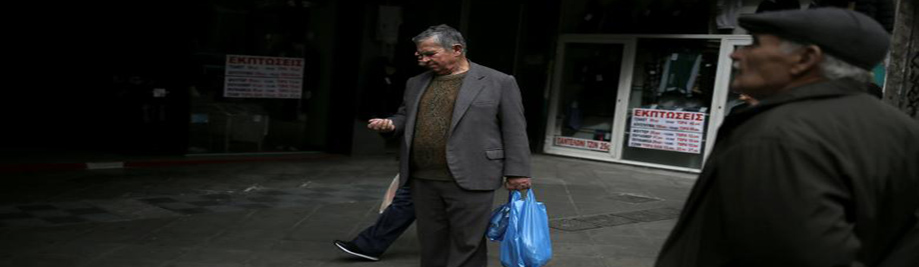
When asked what he thought about the prospect of yet more austerity to be imposed on Greece by its international creditors, Nicos Papapetrou was fairly short, writes Lefteris Papadimas.
"I had better stop ... because I will start swearing," 49-year old Papapetrou, a shop assistant in Athens said.
Greeks appeared resigned on Tuesday to accepting further budget cuts and tax rises after their government agreed to a last-minute compromise of new reforms to keep bailout funds flowing.
Athens and its creditors - the eurozone and International Monetary Fund - agreed on Monday (20 February) to resume talks on the long-stalled bailout review, but only after Greece agreed to examine what it described as "fiscally neutral" reforms from 2019 onwards.
That, local media have speculated, will mean a drop in the income tax threshold and further pension reform, in exchange for lower VAT rates on essential items and reduce annual tax rates on real estate.
"It's a left wing government and they are bringing new cutbacks to pensioners and will tax the poorest. They should be ashamed of themselves," Papapetrou said.
Lenders have sought further reforms to pensions and tax credits, arguing that a present system is based on a relatively small number of taxpayers supporting a large contingent of pensioners.
The Greek government has responded that it needs not only money but some form of debt restructuring.
But ordinary Greeks, who have seen a quarter of their national output wiped out by austerity attached to bailout deals since 2010 with many living off pensions because of high unemployment, take a dim view.
"People simply don't have the money, people cannot afford new measures. They don't have enough to feed themselves," said Spiridoula Gempanoglu, 47, who works at a butchers in central Athens.
"We used to have queues in this shop. Now we have a client an hour at best who buys a couple of pieces of chicken," she said.
Nearly seven years of austerity have led to a spike in poverty levels, and the highest poverty rate increase in the European Union. Eurostat data from 2015 showed 22.2% of Greece's 11 million population were "severely materially deprived".
Greek also has the highest unemployment rate in the EU - at 23% - and has just seen its economy contract again after being in deep recession since around 2009.
Prime Minister Alexis Tsipras, whose leftist-led government is lagging in opinion polls, has frequently said Greeks cannot take more austerity.
But it appeared on Tuesday as if he had had to cave in.
Yanis Varoufakis, who served as finance minister under Tsipras's administration prior to accepting the nation's third bailout in mid-2015, was scathing of the deal.
"Lenders once again imposed on Athens insincere and unattainable targets. Congratulations!" he said in a twitter feed.
"What's certain is that the government will slap on more taxes by lowering the income tax exemption and will further cut pensions," former conservative Deputy Finance Minister Christos Satikouras said in a statement.
"While it was saying it would not yield to the IMF's demands, today it is accepting them ... trapping the country in austerity policies for many more years."
Share this article:

EU Reporter publishes articles from a variety of outside sources which express a wide range of viewpoints. The positions taken in these articles are not necessarily those of EU Reporter. Please see EU Reporter’s full Terms and Conditions of publication for more information EU Reporter embraces artificial intelligence as a tool to enhance journalistic quality, efficiency, and accessibility, while maintaining strict human editorial oversight, ethical standards, and transparency in all AI-assisted content. Please see EU Reporter’s full A.I. Policy for more information.





ECR MEPs question the European Commission on cardiovascular health and diet promoting the Mediterranean diet as an alternative to ultra-processed foods as key to tackling obesity

Albania's Vlora airport standoff tests investor confidence as EU accession clock ticks

Iran’s regime in crisis: Negotiations, internal divisions and growing resistance

Commission approves €659 million German state aid for four new semiconductor facilities

Why a Brussels–Nicosia–Eastern Mediterranean strategic affairs platform would benefit the European Union

Kazakhstan seeks regional AI leadership as economic partnership with China enters new phase

EU law on nitrates pollution remains effective, with scope for smarter implementation

Starmer’s problem? 'He is not a politician'
The EU’s Forced-Labour Regulation Faces a Credibility Test

European Statistical Monitor: July edition

Commission publishes state aid guidance on carbon contracts for difference

Commission greenlights Estonia's fourth payment request for €135.5 million under NextGenerationEU

Drones, dominance, and the Iranian impasse: The West's strategic blind spot

Kazakhstan's fixed capital investment tops 9.5 trillion tenge in H1 2026

Commission registers two European Citizens' Initiatives on education and housing

Kazakhstan and Belgium: Building a Partnership for the Future

Kazakhstan reforms under scrutiny at Brussels Press Club round table

Japan should face up to history and contribute more to regional peace

Ambassador calls for 'speeding up' of co-operation between EU and Kazakhstan

Timur Turlov at Smart Moves Summit 2025: How chess can transform global education

Shevtsova’s case: Out-of-court sanctions dismantling trust in Ukrainian cause

The future of European transport

Trump Vs Trueman

US 'no longer' an 'unconditional ally' for Europe - MEP
-
 Italy4 days ago
ECR MEPs question the European Commission on cardiovascular health and diet promoting the Mediterranean diet as an alternative to ultra-processed foods as key to tackling obesity
-
 Albania4 days ago
Albania's Vlora airport standoff tests investor confidence as EU accession clock ticks
-
 Iran4 days ago
Iran’s regime in crisis: Negotiations, internal divisions and growing resistance
-
 Germany4 days ago
Commission approves €659 million German state aid for four new semiconductor facilities