| Heads of state meet this week hoping to reach an agreement on the size and purpose of the next EU budget. The outcome should tell us whether Europe is able to finance its transition to carbon neutrality.Heads of state and government will meet on 20 February to continue negotiations on the size and priorities of the next seven-year EU budget starting in 2021. [1, 2]
Funded mostly by member state contributions and import duties, the EU budget allocates funds to governments in areas such as agriculture, transport, energy, industry and research. The current 2014-2020 budget amounts to almost €1 trillion.
In line with the EU Green Deal [3] the European Commission has promised that more money than ever before will be allocated to climate action, including a special fund to support a just and fair transition for carbon-intense regions and sectors.
The Commission wants to increase climate funding from 20% to 25% of the overall budget – that means from €206 billion for the previous years to €320bn. The European Parliament has proposed an increase to 30%.
Once governments reach a common position, they will begin the three-way negotiations with the Commission and Parliament before a compromise is agreed by the end of the year.
In a letter sent this week, the European Environmental Bureau (EEB) is urging EU governments to:
- Allocate at least 40% of the overall budget to climate and nature;
- Stop funding environmentally harmful activities, including new gas infrastructure and intensive farming. Funds should be used to boost clean energy as well as responsible business and farming practices.
- Provide details on how funding requests will contribute to the objectives of the EU Green Deal (e.g. through the ‘Partnership Agreements’);
- Improve governance and monitoring of how EU funds are spent and their impact.
EEB EU Policy Director Patrick ten Brink said: “This is one of Europe’s very last chances to reverse the climate crisis. EU governments have a moral and political obligation to ensure a credible and ambitious climate budget. Advertisement
"Our future depends on the investments we make today. We cannot afford to continue wasting taxpayers’ money on business practices that lock Europe into carbon emissions and destroy our natural resources. EU funds must be urgently and entirely redirected towards clean energy and truly sustainable solutions."
This week’s meeting comes a month after the European Commission announced an investment plan that would help raise €100bn for European regions and industries to move beyond fossil fuels. [5]
As part of the plan, the Commission has proposed the development of a Just Transition Fund which would bring in €7.5bn of extra money from national contributions.
This is expected to be one of the most contentious issues that will be discussed this week, as governments split into two opposite coalitions. On the one side, the EU’s net contributors – led by Austria, Denmark, the Netherlands and Sweden – want to avoid increasing contributions.
On the other, the self-styled Friends of Cohesion – led by Portugal and including the majority of EU countries – are pushing for extra money to fund the Just Transition. As net beneficiaries, this is hardly surprising.
More than a budget
Despite accounting for just 1% of the bloc’s GDP, the EU budget is the most important financial tool in the hands of EU institutions. Because of its political weight, it has the potential to drive further investments from municipalities, governments and the private sector.
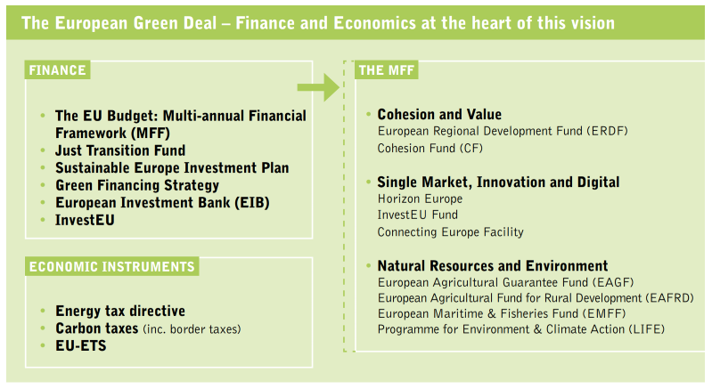
A budget to address the climate crisis, EEB and Heinrich Böll Foundation 2019
Facts and figures
The EU budget needs better oversight and targeting. This perception was backed by 100 NGOs from 22 countries, which were surveyed and consulted by Clean Air Action Group in 2018 and 2019. [1]
The groups gave a mixed review of the EU budget, arguing that while some money helped implement much-needed environmental projects, most were still used to fund the expansion of fossil fuels and other environmentally harmful activities.
They also complained that funding has been riddled with poor governance and corruption in a number of countries. [6] Only a month ago, in the latest scandal linked to EU funding, 94 people were arrested in Italy over the allegedly fraudulent use of EU farm subsidies. The accused were affiliated to mafia clans which carried out several scams to obtain EU funds in the order of €5.5 million, media reported. [7] |