EU
#Montenegro election: Opposition parties eye tiny majority

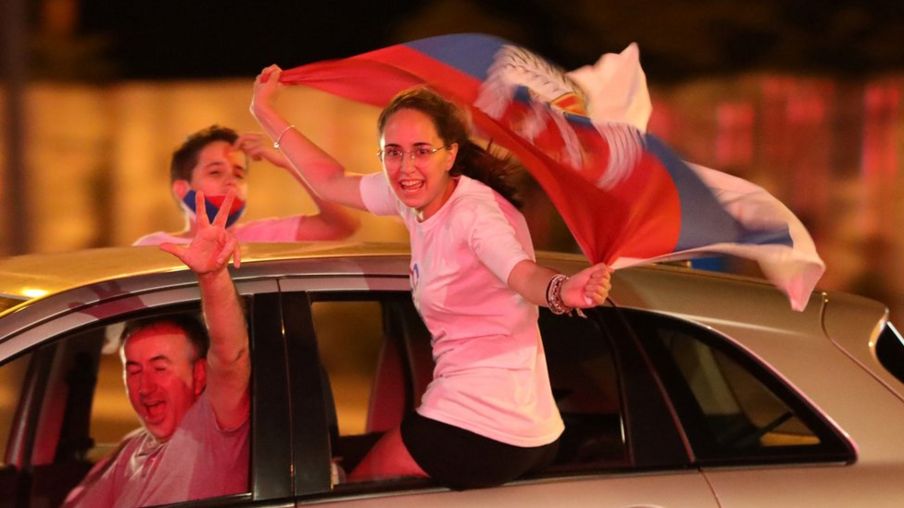 Opposition supporters celebrated in the capital Podgorica
Opposition parties in Montenegro have between them won a wafer-thin majority in the ex-Yugoslav country's election, official results suggest, writes Guy de Launey.
The pro-Western party of long-serving president Milo Djukanovic won most of the vote on Sunday but fell one seat short of a majority.
His Democratic Party of Socialists (DPS) has been in power for 30 years.
With nearly all the votes counted, there is a possibility the opposition could form a technocratic government.
The Democratic Front (DF) is the largest opposition party but its right-wing policies and close relations with Serbia and Russia are not shared by other parties.
President Djukanovic says he and his party will respect the results and the "free democratic will" of Montenegro's people but will wait for the final outcome.
What bolstered the opposition?
With 99.65% of the vote counted, the DPS had won 35.1% while the DF had 32.51%. Peace is Our Nation, an opposition alliance of centrist parties, was in third place with 12.5% and another alliance led by the green United Reform Action party had 5.53%.
Divisions over the powerful Serbian Orthodox Church dominated the campaign.
There have been months of protests since a law was adopted in December allowing the state to seize religious assets when their historical ownership could not be proven.
The Church urged people to vote against the DPS.
What's the background?
Montenegro remained allied in a union with Serbia until 2006 - long after the former Yugoslavia dissolved into independent states.
President Djukanovic, 58, has been in charge since 1990.
In more recent years, he was instrumental in securing Montenegro's accession to Nato in June 2017 and has been leading ongoing efforts to gain membership to the European Union.
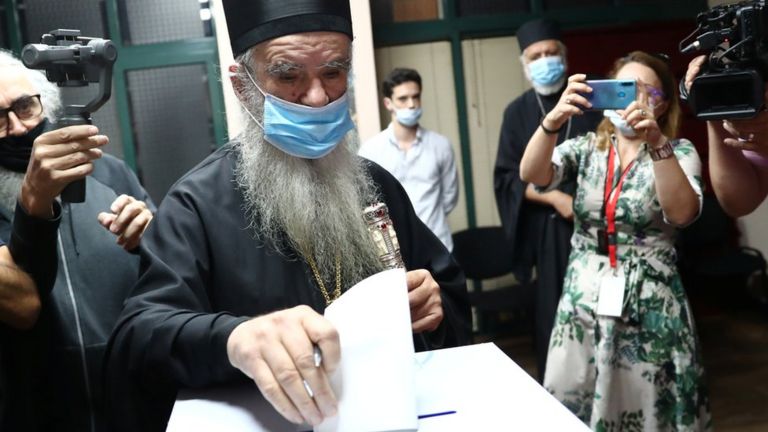 Metropolitan Amfilohije, the Serbian Orthodox Church's top cleric in Montenegro, called on people to vote against the ruling party
Montenegrins who identify as ethnic Serbs account for about a third of the country's 630,000 population, according to the latest census data.
And as the majority of Montenegrins are members of the Church, its influence is considerable.
The opposition has accused Mr Djukanovic and his party of having links to organised crime and running the country as an autocracy.
Mr Djukanovic has denied this and says the opposition, with the backing of Russia and Serbia, is seeking to undermine the country's independence.
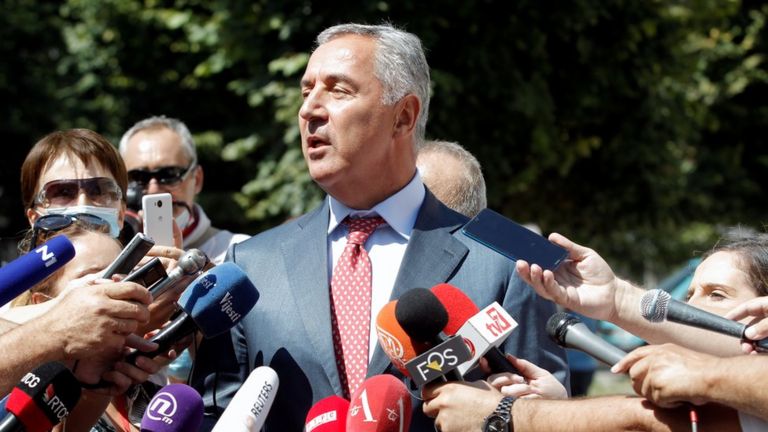 Milo Djukanovic's Democratic Party of Socialists has ruled Montenegro for 30 years
During the previous parliamentary vote in 2016, authorities said they had thwarted a planned coup orchestrated by Russian agents and a group of Serb nationalists.
A court in Montenegro last year handed five-year jail terms to two pro-Russian opposition politicians it found to be involved in the plot.
Russia called the inquiry absurd and Montenegro's opposition called it a "false-flag" operation - a fake act aimed at incriminating an opponent - to keep Mr Djukanovic in power.
Share this article:

EU Reporter publishes articles from a variety of outside sources which express a wide range of viewpoints. The positions taken in these articles are not necessarily those of EU Reporter. Please see EU Reporter’s full Terms and Conditions of publication for more information EU Reporter embraces artificial intelligence as a tool to enhance journalistic quality, efficiency, and accessibility, while maintaining strict human editorial oversight, ethical standards, and transparency in all AI-assisted content. Please see EU Reporter’s full A.I. Policy for more information.





The security environment of the South Caucasus amid changing geopolitical realities
The South Caucasus at a historic turning point: Between lasting peace and renewed confrontation

Commission endorses Latvia’s €617 million Social Climate Plan to support vulnerable households and transport users in the clean transition

Commission sends Statements of Objections to several companies and trade associations in suspected construction chemicals cartel

As Ireland chairs the EU Presidency, what impact has over fifty years of EU membership had on Ireland

Why the US is losing its legitimacy as a global superpower and the trust of the comity of nations

Commission fines AliExpress €550 million for breaching the Digital Services Act

British political shifts and the future of UK-China ties

Europe’s AI crossroads: Regulation and the race to keep up

Freedom holding corp: How Kazakhstan is turning a transit corridor into a global logistics hub

Oil Coordination Group confirms no immediate supply concerns in the EU

EU adopts 21st package of sanctions against Russia

Why Vučić is stepping down

New EU energy rules: Cleaner, more secure energy and stronger consumer protection

France is right to ban social media for children

Belgium's best tourist attraction just got even better

Kazakhstan reforms under scrutiny at Brussels Press Club round table

Japan should face up to history and contribute more to regional peace

Ambassador calls for 'speeding up' of co-operation between EU and Kazakhstan

Timur Turlov at Smart Moves Summit 2025: How chess can transform global education

Shevtsova’s case: Out-of-court sanctions dismantling trust in Ukrainian cause

The future of European transport

Trump Vs Trueman

US 'no longer' an 'unconditional ally' for Europe - MEP
-
 South Caucasus5 days ago
The security environment of the South Caucasus amid changing geopolitical realities
-
South Caucasus4 days ago
The South Caucasus at a historic turning point: Between lasting peace and renewed confrontation
-
 European Commission5 days ago
Commission endorses Latvia’s €617 million Social Climate Plan to support vulnerable households and transport users in the clean transition
-
 European Commission5 days ago
Commission sends Statements of Objections to several companies and trade associations in suspected construction chemicals cartel