Civil liberties
#FreedomReligion: Ex-Commissioner Figel' becomes religious freedom Special Envoy for outside EU


Jan Figel' (left) and Viktor Orban at the EPP summit
Speaking from the Vatican, on the occasion of the award of the Charlemagne Prize to Pope Francis, President Jean-Claude Juncker announced his decision to appoint Slovakian Ján Figel’ as the first special envoy for the promotion of freedom of religion or belief outside the European Union. Figel’ assumes this new role as of today (6 May) for an initial mandate of one year.
Like Juncker, Figel’ is from the EPP (European People's Party). He served briefly in the Prodi Commission when Slovakia first joined the EU. He was later appointed as the European Commissioner for Education and Culture, in the Barroso Commission. He resigned from the Commission in September 2009, just before the end of his mandate, to become the leader of the Christian Democratic Movement in Slovakia before national elections in 2010. Following the elections he became one of five Deputy-Prime Ministers in a complicated coalition that lasted two years.
As part of his mission, Figeľ will present a report ‘in the context of the on-going dialogue between the Commission and churches and religious associations or communities’, which is led by First Vice President Frans Timmermans.
Juncker explains that the initiative is at the request of the European Parliament. Up to now, the Commission has not been noted for taking much account of parliament’s resolutions. The resolution referred to is on ‘the systematic mass murder of religious minorities by the so-called ISIS/Daesh, and does, among other things, call for the EU to establish a permanent ‘Special Representative for Freedom of Religion and Belief’.
Slovakia
Slovakia does not have a great reputation for religious tolerance. In relation to the refugee crisis, the Slovakian government said that it would only accept Christian Syrian refugees under the proposed EU relocation scheme. The Slovakian Interior minister of that time explained that Muslims would not be accepted because ‘they would not feel at home’. The comment prompted the UNHCR to urge countries to take a more inclusive approach.
Following the Paris attacks, the Slovakian Prime Minister announced that it would be monitoring every Muslim. Muslims make up about 0.2% of Slovakia’s population, most of them settled there during the conflict in the former-Yugoslavia.
The views of Figel’ on Muslims living in Slovakia are unknown; it is assumed that he would both defend their rights to build places of worship and to go about their daily lives without assuming that they are under surveillance as potential terrorists. However, he is not known as an outspoken defender of religious freedom in Slovakia. It is not clear why he was chosen for this role, and who the alternative candidates were. Were there no other former commissioners or other candidates suitable for this role?
Share this article:
EU Reporter publishes articles from a variety of outside sources which express a wide range of viewpoints. The positions taken in these articles are not necessarily those of EU Reporter. Please see EU Reporter’s full Terms and Conditions of publication for more information EU Reporter embraces artificial intelligence as a tool to enhance journalistic quality, efficiency, and accessibility, while maintaining strict human editorial oversight, ethical standards, and transparency in all AI-assisted content. Please see EU Reporter’s full A.I. Policy for more information.



EU foreign ministers to discuss options for restricting trade with Israeli communities in Judea and Samaria

Srebrenica's lesson is prevention. Why isn't the world applying It to Kashmir?

European operation dismantles €10 million illicit cigarette network in Spain

AIFC to host Astana Finance Days 2026 in September

ALROSA Re-elects Supervisory Board with Minimal Changes

Joint statement by High Representative/Vice-President Kallas and Commissioner Kos on the 31st anniversary of the Srebrenica genocide

Energy Union Task Force takes stock of oil and gas security of supply in the EU

Commission preliminarily finds the addictive design of Instagram and Facebook in breach of the Digital Services Act

Shared commitment to advance EOSC through new EOSC Nodes and EOSC projects

Why young jobseekers struggle to find roles abroad that fit their expertise

Farmers, fair markets and consumers: new report highlights the role of EU competition rules in agriculture

EU and South Africa kick off intergovernmental dialogue on Clean Trade and Investment Partnership

Seveso - 50 years on: EU strengthens its commitment to industrial safety in a changing landscape of risk

Commission opens formal investigation into possible gun jumping in XXXLutz's acquisition of Porta

EU weighs age-13 limit for 'social media plus'
ALROSA Re-elects Supervisory Board with Minimal Changes

Kazakhstan reforms under scrutiny at Brussels Press Club round table

Japan should face up to history and contribute more to regional peace

Ambassador calls for 'speeding up' of co-operation between EU and Kazakhstan

Timur Turlov at Smart Moves Summit 2025: How chess can transform global education

Shevtsova’s case: Out-of-court sanctions dismantling trust in Ukrainian cause

The future of European transport

Trump Vs Trueman

US 'no longer' an 'unconditional ally' for Europe - MEP
-
 Israel3 days ago
EU foreign ministers to discuss options for restricting trade with Israeli communities in Judea and Samaria
-
 Kashmir2 days ago
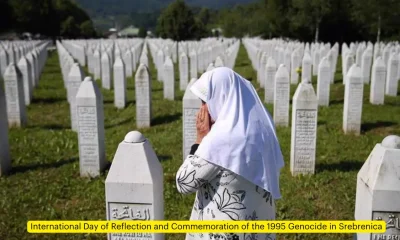
Srebrenica's lesson is prevention. Why isn't the world applying It to Kashmir?
-
 Cigarettes2 days ago
European operation dismantles €10 million illicit cigarette network in Spain
-
 Kazakhstan1 day ago
AIFC to host Astana Finance Days 2026 in September