Russia
EU trade of goods with Russia remains low


EU trade with Russia has been strongly affected by import and export restrictions imposed by the EU following Russia's invasion of Ukraine.
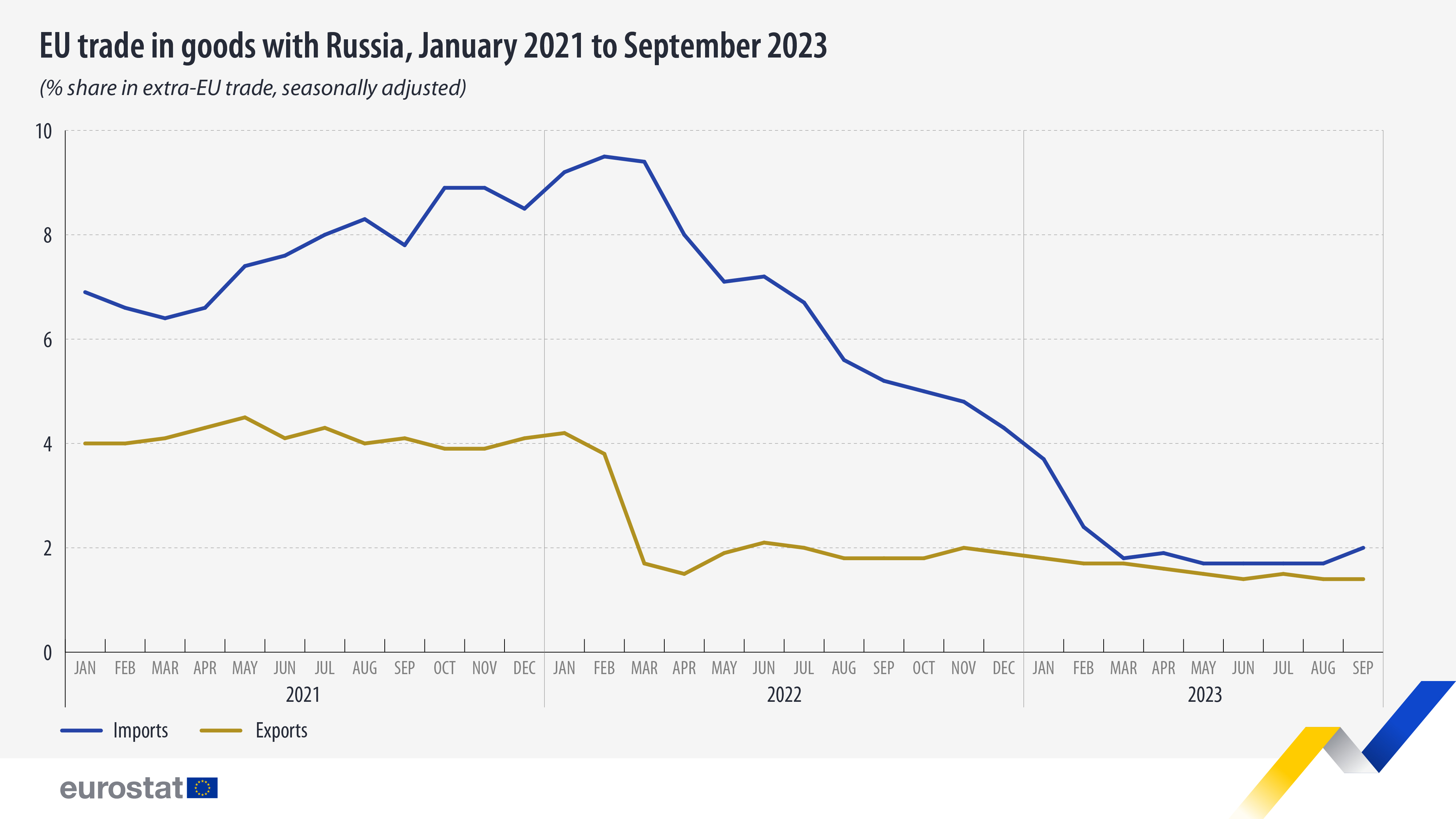
Both exports and imports have dropped considerably below the level prior to the invasion. Seasonally adjusted values show that Russia’s share in extra-EU imports fell from 9.5% in February 2022 to 2.0% in September 2023, while the share of extra-EU exports fell from 3.8 % to 1.4% in the same period.
Source dataset: ext_st_eu27_2020sitc
In March 2022, a peak trade deficit with Russia amounted to €18.6 billion due to high prices of energy products. This deficit was brought down to €0.1bn in March 2023 and did not change much until September 2023 when it amounted to €1bn. This change was heavily influenced by the drop in the monthly value of imports from Russia.
Russia’s share in extra-EU imports has decreased for the majority of key products
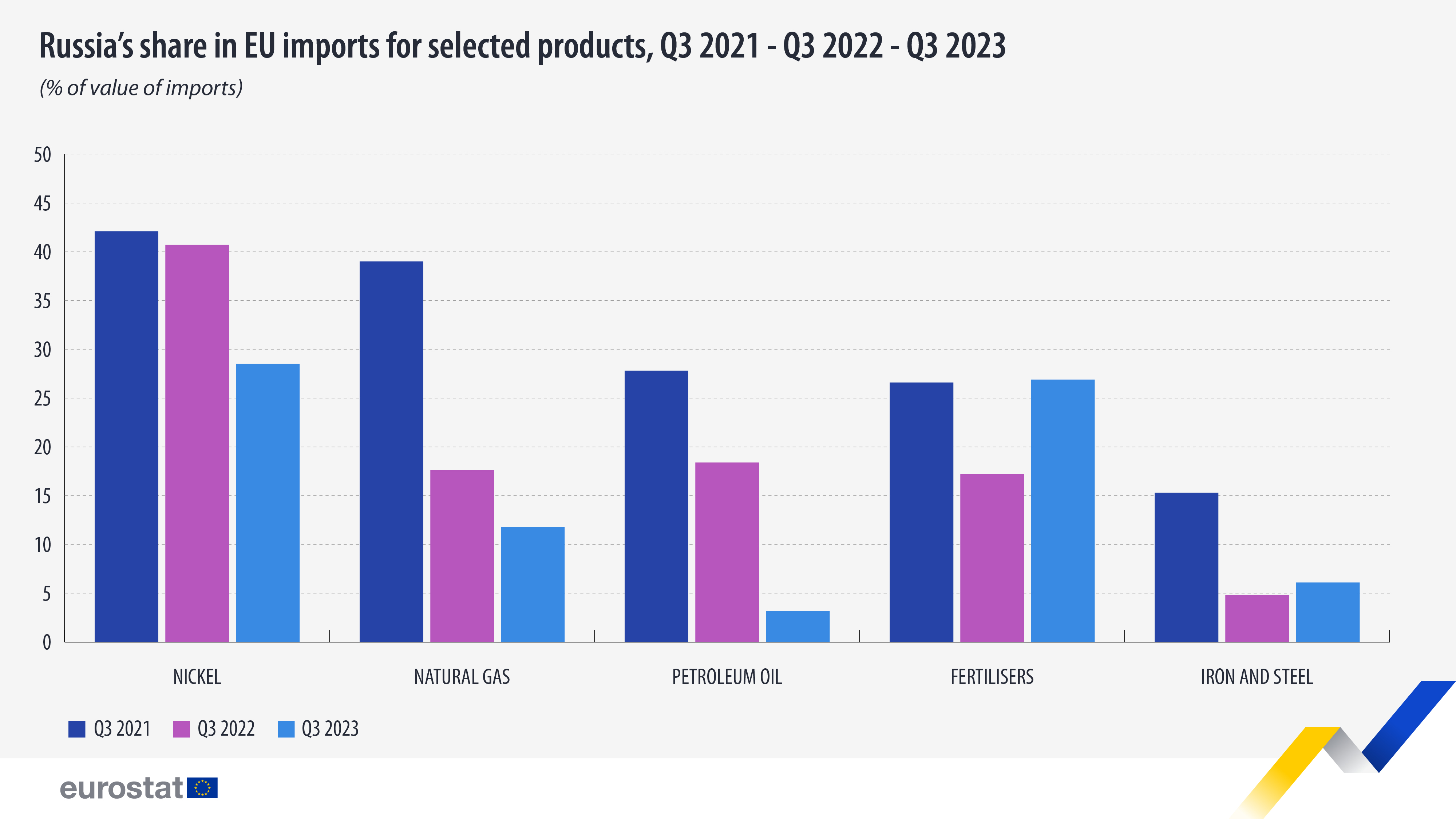
Altogether, natural gas, petroleum oils, nickel, iron and steel and fertilisers account for around two-thirds of total extra-EU imports from Russia.
Between the third quarter of 2021 and the third quarter of 2023, Russia’s share in extra-EU imports of natural gas decreased significantly (-27 percentage points, pp) while the opposite was observed for imports from the United States (+14 pp), Norway (+7.6 pp) and Algeria (+5.5 pp).
A similar phenomenon was observed for extra-EU imports of petroleum oils, with a decrease of Russia's share (-25 pp), while the respective shares of the United States (+7 pp), Norway (+4 pp), and Saudi Arabia (+2 pp) increased.
In the case of nickel imports, the United States expanded their share (+5 pp) while Russia's share declined (-14 pp).
China emerged as the primary supplier for iron and steel (share increasing by 5 pp) following a drop in imports from Russia (share decreasing by 9 pp).
However, trade in fertilisers shows a different pattern. Russia's share in extra-EU imports decreased from 27% in the third quarter of 2021 to 17% in the third quarter of 2022, but bounced back to 27% in the third quarter of 2023.
Source dataset: ds-059322
More information
- Statistics Explained article on EU trade with Russia - latest developments
- Thematic section on international trade in goods
- Database on international trade in goods
Methodological notes
The following Harmonised System (HS) codes were used for selected products:
- HS 75: nickel and articles thereof.
- HS 271111 + 271121: petroleum gases and other gaseous hydrocarbons; liquefied, natural gas and petroleum gases and other gaseous hydrocarbons; in gaseous state, natural gas.
- HS 2709 + 2710: petroleum oils and oils obtained from bituminous minerals; crude and petroleum oils and oils from bituminous minerals, not crude; preparations n.e.c, containing by weight 70% or more of petroleum oils or oils from bituminous minerals; these being the basic constituents of the preparations; waste oils.
- HS 31: fertilizers.
If you have any queries, please visit the contact page.
Share this article:
EU Reporter publishes articles from a variety of outside sources which express a wide range of viewpoints. The positions taken in these articles are not necessarily those of EU Reporter. Please see EU Reporter’s full Terms and Conditions of publication for more information EU Reporter embraces artificial intelligence as a tool to enhance journalistic quality, efficiency, and accessibility, while maintaining strict human editorial oversight, ethical standards, and transparency in all AI-assisted content. Please see EU Reporter’s full A.I. Policy for more information.




Does Europe need tech sovereignty?

Azerbaijan’ s foreign policy as a middle power and its role in promoting regional peace

Kallas responds to Sa’ar: ‘The EU and Israel have a lot that binds us’

Thousands of Iranians from Belgium to join the Free Iran Rally in Paris

Support for EU accession remains high across enlargement partners, latest surveys show

EU-funded technology strengthening Europe’s security

CEF Transport: €1.1 billion available for infrastructure projects across the EU

Philip Morris urges von der Leyen to include tobacco sector in EU competitiveness debate

Trade and economic development in Central Asia 'can boost links between EU and Kazakhstan'

EU and China step up dialogue on biodiversity protection and finance, plastic pollution and global environmental governance

New cultural programme to celebrate Ireland's incoming EU presidency

MEPs warn of women’s health ‘blind spot’

Ending child sexual abuse: EU bans abuse manuals, strengthens prevention and delivers justice for victims

Hitting the right notes...that's Brussels' cathedral summer series

Top airline offers soaraway summer specials

MEPs adopt cardiovascular strategy, prioritising early detection and risk reduction

Kazakhstan reforms under scrutiny at Brussels Press Club round table

Japan should face up to history and contribute more to regional peace

Ambassador calls for 'speeding up' of co-operation between EU and Kazakhstan

Timur Turlov at Smart Moves Summit 2025: How chess can transform global education

Shevtsova’s case: Out-of-court sanctions dismantling trust in Ukrainian cause

The future of European transport

Trump Vs Trueman

US 'no longer' an 'unconditional ally' for Europe - MEP
-
 Digital economy3 days ago
Does Europe need tech sovereignty?
-
 Azerbaijan3 days ago
Azerbaijan’ s foreign policy as a middle power and its role in promoting regional peace
-
 Israel4 days ago
Kallas responds to Sa’ar: ‘The EU and Israel have a lot that binds us’
-
 Iran4 days ago
Thousands of Iranians from Belgium to join the Free Iran Rally in Paris