Kazakhstan
Trade and economic development in Central Asia 'can boost links between EU and Kazakhstan'

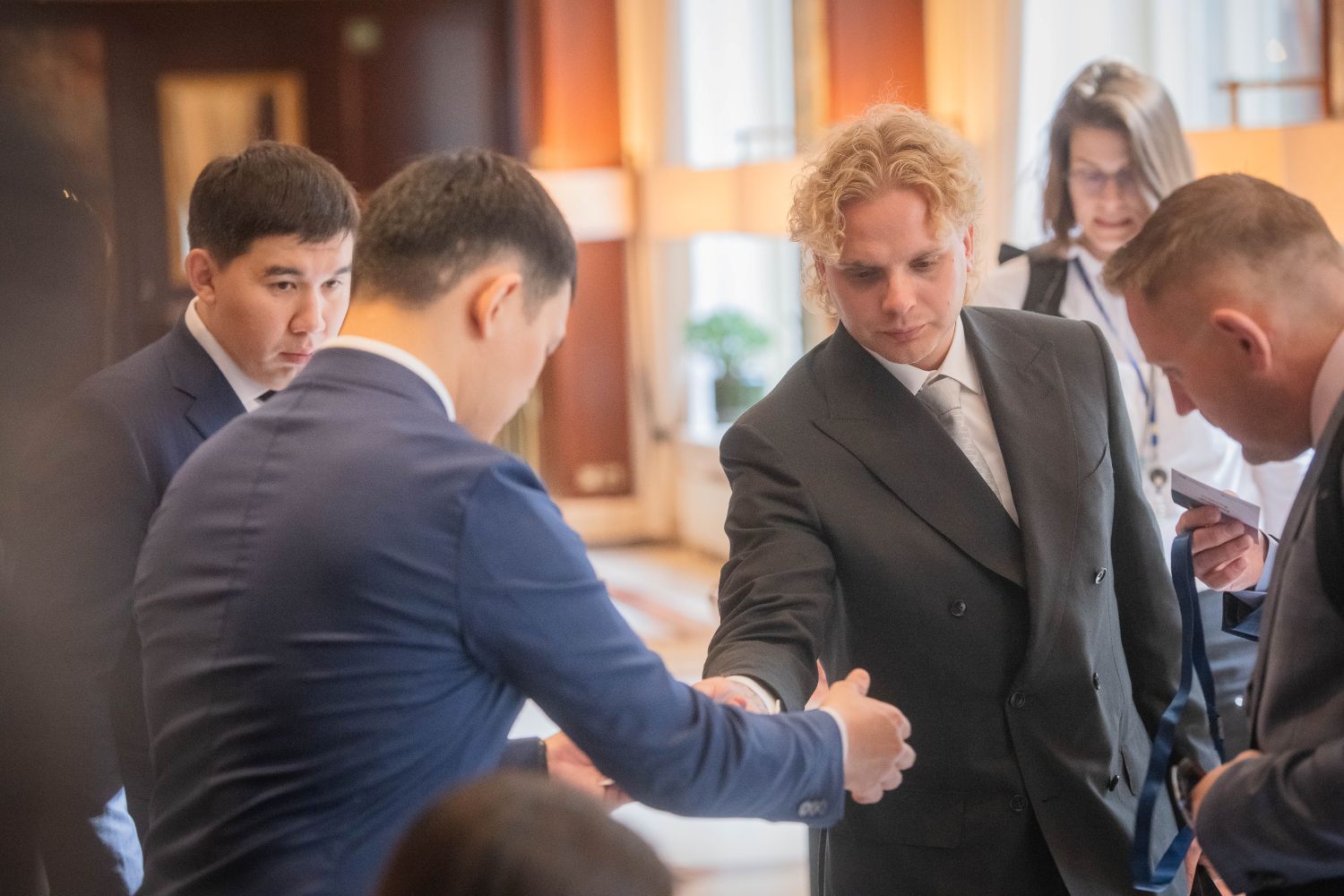
A highly ambitious trade and economic development in Central Asia can help forge ever-closer links between the EU and Kazakhstan.
That was one of the messages to emerge from an international business conference in Brussels.
The event focused on the growing strategic importance of the Middle Corridor.
Kazakhstan plays a central role in the development of the Middle Corridor as a transit, logistics, and investment hub.
The development of the Middle Corridor continues to enhance connectivity between Asia and Europe.
The recent expansion of the Baku–Tbilisi–Kars railway’s annual freight capacity to 5 million tons marks another important step in strengthening regional transport links, boosting trade flows and reinforcing Kazakhstan’s role as a key transit hub along this strategic route.
Kazakhstan, it was said at the event earlier this week, has established itself as a key economic partner for the EU and a gateway to new opportunities across Central Asia.
Commenting, Marat Terterov, founder of Brussels Energy Club, told this site that, at the conference: “Both sides underlined and understated the importance of the Middle Corridor development.”
Particular attention, the event heard, is being paid to integrating the Middle Corridor with the European Union’s Global Gateway initiative, as well as to expanding transport and digital connectivity between Europe and Central Asia.
The Middle Corridor (officially the Trans-Caspian International Transport Route or TITR) is a multimodal trade and transport network connecting Asia and Europe. It spans over 4,250 kilometers of rail and 500 kilometers of sea routes, linking China through Central Asia, the Caspian Sea, the South Caucasus, and Türkiye.
The Global Gateway is a strategy to fund sustainable, high-quality infrastructure projects worldwide. Launched in 2021, the initiative aims to mobilize up to €400 billion in public and private investments by 2027 to narrow the global infrastructure gap while serving as a strategic alternative to China's Belt and Road Initiative.
The conference, entitled “Strengthening Kazakhstan–EU Connectivity: Prospects and Strategic Potential of the Trans-Caspian International Transport Route (TITR)”, was organised by JSC National Company Kazakhstan Temir Zholy, with the support of the Kazakhstan Government and its embassy in Belgium.
It brought together more than 100 high-level participants from Kazakhstan and the EU, including Members of the European Parliament, representatives of the European Commission and senior officials from the Presidential Administration and Kazak Government.
They were joined by the management of JSC National Company Kazakhstan Temir Zholy, representatives of international financial institutions, including the European Bank for Reconstruction and Development and the European Investment Bank, as well as leading transport and logistics companies, cargo owners and industry associations.
Keynote addresses were given by representatives of the Presidential Administration and the Kazak Government, the European Parliament, the management of Kazakhstan Temir Zholy, and senior executives of leading European logistics corporations.
These included DHL Global Forwarding, Alstom, DB Cargo, HHLA International, Rhenus, Hellmann Worldwide Logistics, Ahlers Logistics and A.P. Moller–Maersk.
The one-day conference was held in the context of the official visit of the Kazakhstan President, Kassym-Jomart Tokayev, to Belgium at the invitation of the President of the European Council, Antonio Costa.
The get together, participants were told, served as a “practical continuation" of current high-level strategic dialogue between the two sides.
It was said the partnership between Kazakhstan and EU continues to evolve, moving beyond traditional areas of cooperation and embracing new opportunities for economic growth, innovation and connectivity.
During his visit, the Head of State is scheduled to hold important talks with António Costa, his European Commission counterpart, Ursula von der Leyen, and Belgium PM Bart De Wever.
The discussions, at a city centre hotel on Monday, focused on strategic issues related to the development of the Middle Corridor.
These included increasing the capacity of the TITR, modernising railway, port and terminal infrastructure, digitalising logistics processes, and establishing resilient supply chains across the Eurasian region.
The event was told that the high level of the participating delegations and the conference’s close alignment with the agenda of the President of Kazakhstan’s visit demonstrate the “growing interest” of European institutions, international financial organisations and the business community in the development of the Middle Corridor.
This further reinforces, it was also said, Kazakhstan’s status as a key transit and logistics hub connecting Eurasia with the European Union.
Kazakhstan continues to demonstrate economic resilience despite inflationary pressures and global uncertainty. According to the International Monetary Fund (IMF), the country’s economy is projected to grow by 4.6% in 2026,
Share this article:
EU Reporter publishes articles from a variety of outside sources which express a wide range of viewpoints. The positions taken in these articles are not necessarily those of EU Reporter. Please see EU Reporter’s full Terms and Conditions of publication for more information EU Reporter embraces artificial intelligence as a tool to enhance journalistic quality, efficiency, and accessibility, while maintaining strict human editorial oversight, ethical standards, and transparency in all AI-assisted content. Please see EU Reporter’s full A.I. Policy for more information.






EU foreign ministers to discuss options for restricting trade with Israeli communities in Judea and Samaria

European operation dismantles €10 million illicit cigarette network in Spain

Srebrenica's lesson is prevention. Why isn't the world applying It to Kashmir?

ALROSA Re-elects Supervisory Board with Minimal Changes

AIFC to host Astana Finance Days 2026 in September

Energy Union Task Force takes stock of oil and gas security of supply in the EU

Joint statement by High Representative/Vice-President Kallas and Commissioner Kos on the 31st anniversary of the Srebrenica genocide

EU launches a Team Gaza Initiative to support early recovery in Gaza with an initial amount of nearly €900 million

Britain’s leadership crisis is a symptom, not the disease

Chinese “leadership and coordination”

Shared commitment to advance EOSC through new EOSC Nodes and EOSC projects

Why young jobseekers struggle to find roles abroad that fit their expertise

Farmers, fair markets and consumers: new report highlights the role of EU competition rules in agriculture

EU and South Africa kick off intergovernmental dialogue on Clean Trade and Investment Partnership

Seveso - 50 years on: EU strengthens its commitment to industrial safety in a changing landscape of risk

Commission opens formal investigation into possible gun jumping in XXXLutz's acquisition of Porta

Kazakhstan reforms under scrutiny at Brussels Press Club round table

Japan should face up to history and contribute more to regional peace

Ambassador calls for 'speeding up' of co-operation between EU and Kazakhstan

Timur Turlov at Smart Moves Summit 2025: How chess can transform global education

Shevtsova’s case: Out-of-court sanctions dismantling trust in Ukrainian cause

The future of European transport

Trump Vs Trueman

US 'no longer' an 'unconditional ally' for Europe - MEP
-
 Israel3 days ago
EU foreign ministers to discuss options for restricting trade with Israeli communities in Judea and Samaria
-
 Cigarettes3 days ago
European operation dismantles €10 million illicit cigarette network in Spain
-
 Kashmir3 days ago
Srebrenica's lesson is prevention. Why isn't the world applying It to Kashmir?
-
 Economy1 day ago
ALROSA Re-elects Supervisory Board with Minimal Changes