Environment
Rotary : Another brick in the wall against plastic waste

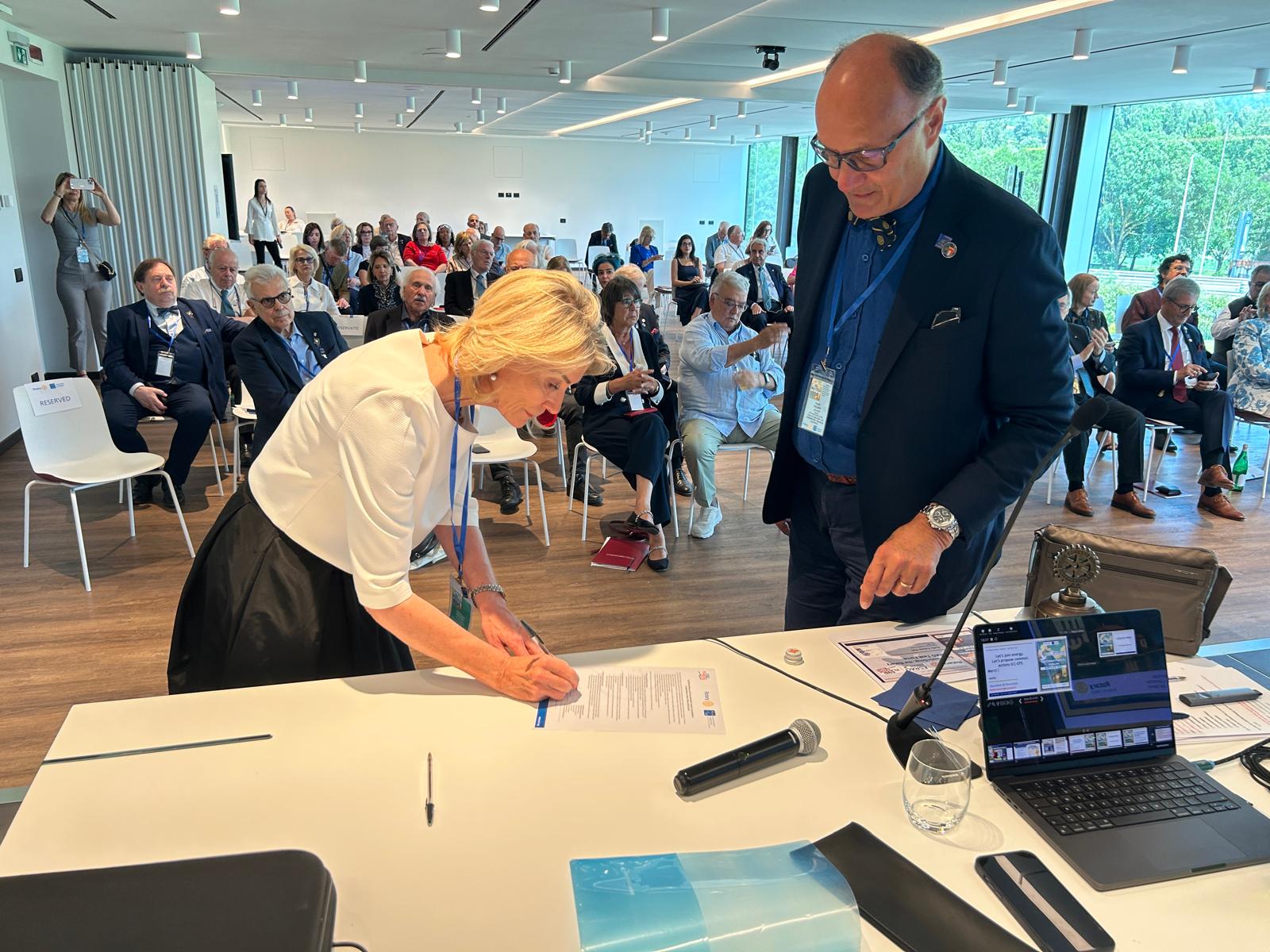
EndPlasticSoup (EPS) and International Country Committees (ICC) renewed their cooperation on plastic waste by signing the Cooperation Action Plan 2026/2028, in Brussels on 28 May 2026, writes Stavros Papagianneas, author of Embracing Chaos (2021), Rebranding Europe (2024) and managing director of STP Communications.
EPS and the ICC Executive Council refer to the Cooperation Agreement signed in London in 2024 to encourage collaboration between the two Rotary networks.
This initiative offers a platform for collaboration to reduce the impacts of plastic pollution on people of all ages, wildlife and the environment on our planet.
The Action Plan was signed by Dr Azelio Fulmini, EPS Director to ICC, and Annemarie Mosterd, President of the ICC Executive Council 2026-2028, as pictured here.
EndPlasticSoup is a global Rotary initiative aiming to eliminate plastic pollution from oceans, rivers, and forests by 2050 through local action, in partnership with its worldwide network of over 60 Alliances.
It addresses the plastic pollution problem through awareness and education, action & projects, and alliances, to reduce, reuse, and recycle across the lifecycle, including improved waste management and reduced single-use plastics and microplastics.
In February 2024, the Rotary Intercountry Committees (ICC) signed a Memorandum of Understanding (MoU) with EndPlasticSoup to mobilise its international network in support of this cause.
Plastic waste is a significant environmental issue, with millions of tons produced annually, causing pollution, harming wildlife, and posing health risks. The EU is actively working to address plastic waste and improve recycling rates. The European Green Deal aims to transform the European Union (EU) into a modern, resource-efficient and competitive economy.
To achieve this goal, the transition from a linear to a circular economy in Europe will require major transformations in the plastics sector, particularly in light of new, ambitious recycling targets (e.g., a 55% recycling rate of plastic packaging waste by 2030, as indicated by the Packaging and Packaging Waste Directive1).
However, of the 32.3 Mt of plastic waste generated in the EU in 2022, only 27 % is estimated to have been recycled after impurities and unsuitable substances were removed from the sorted materials. (Resources, Conservation & Recycling, Volume 215, April 2025)
Developing innovative recycling technologies is therefore key to increasing recycling rates and potentially improving environmental performance compared with existing treatment technologies.
Share this article:

EU Reporter publishes articles from a variety of outside sources which express a wide range of viewpoints. The positions taken in these articles are not necessarily those of EU Reporter. Please see EU Reporter’s full Terms and Conditions of publication for more information EU Reporter embraces artificial intelligence as a tool to enhance journalistic quality, efficiency, and accessibility, while maintaining strict human editorial oversight, ethical standards, and transparency in all AI-assisted content. Please see EU Reporter’s full A.I. Policy for more information.




Is the ‘King of the North’ on course to topple the prime minister of the UK?

Going down a treat - that's Belgian wine

Azerbaijan and the emerging alliance reshaping the Middle East

Does Europe need tech sovereignty?

No democracy without equality!

Hands of our nature, hands off Albania

Azerbaijan’ s foreign policy as a middle power and its role in promoting regional peace

The CIA director’s warning and the illusion of peace with Iran

Lange warns ‘Section 301’ investigation threatens Turnberry trade deal

Brexit has had 'negative' impact, says major new poll

Philip Morris urges von der Leyen to include tobacco sector in EU competitiveness debate

Rotary : Another brick in the wall against plastic waste

Kazakhstan and the European Union: Building the next chapter of a strategic partnership

Support for EU accession remains high across enlargement partners, latest surveys show

EU delivers €34 million in immediate support to Armenia as announced by President von der Leyen

CEF Transport: €1.1 billion available for infrastructure projects across the EU

Kazakhstan reforms under scrutiny at Brussels Press Club round table

Japan should face up to history and contribute more to regional peace

Ambassador calls for 'speeding up' of co-operation between EU and Kazakhstan

Timur Turlov at Smart Moves Summit 2025: How chess can transform global education

Shevtsova’s case: Out-of-court sanctions dismantling trust in Ukrainian cause
The future of European transport

Trump Vs Trueman

US 'no longer' an 'unconditional ally' for Europe - MEP
-
 Nigel Farage5 days ago
Is the ‘King of the North’ on course to topple the prime minister of the UK?
-
 Belgium4 days ago
Going down a treat - that's Belgian wine
-
 Azerbaijan5 days ago
Azerbaijan and the emerging alliance reshaping the Middle East
-
 Digital economy24 hours ago
Does Europe need tech sovereignty?