Cyber-espionage
Terrorism: EU security agenda fails to deliver on expectations says S&D


"The new European Commission strategy to counter-terrorism is a step forward, but it does not go deep enough to address the roots of terrorism and to deliver a comprehensive security agenda," said senior S&D members in Strasbourg, following the 28 April presentation by the European Commission of a new European security agenda.
Last week in Brussels, the S&D Group released its own anti-terrorism strategy, a set of proposals ranging from the issue of foreign fighters to de-radicalization in prisons, from PNR (Passenger Name Records) to cyber security.
S&D vice-president and co-chair of the task force on terrorism, Tanja Fajon MEP, said: "Some of the proposals put forward by the European Commission are in line with the ones outlined in our strategy, but overall they do not go far enough and are not innovative. The European Commission praises several existing policies and the idea that we have to fully implement them while also introducing PNR, revised proposal on Smart Borders and making a strong link to the European Agenda on Migration. From this perspective, we clearly fear that security measures will eventually prevail over fundamental rights.
"Moreover, we were expecting greater emphasis on social challenges such as de-radicalization, rehabilitation in prisons, parental authorization for minors, and development aid to third countries. The EC strategy does not mention at all the need to promote religious tolerance or specific projects to deal with returning youngsters who have been disillusioned by the ISIS."
Voicing his group's disappointment, S&D vice-president and co-chair of the taskforce on terrorism, Knut Fleckenstein MEP, said: "The Commission's strategy paper focuses almost exclusively on the internal dimension of security, it doesn't sufficiently address the need for a better international effort, avoiding the mistakes of previous military interventions. The fight against terrorism can only be promoted at global level, going beyond our usual western allies, especially in those regions where terrorist groups stem from, or terrorists are being trained.
"We need to engage also those leaders, who do not share and promote our values. However, this dialogue must not be focused on counter-terrorism alone, but always go hand in hand with a dialogue on Human Rights and the rule of law.
"Short-term gains from cooperation with dictatorial regimes are counterproductive. The EU could be seen as co-operating with dictators, this serving as a potent recruitment tool for the extremists both in the Muslim countries and in Europe.
"Finally, according to the strategy presented today, 'the Commission will also explore the need for and possible benefits of additional measures in the area of terrorism financing'. This commitment is too vague. We should be more resolute in cutting off financial and arms support to terrorist organisations, engaging countries such as Saudi Arabia and Qatar, from where financial support for terrorist groups is knowingly coming, but also addressing the selling of weapons coming from some EU countries."
Share this article:
EU Reporter publishes articles from a variety of outside sources which express a wide range of viewpoints. The positions taken in these articles are not necessarily those of EU Reporter. Please see EU Reporter’s full Terms and Conditions of publication for more information EU Reporter embraces artificial intelligence as a tool to enhance journalistic quality, efficiency, and accessibility, while maintaining strict human editorial oversight, ethical standards, and transparency in all AI-assisted content. Please see EU Reporter’s full A.I. Policy for more information.



EU foreign ministers to discuss options for restricting trade with Israeli communities in Judea and Samaria

European operation dismantles €10 million illicit cigarette network in Spain

Srebrenica's lesson is prevention. Why isn't the world applying It to Kashmir?

ALROSA Re-elects Supervisory Board with Minimal Changes

AIFC to host Astana Finance Days 2026 in September

Energy Union Task Force takes stock of oil and gas security of supply in the EU

Joint statement by High Representative/Vice-President Kallas and Commissioner Kos on the 31st anniversary of the Srebrenica genocide

EU launches a Team Gaza Initiative to support early recovery in Gaza with an initial amount of nearly €900 million

Britain’s leadership crisis is a symptom, not the disease

Chinese “leadership and coordination”

Shared commitment to advance EOSC through new EOSC Nodes and EOSC projects

Why young jobseekers struggle to find roles abroad that fit their expertise

Farmers, fair markets and consumers: new report highlights the role of EU competition rules in agriculture

EU and South Africa kick off intergovernmental dialogue on Clean Trade and Investment Partnership

Seveso - 50 years on: EU strengthens its commitment to industrial safety in a changing landscape of risk

Commission opens formal investigation into possible gun jumping in XXXLutz's acquisition of Porta

Kazakhstan reforms under scrutiny at Brussels Press Club round table

Japan should face up to history and contribute more to regional peace

Ambassador calls for 'speeding up' of co-operation between EU and Kazakhstan

Timur Turlov at Smart Moves Summit 2025: How chess can transform global education

Shevtsova’s case: Out-of-court sanctions dismantling trust in Ukrainian cause

The future of European transport

Trump Vs Trueman

US 'no longer' an 'unconditional ally' for Europe - MEP
-
 Israel3 days ago
EU foreign ministers to discuss options for restricting trade with Israeli communities in Judea and Samaria
-
 Cigarettes3 days ago
European operation dismantles €10 million illicit cigarette network in Spain
-
 Kashmir3 days ago
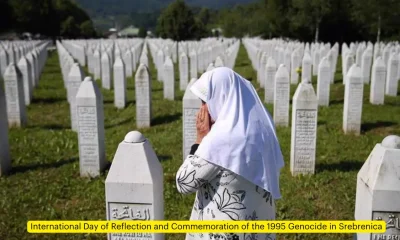
Srebrenica's lesson is prevention. Why isn't the world applying It to Kashmir?
-
 Economy1 day ago
ALROSA Re-elects Supervisory Board with Minimal Changes