Economy
European Commission welcomes provisional agreement on EU road charging rules


The European Commission welcomed the 16 June provisional agreement between the co-legislators on new road charging rules (Eurovignette Directive). The revised rules introduce CO2 emission-based tolling for heavy-duty vehicles across the EU, a key pillar of the EU's commitment to reaching climate neutrality by 2050 and its Sustainable and Smart Mobility Strategy.
Transport Commissioner Adina Vălean said: “Alongside emission standards, digitalization and alternative fuels, road charging will help us reduce emissions from transport. This agreement is an important step in that direction and it clearly demonstrates that the EU is serious about putting the ‘polluter pays' principle into practice.”
The current rules cover lorries over 3.5 tonnes. The provisional agreement extends the scope to all heavy and light vehicles and foresees more proportionate road charges for cars, too. Future charges for lorries and buses will address CO2, as well as pollutant emissions, and the revised Directive will also introduce the option to charge for congestion and charge more for travel in sensitive areas, with revenues from those additional charges used for the benefit of sustainable transport. The Commission tabled its proposal for the revised Eurovignette Directive on 31 May 2017. Once the provisional agreement is formally approved by Parliament and Council, the Directive will enter into force on the 20th day after its publication.
Share this article:
EU Reporter publishes articles from a variety of outside sources which express a wide range of viewpoints. The positions taken in these articles are not necessarily those of EU Reporter. Please see EU Reporter’s full Terms and Conditions of publication for more information EU Reporter embraces artificial intelligence as a tool to enhance journalistic quality, efficiency, and accessibility, while maintaining strict human editorial oversight, ethical standards, and transparency in all AI-assisted content. Please see EU Reporter’s full A.I. Policy for more information.



Study: Europe's defense runs on American servers

Commission proposes five joint defence projects to strengthen Europe's industrial capabilities

Can digital sovereignty survive an open trading system?

Commissioner Šuica travels to Cairo to strengthen euro-mediterranean parliamentary cooperation and youth engagement

Friedman Institute and Trends Group at the Italian parliament: Countering the Muslim brotherhood

Can the EU resist US pressure on medicine prices?

From a remote island to shelves around the world: The story of Azorean canned fish

Commission seeks feedback on targeted amendment of EMFAF

Safer cars, safer roads: New rules take effect

Survey of city economic experts: Cities are driving Draghi’s competitiveness agenda, but need EU recognition to scale action

Europe's Cloud moment: The DMA must now deliver

EU-Mexico: While others build walls, Europe builds bridges

New EU strategy must help farmers move toward a more humane food system

Kashmir's 9,765 missing women and girls demand international attention

Quarterly reports show a surge in solar energy and e-vehicles, with record highs in 2025

EU deploys wildfire support to face multiple fires across Portugal and France

Kazakhstan reforms under scrutiny at Brussels Press Club round table

Japan should face up to history and contribute more to regional peace

Ambassador calls for 'speeding up' of co-operation between EU and Kazakhstan

Timur Turlov at Smart Moves Summit 2025: How chess can transform global education

Shevtsova’s case: Out-of-court sanctions dismantling trust in Ukrainian cause

The future of European transport

Trump Vs Trueman

US 'no longer' an 'unconditional ally' for Europe - MEP
-
 Defence4 days ago
Study: Europe's defense runs on American servers
-
 Industry4 days ago
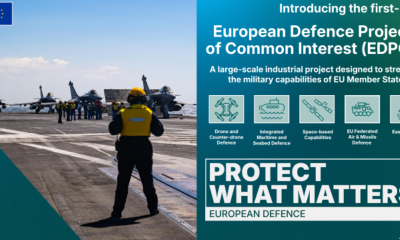
Commission proposes five joint defence projects to strengthen Europe's industrial capabilities
-
 Digital economy3 days ago
Can digital sovereignty survive an open trading system?
-
 Egypt4 days ago
Commissioner Šuica travels to Cairo to strengthen euro-mediterranean parliamentary cooperation and youth engagement