Agriculture
EU’s agricultural labour productivity down by 7% in 2023


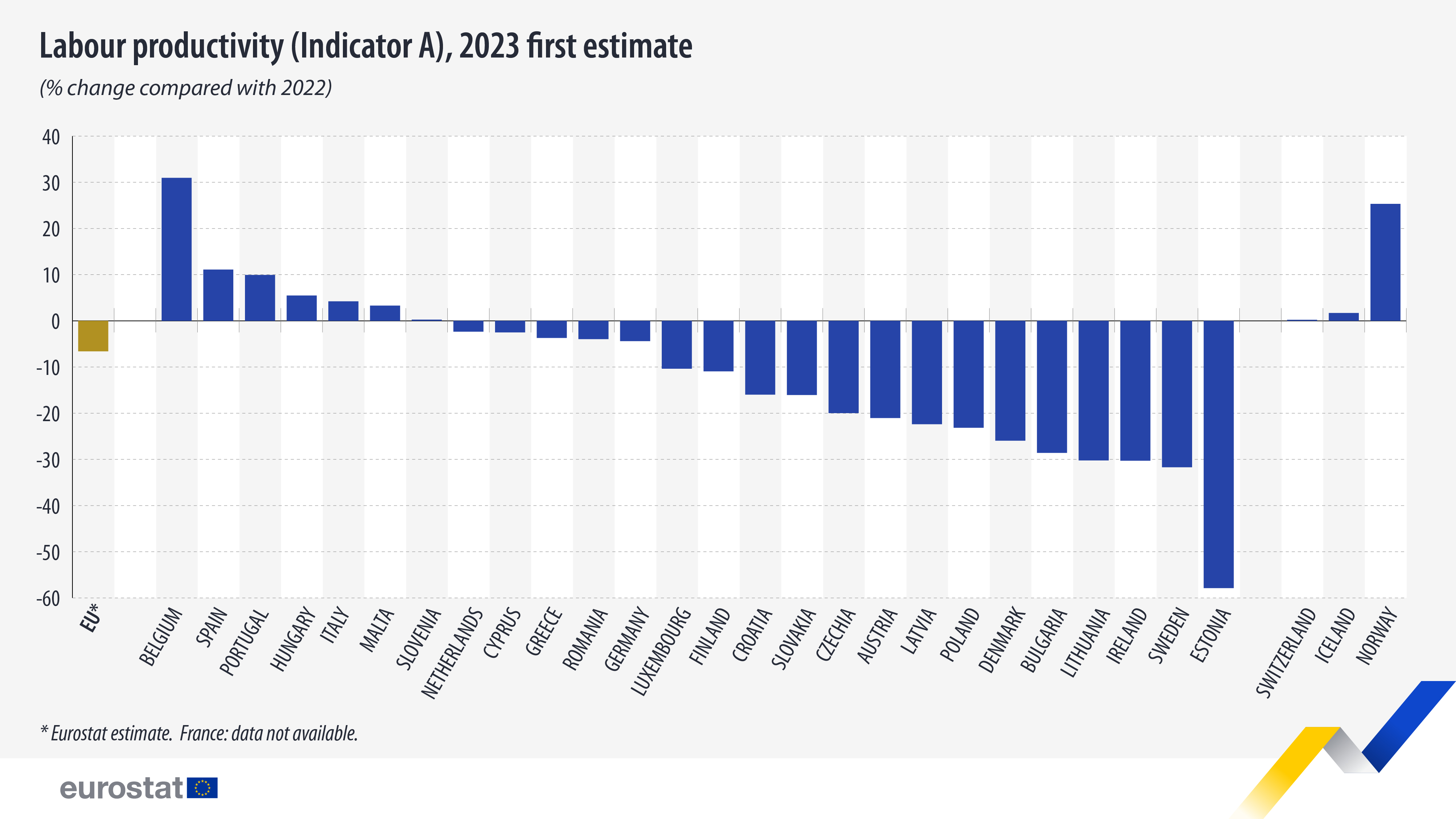
According to the first preliminary data for 2023 from the economic accounts for agriculture (EAA), the index of agricultural labour productivity in the EU is estimated to have decreased year-on-year by 6.6%, after growth between 2019 and 2022. This downturn was underpinned by a 7.9% decrease in the real value of the income generated by units engaged in agricultural production activities (factor income) and a further reduction (-1.4%) in the volume of agricultural labour (as measured by annual work units, representing full-time labour equivalents).
This information comes from data on agriculture published by Eurostat today.
Most EU countries (19) registered lower agricultural labour productivity in 2023 (as measured by the index of the real income of factors in agriculture per annual work unit). The steepest rates of decline were for Estonia (-57.9%), Sweden (-31.7%), Ireland (-30.3%), Lithuania (-30.2%) and Bulgaria (-28.6%).
Nevertheless, there were higher levels in 7 EU countries; the sharpest rate of increase was in Belgium (+31.0%), followed by Spain (+11.1%), Portugal (+9.9%), Hungary (+5.5%), Italy (+4.2%), Malta (+3.3%) and Slovenia (+0.3%). These increases were due to lower prices of fertilisers and input and higher prices of products in which these countries are specialised, such as olive oil, potatoes or swine.
Source dataset: aact_eaa06
The gross value added by the EU's agricultural industry, which is the difference between the value of agricultural output and the costs of the services and goods used in the production process (intermediate consumption), held relatively steady (+0.9%) in 2023 after a sharp rise (+15.1%) in 2022. In turn, this reflected prices that remained relatively unchanged after strong growth in 2021 and 2022, both for output (+0.5%) and intermediate consumption (-0.9%), as well as volumes that were down only slightly for output (-1.0%) and intermediate consumption (-0.6%).
EU agricultural labour productivity 35% higher in 2023 than in 2015
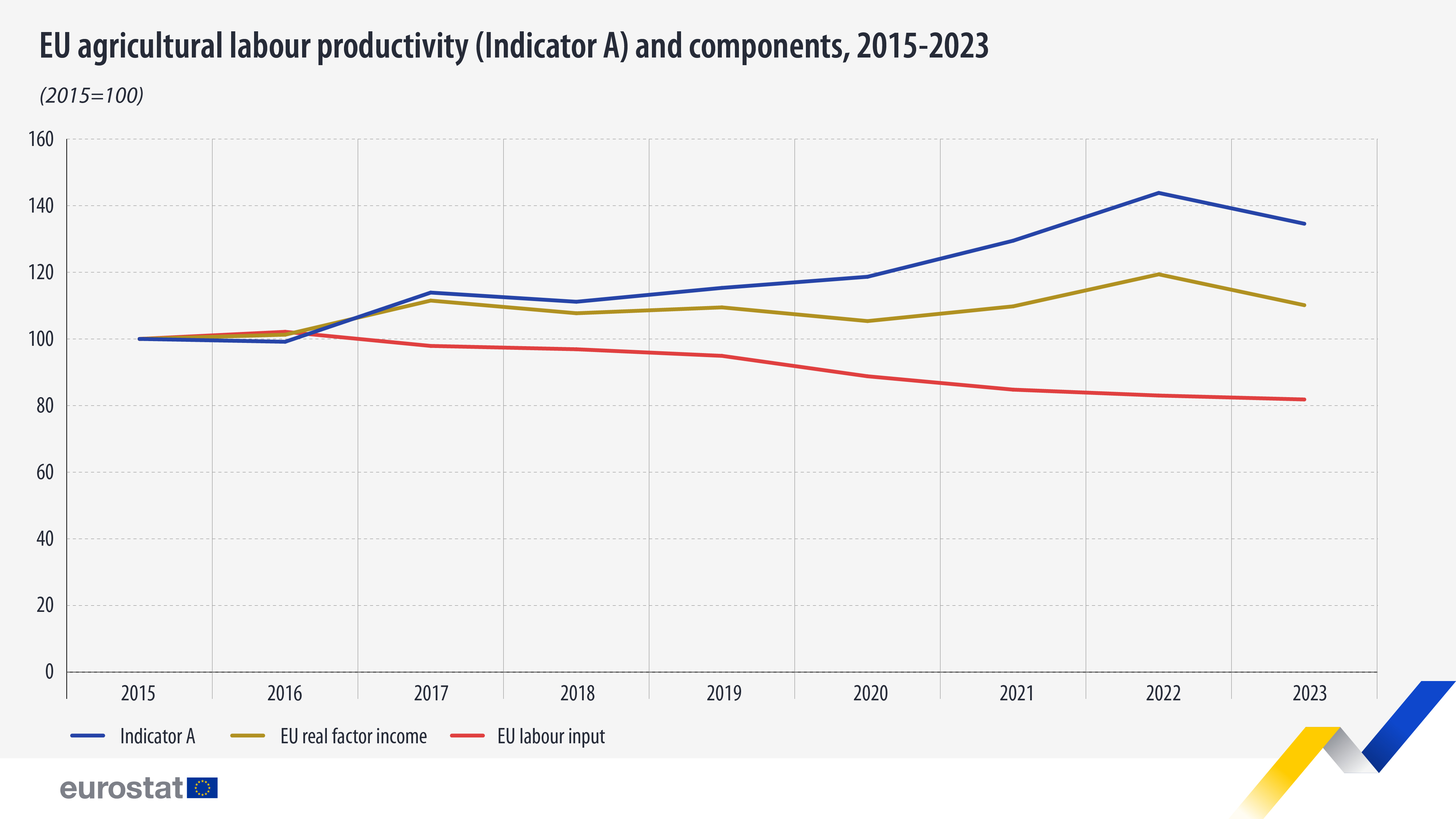
Despite the downturn in 2023, the index level of EU real factor income in 2023 remained 10.1% higher than in 2015. This income was nominally shared among a much smaller amount of labour; the index of agricultural labour input declined by 18.2% over the same period. Together, these changes resulted in EU agricultural labour productivity (Indicator A) being 34.6% higher in 2023 than in 2015, despite the estimated downturn in 2023.
Source datasets: aact_eaa05, aact_eaa06 and aact_ali02
More information
- Thematic section of agriculture statistics
- Database of agriculture statistics
- Key figures on the European food chain - 2023 edition
Methodological notes
- All data are estimates. EU aggregates in this News Item are Eurostat estimates made for the purpose of this publication. Data are unavailable for France.
- These first estimates of the EAA are compiled from the partial information available. The data for the 2023 EAA will be revised and published on 15 May 2024.
- The labour productivity of the agricultural industry can be measured as factor income expressed per full-time labour equivalent. This measures the remuneration of all factors of production (land, capital, labour) by the equivalent of each full-time worker in the agricultural industry, presented in real terms (adjusted for inflation) and expressed as an index.
- Agricultural labour productivity should not be confused with the total income of farming households or the income of a person working in agriculture.
Share this article:
EU Reporter publishes articles from a variety of outside sources which express a wide range of viewpoints. The positions taken in these articles are not necessarily those of EU Reporter. Please see EU Reporter’s full Terms and Conditions of publication for more information EU Reporter embraces artificial intelligence as a tool to enhance journalistic quality, efficiency, and accessibility, while maintaining strict human editorial oversight, ethical standards, and transparency in all AI-assisted content. Please see EU Reporter’s full A.I. Policy for more information.




EU foreign ministers to discuss options for restricting trade with Israeli communities in Judea and Samaria

European operation dismantles €10 million illicit cigarette network in Spain

Srebrenica's lesson is prevention. Why isn't the world applying It to Kashmir?

AIFC to host Astana Finance Days 2026 in September

Energy Union Task Force takes stock of oil and gas security of supply in the EU

ALROSA Re-elects Supervisory Board with Minimal Changes

Joint statement by High Representative/Vice-President Kallas and Commissioner Kos on the 31st anniversary of the Srebrenica genocide

EU clarifies rules to allow continued waste recovery shipments to Switzerland

Natura 2000 Network offers opportunities for sustainable tourism across Europe

Commission adds exemptions to rules on removability of portable batteries

EU steps up international support for Palestinians with major initiative for Gaza's early recovery and stronger international coordination

Kurmuk gold project highlights Africa’s changing investment landscape

Falling in love with the Maldives

Britain’s leadership crisis is a symptom, not the disease

Chinese “leadership and coordination”

Shared commitment to advance EOSC through new EOSC Nodes and EOSC projects

Kazakhstan reforms under scrutiny at Brussels Press Club round table

Japan should face up to history and contribute more to regional peace

Ambassador calls for 'speeding up' of co-operation between EU and Kazakhstan

Timur Turlov at Smart Moves Summit 2025: How chess can transform global education

Shevtsova’s case: Out-of-court sanctions dismantling trust in Ukrainian cause

The future of European transport

Trump Vs Trueman

US 'no longer' an 'unconditional ally' for Europe - MEP
-
 Israel4 days ago
EU foreign ministers to discuss options for restricting trade with Israeli communities in Judea and Samaria
-
 Cigarettes3 days ago
European operation dismantles €10 million illicit cigarette network in Spain
-
 Kashmir3 days ago
Srebrenica's lesson is prevention. Why isn't the world applying It to Kashmir?
-
 Kazakhstan2 days ago
AIFC to host Astana Finance Days 2026 in September