European Parliament
Indian lawyer Harsh Patel joins top EU and Indian policymakers at European Parliament to discuss trade, tax, and global partnership


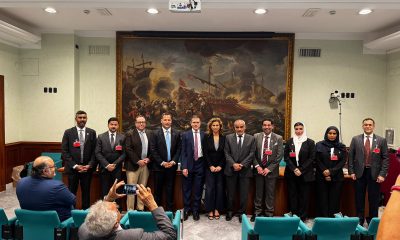
Brussels, 5 November 2025 — The European Parliament this week hosted the EU–India Leaders Conference, bringing together senior policymakers, diplomats, and business leaders to strengthen strategic and economic relations between the European Union and India.
Among the distinguished speakers were H.E. Angelika Niebler, Chair of the Delegation for Relations with India; H.E. Vladimir Prebilic, Member of the European Parliament; Mr. Sujit Nair, Chairman of the Europe India Centre for Business & Industry (EICBI); Mr. John Alistair Clarke, former Director of International Affairs at the European Commission and former Head of the EU Delegation to the WTO and UN; and Dr. Werner Steinhögl, Head of Sector, DG CNECT C3, European Commission.
Representing India’s new generation of thought leaders, Advocate CA. Harsh Patel, Founder & Global CEO of Water & Shark, delivered a compelling address that blended legal insight with pragmatic diplomacy — earning attention from both European and Indian delegates for his clarity and foresight.
Beyond trade: Structure as the foundation of partnership

Speaking on “Tax and Legal Architecture for EU–India Trade Expansion,” Patel emphasized that trade discussions between India and the EU must evolve beyond tariffs and market access.
“As we deepen the EU–India trade relationship, the conversation must move beyond tariffs and market access — toward architecture and alignment,” he said. “For businesses and families operating between India and Europe, success will depend on how early and how intelligently they structure their operations, wealth, and governance. The absence of structure often costs more than the absence of opportunity.”
He argued that the EU–India corridor should not be viewed solely through the lens of free trade, but through institutional cooperation — creating predictable tax, legal, and regulatory frameworks that allow entrepreneurs, family offices, and enterprises to operate across borders with clarity and continuity.
“If trade is the engine of growth,” Patel concluded, “legal and tax architecture is the steering wheel. Without it, we move — but not necessarily forward.”
SMEs at the core of the EU–India growth story

During the panel discussion on SME Participation in EU–India Trade, Patel highlighted that while both India and Europe recognize the potential of small and medium enterprises, regulatory complexity remains their biggest obstacle.
“SMEs are the backbone of both India and Europe — yet most are held back not by opportunity, but by complexity,” he noted. “We must simplify governance before we liberalize trade.”
He called for the creation of a unified digital compliance window, predictable taxation frameworks, and mutual recognition of standards — measures that would democratize bilateral trade and make it more inclusive.
“The goal should be to build a corridor where an Indian SME can operate in Europe as seamlessly as a European SME can invest in India,” he added. “Structure must precede strategy — because legal and tax predictability is what turns entrepreneurs into exporters.”
A broader vision of partnership
Echoing Patel’s sentiments, both MEP Angelika Niebler and Vladimir Prebilic stressed that the future of the EU–India relationship goes far beyond the conclusion of a Free Trade Agreement.
They underlined the importance of a values-based partnership grounded in mutual respect, culture, and human connection.
“Europe and India are not just trading partners; we are strategic partners in democracy, technology, and people,” said Niebler, reinforcing the message that cooperation must be sustainable and inclusive.
About the speaker

Harsh Patel is an internationally recognized lawyer, chartered accountant, and entrepreneur, known for his expertise in global tax, wealth structuring, and cross-border law.
He leads Water & Shark, a multi-jurisdictional legal and advisory network operating in over 12 countries, and advises royal family offices, global founders, and multinational groups on tax, governance, and regulatory frameworks.
Harsh Patel’s social media profiles:
Facebook: https://www.facebook.com/Harshp.LawyerCA/
Instagram: https://www.instagram.com/harshpatel_lawyerca/
LinkedIn: https://en.wikipedia.org/wiki/Harsh_Patel
A step toward structured globalization
As the conference concluded, participants agreed that the EU–India dialogue must continue to focus not just on policy outcomes, but on institutional alignment and mutual understanding.
Patel’s intervention highlighted how structure, governance, and foresight form the backbone of long-term prosperity — a message that resonated strongly among both European policymakers and Indian entrepreneurs.
“In diplomacy, as in business,” Patel remarked, “trust is built not just by what we trade, but by how we structure it.”
Share this article:

EU Reporter publishes articles from a variety of outside sources which express a wide range of viewpoints. The positions taken in these articles are not necessarily those of EU Reporter. Please see EU Reporter’s full Terms and Conditions of publication for more information EU Reporter embraces artificial intelligence as a tool to enhance journalistic quality, efficiency, and accessibility, while maintaining strict human editorial oversight, ethical standards, and transparency in all AI-assisted content. Please see EU Reporter’s full A.I. Policy for more information.




Can digital sovereignty survive an open trading system?

Friedman Institute and Trends Group at the Italian parliament: Countering the Muslim brotherhood

From a remote island to shelves around the world: The story of Azorean canned fish

Can the EU resist US pressure on medicine prices?

EU deploys wildfire support to face multiple fires across Portugal and France

Europe’s job market is shifting, and EURES is ready to lead the way into 2030

EU agricultural markets remain robust despite uncertainties and rising input costs

Commission report highlights achievements of EU rules on animal health

EU foreign ministers to discuss options for restricting trade with Israeli communities in Judea and Samaria

Safer cars, safer roads: New rules take effect

Survey of city economic experts: Cities are driving Draghi’s competitiveness agenda, but need EU recognition to scale action

Europe's Cloud moment: The DMA must now deliver

EU-Mexico: While others build walls, Europe builds bridges

New EU strategy must help farmers move toward a more humane food system

Kashmir's 9,765 missing women and girls demand international attention

Quarterly reports show a surge in solar energy and e-vehicles, with record highs in 2025

Kazakhstan reforms under scrutiny at Brussels Press Club round table

Japan should face up to history and contribute more to regional peace

Ambassador calls for 'speeding up' of co-operation between EU and Kazakhstan

Timur Turlov at Smart Moves Summit 2025: How chess can transform global education

Shevtsova’s case: Out-of-court sanctions dismantling trust in Ukrainian cause

The future of European transport

Trump Vs Trueman

US 'no longer' an 'unconditional ally' for Europe - MEP
-
 Digital economy4 days ago
Can digital sovereignty survive an open trading system?
-
 Islam4 days ago
Friedman Institute and Trends Group at the Italian parliament: Countering the Muslim brotherhood
-
 Maritime4 days ago
From a remote island to shelves around the world: The story of Azorean canned fish
-
 Health5 days ago
Can the EU resist US pressure on medicine prices?