Committee of the Regions (CoR)
Committee of the Regions supports fight against misuse of European Aid


During its 105th plenary session the Committee of the Regions (CoR) adopted an opinion on the European Commission’s proposal to establish a European Public Prosecutor's Office (EPPO). The CoR gives strong support to the initiative as regions and cities are directly affected by cross-border fraud and the CoR therefore stresses the importance of protecting regions against economic damage.
The EPPO should make sure that every case involving suspected fraud against the EU's financial interests is followed up and brought to justice according to similar standards. The Lisbon Treaty has created the legal basis for the European Commission to propose the creation of a European level public prosecutor.
As rapporteur for the CoR opinion, Minister of Justice of the Free State of Thuringia Holger Poppenhäger (DE/PES) stressed that the establishment of an EPPO provides significant added value for regions and cities. In many cases fraud is committed in the use of structural funds; this money is directly lost for local and regional authorities and citizens.
Poppenhäger recommends that each member state has at least one national or regional member at the seat of the EPPO to profit from linguistic and legal expertise during investigations. The positive impact of fighting cross-border offences against the financial interests of the European Union will be greater if all member states take part.
The proposed regulation would now have to be adopted unanimously by the member states in the Council. Given that some member states have opt-outs from co-operation in justice matters, and some others have expressed reservations about the proposal, it is unlikely that unanimity can be reached. The European Commission may therefore consider to advance the proposal under the 'enhanced co-operation' method.
In this regard the CoR further stresses that an enhanced cooperation could raise the costs for all member states as existing structures – such as the European Anti-Fraud Office or Eurojust – would need to be preserved in parallel to the EPPO being set up. The CoR stresses that the powers of EPPO must be linked with clear fundamental rights' guarantees for those accused of crimes and that the EPPO`s powers to transfer data and information should be appropriately regulated, making sure there is an appropriate level of data protection as guaranteed by EU and national law.
As the 'Yellow Card' mechanism of the Lisbon treaty has been used by a number of national parliaments to raise their concerns about the subsidiarity implications of the proposal, it will be important to ensure that the CoR can play its role in this intensified dialogue about subsidiarity. The CoR expects the EC to analyse the points of concern and states its desire to comment on further developments at the appropriate time.
Background
The Commission's proposal triggered many reactions. National parliaments of 14 member states expressed their critical concerns, 11 of which formally submitted a reasoned opinion, objecting that the proposal does not respect the principle of subsidiarity. By using the Early Warning System laid down in the Lisbon treaty these national parliaments issued a so-called Yellow Card against the EPPO proposal. In its reaction to the Yellow Card, the Commission stated that it will maintain its proposal but will take due account of the national parliaments' reasoned opinions during the legislative process.
Share this article:
EU Reporter publishes articles from a variety of outside sources which express a wide range of viewpoints. The positions taken in these articles are not necessarily those of EU Reporter. Please see EU Reporter’s full Terms and Conditions of publication for more information EU Reporter embraces artificial intelligence as a tool to enhance journalistic quality, efficiency, and accessibility, while maintaining strict human editorial oversight, ethical standards, and transparency in all AI-assisted content. Please see EU Reporter’s full A.I. Policy for more information.



Russia’s Gulf pivot: How Oman Is emerging as a strategic partner for Moscow’s post-sanctions economy

Security realignment inevitable in Middle East after Netanyahu-Trump's war

'Ukraine does not need investment out of sympathy': Seyar Kurshutov on the rational case for early entry

The Third International Maqom Art Forum and the New Uzbekistan

Better enforcement of passenger rights: New EU agreement strengthens protection across all modes of transport

Shen Yun - The Abuses and Human Rights Violations

EU deploys emergency assistance to Venezuela following earthquakes

Dismantling 'high walls' for a shared European-Asian future

Region Trade Bank strengthens international governance as Iraq's banking sector deepens global engagement

Commissioner Brunner participates in youth policy dialogue in Austria

Executive Vice President Virkkunen presents awards to projects boosting digital skills

High Representative Kallas with Commissioners Kos and Brunner in Türkiye to advance bilateral cooperation

President von der Leyen travels to Azerbaijan and Armenia

Commission approves new geographical indication from Slovakia

EU delivers emergency aid and organises a humanitarian flight in response to earthquakes in Venezuela

What the latest data reveals about labour market imbalances across Europe

Kazakhstan reforms under scrutiny at Brussels Press Club round table

Japan should face up to history and contribute more to regional peace

Ambassador calls for 'speeding up' of co-operation between EU and Kazakhstan

Timur Turlov at Smart Moves Summit 2025: How chess can transform global education

Shevtsova’s case: Out-of-court sanctions dismantling trust in Ukrainian cause

The future of European transport

Trump Vs Trueman

US 'no longer' an 'unconditional ally' for Europe - MEP
-
 Oman5 days ago
Russia’s Gulf pivot: How Oman Is emerging as a strategic partner for Moscow’s post-sanctions economy
-
 Middle East3 days ago
Security realignment inevitable in Middle East after Netanyahu-Trump's war
-
 Ukraine4 days ago
'Ukraine does not need investment out of sympathy': Seyar Kurshutov on the rational case for early entry
-
 Uzbekistan3 days ago
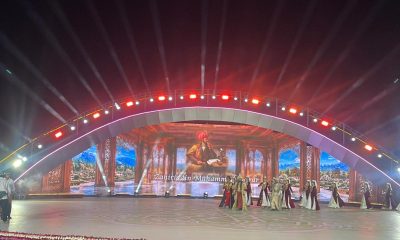
The Third International Maqom Art Forum and the New Uzbekistan