Committee of the Regions (CoR)
Charter for Multilevel Governance in Europe opens for signature


On the occasion of Europe Day on 9 May, the EU's Committee of the Regions (CoR) is calling all local and regional authorities to sign up to the 'Charter for Multilevel Governance in Europe'.
With the European elections on 23-25 May, the CoR urges all levels of government to use "multilevel governance" as a guiding principle in policy design, helping to learn from each other, share best practices and further develop participatory democracy. The Charter is available online and is open for electronic signature by cities and regions here.
What is the Charter for Multilevel Governance?
Adopted by the CoR on 3 April 214 and supported by the Congress of Local and Regional Authorities of the Council of Europe, the Charter is a political manifesto from European cities and regions inviting all public authorities to make "multilevel governance" a reality in day-to-day policy-making and delivery. This primarily involves working in partnership between the different levels of government (local, regional, national and European) and applying a set of principles that should guide efficient policy-making, such as participation, cooperation, openness, transparency, inclusiveness and policy coherence, all of which are essential conditions to guarantee the success of public policies in the interest of the citizens.
CoR President Ramón Luis Valcárcel said: "On Europe Day, two weeks ahead of the European elections, the launch of the signatory campaign on the Charter for Multilevel Governance by the CoR marks the strong will of regional and local authorities all across Europe to become fully-fledged partners in EU policy making. Only by acting together can responsible actors at all levels of governance close the 'delivery gap' ensuring the EU meets its objectives on sustainable growth, quality jobs creation and territorial cohesion."
Although not legally binding, the Charter will commit its signatories to use multilevel governance in the management of public policies, to launch projects in partnership with both the public and private sectors, to further develop territorial cooperation and to modernize their administration. This is all part of the CoRs' commitment to ensuring a good application of "subsidiarity", which places decisions at the most effective level and as close to citizens as possible.
Who can sign?
Signature of the Charter is open to all European Union local and regional authorities, i.e. city, county, district, metropolitan area, province, region, etc. European and national associations of local and regional authorities, as well as local and regional authority networks, are also invited to give their formal support. Politicians at all levels of governance can give their support by signing the Charter.
For what purposes?
By adhering to the Charter, signatories will aim to use multilevel governance to
* Foster a European mind-set in their region/city by co-operating with political and administrative bodies from the local to the European level, and vice-versa;
* promote cross-border collaboration with other regions/cities whilst overcoming administrative hurdles and geographic frontiers;
*modernize their administration, taking full advantage of digital and innovative solutions, increasing transparency and openness, whilst offering quality public services easily accessible to the citizens, and;
*promote citizen and civil society participation in the decision making process, hence further developing participatory democracy.
What are the benefits?
Adhesion will allow signatories' initiatives, taken in accordance to the Charter, to gain more visibility. Such initiatives will be highlighted on the website of the Charter and at high-level events organized for local and regional authorities, Member States and European institutions.
The Charter website and events will serve as platforms for exchange to:
* Identify good practices and innovative projects launched by other signatories;
*look for potential partners before launching joint initiatives, and;
* prepare and monitor EU policies at the local and regional level, but also together with the European institutions.
How to join?
To sign or support the Charter, local and regional authorities and their networks/associations must complete a short online form available here .
Background
With its 2009 White Paper on Multilevel governance, the CoR launched a public consultation for drafting the charter in order to include a common and shared understanding of European governance in the core values of the European Union. The CoR then renewed this commitment in a report on Building a European culture of multilevel governance: follow-up to the Committee of the Regions' White Paper. Since then the CoR has been actively developing a method for monitoring usage of multilevel governance by European institutions, regularly produces a scoreboard on the issue, and is working on compiling good multilevel governance practices in cooperation with the European Commission.
Multilevel governance is recognized as a guiding principle in the new EU rules for the management of the Structural and Investment Funds 2014-2020.
Share this article:
EU Reporter publishes articles from a variety of outside sources which express a wide range of viewpoints. The positions taken in these articles are not necessarily those of EU Reporter. Please see EU Reporter’s full Terms and Conditions of publication for more information EU Reporter embraces artificial intelligence as a tool to enhance journalistic quality, efficiency, and accessibility, while maintaining strict human editorial oversight, ethical standards, and transparency in all AI-assisted content. Please see EU Reporter’s full A.I. Policy for more information.



Astana's congress of world religions: A global platform for dialogue in an age of division

Protect children from online sexual abuse: Call for urgent negotiations and permanent solution

Solana company partners with Kazakhstan on $6B Alatau Crypto Megacity

Will the Gulf monarchies rise above internecine disputes in the interest of collective security?

Europe must double down on nuclear progress to achieve its long-term ambitions

International Plastic Bag Free Day – from single use to reuse

Study: Europe's defense runs on American servers

Commission proposes five joint defence projects to strengthen Europe's industrial capabilities

Safer cars, safer roads: New rules take effect

Survey of city economic experts: Cities are driving Draghi’s competitiveness agenda, but need EU recognition to scale action

Europe's Cloud moment: The DMA must now deliver

EU-Mexico: While others build walls, Europe builds bridges

New EU strategy must help farmers move toward a more humane food system

Kashmir's 9,765 missing women and girls demand international attention

Quarterly reports show a surge in solar energy and e-vehicles, with record highs in 2025

EU deploys wildfire support to face multiple fires across Portugal and France

Kazakhstan reforms under scrutiny at Brussels Press Club round table

Japan should face up to history and contribute more to regional peace

Ambassador calls for 'speeding up' of co-operation between EU and Kazakhstan

Timur Turlov at Smart Moves Summit 2025: How chess can transform global education

Shevtsova’s case: Out-of-court sanctions dismantling trust in Ukrainian cause

The future of European transport

Trump Vs Trueman

US 'no longer' an 'unconditional ally' for Europe - MEP
-
 Kazakhstan5 days ago
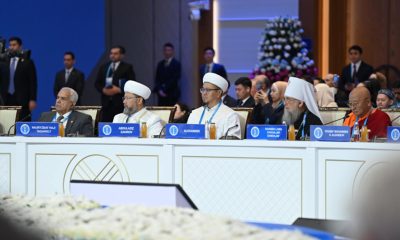
Astana's congress of world religions: A global platform for dialogue in an age of division
-
 Child sexual abuse5 days ago
Protect children from online sexual abuse: Call for urgent negotiations and permanent solution
-
 Kazakhstan5 days ago
Solana company partners with Kazakhstan on $6B Alatau Crypto Megacity
-
 Iran5 days ago
Will the Gulf monarchies rise above internecine disputes in the interest of collective security?