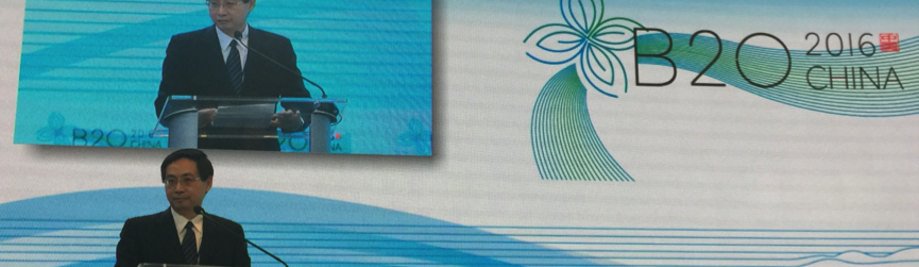
Jack Ma at Boao Forum in March 2016 (Source: XinHua News Agency)
The idea of an eWTP (Electronic World Trade Platform) was originally launched by Jack Ma, Executive Chairman of Alibaba Group and also Chair of the SME Development Taskforce, at Boao Forum (to read Ma Yun’s full speech in Chinese, please click here) in March this year. The platform will facilitate SMEs’ development and integrate public-private dialogue on e-commerce trading modes.
The key goal of eWTP is to promote ‘inclusive’ trade. Inclusive trade refers to reducing the threshold effect, faced by SMEs to participate in cross-border e-trade. The WTP will provide SMEs a transparent and open platform to sell their goods and services globally.
E-trade, often known as cross border electronic commerce, is an innovative trade mode, seen in many ways as a game changer for global trade. It opens new opportunities for revenue growth through cost reduction and reach to more customers, benefiting all businesses and especially SMEs.
The problems many SMEs face today include limited access to the market, limited access to information about export opportunities and access to trade finance, and limited access to information on legislations in different regions.
E-trade therefore offers a new and efficient channel for SMEs to conduct cross border trade directly, and to set up seamless interactions with their customers.
E-trade brings SMEs interactive connections with significant numbers of both domestic and overseas customers, as well as highly efficient digitalized operations. It helps lower the threshold of cross border trade for SMEs to enter as well as facilitates more efficient flow of products, information and money. In addition to expanding consumption and promoting trade growth, it can also drive innovation and industrial upgrade.
E-WTP proposes to bring together all stakeholders and enable efficient dialogue between public and private sectors to address policy challenges facing SMEs, sum up best practices and generate common industry standards.
As Mary Andringa, Co-Chair of SME Taskforce, Chair of Vermeer Corporation stated, 95% of the number of firms in the G20 countries are SMEs, generating two thirds of employment and 80% of GDP. Digital economy is key for SMEs to reduce complexity in regulations, access to GVCs and access to finance, among which e-commerce is the only element which can make the difference.
ChinaEU is actively advocating lifting all barriers preventing European and Chinese enterprises to interact in the digital ecosystem and advocating facilitating access to information on export opportunities and legislations. The ChinaEU Digital Research Center, to be launched later this year in cooperation with China Internet Development Foundation (CIDF), exactly aims at monitoring and comparing legislations and regulations in key digital areas, such as e-commerce and cloud services, data protection, 5G and future networks. The research center will not only accelerate information sharing between European and Chinese digital markets, but will also in the medium term help identify best practices.
By the end of May this year, CCPIT (China Council for the Promotion of International Trade), in cooperation with the OECD, will co-organize an e-commerce summit during the China Beijing International Fair for Trade and Services which takes place from 28th May to 1st June. Representatives from both B20 and WTO will attend, sharing constructive views on the implementation of e-WTP. This meeting will be followed by the Second B20 Joint Taskforce Meeting, to be held in Paris on May 31st.