Canada
#CETA: 'If people want a double-check, let’s do it'


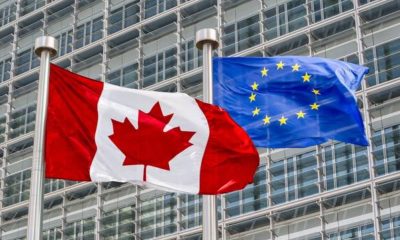
The trade deal between Canada and the EU is the latest trade agreement to attract controversy. Negotiations for the Comprehensive Economic and Trade Agreement (CETA) have been concluded, but it will still need to be approved by the European Parliament, the Council and the national parliaments. On 31 August the international trade committee discussed the agreement and afterwards Latvian EPP member Artis Pabriks (pictured), who is responsible for steering the agreement through Parliament, explained the situation.
Why do we need CETA ? How will it really benefit Europeans and what would be the pitfalls ?
CETA, a trade agreement between Canada and the European Union, is very comprehensive and a highly modern agreement. It sets an example for future trade agreements and is based on an understanding between two partners sharing many values. If you are looking for the closest partner outside the US, then Canada is the first country that comes to mind.
It has clear economic benefits. They are relatively huge because the EU’s wealth is very much linked to trade and the possibility to trade. It would create more jobs and especially assist small and medium-sized enterprises, which form the backbone of the economy.
Many people fear CETA would give companies too much power to overturn decisions by democratically-elected governments. Will the proposed Investment Court System be enough to prevent this?
I believe it will be more than enough. We know there has been unease about investment and big corporations’ influence but we know from history that even with not very advanced trade treaties states were not toothless against big corporations
In the case of CETA, governments are in a very strong position. We need to adopt this modern version because it will set an example for many others. If we do not adopt this, then we will still be questioning this issue for many years. The Canadian-European treaty is the one that can solve this issue also globally.
National parliaments will also get to vote on CETA. Wouldn’t this make it much more difficult to conclude international trade agreements?
There is an old saying in Latvia: “Double doesn’t break”. Getting the national parliaments involved increases the bureaucratic burden, but at the same time we live in a democratic world and if people want to have a double-check, let’s do it. I would personally be able to convince our Latvian voters that it’s enough with the European Parliament.
Share this article:
EU Reporter publishes articles from a variety of outside sources which express a wide range of viewpoints. The positions taken in these articles are not necessarily those of EU Reporter. Please see EU Reporter’s full Terms and Conditions of publication for more information EU Reporter embraces artificial intelligence as a tool to enhance journalistic quality, efficiency, and accessibility, while maintaining strict human editorial oversight, ethical standards, and transparency in all AI-assisted content. Please see EU Reporter’s full A.I. Policy for more information.



ECR MEPs question the European Commission on cardiovascular health and diet promoting the Mediterranean diet as an alternative to ultra-processed foods as key to tackling obesity

Falling in love with the Maldives

Kurmuk gold project highlights Africa’s changing investment landscape

Albania's Vlora airport standoff tests investor confidence as EU accession clock ticks

Commission adds exemptions to rules on removability of portable batteries

Iran’s regime in crisis: Negotiations, internal divisions and growing resistance

EU steps up international support for Palestinians with major initiative for Gaza's early recovery and stronger international coordination

Natura 2000 Network offers opportunities for sustainable tourism across Europe

Kazakhstan and Belgium: Building a Partnership for the Future

New court ruling questions 'proportionality' of Mayor Erion Veliaj’s detention

Rome–Washington Axis: Italian Diplomat Zanardi Landi to Help Save Bosnia

Burnham as PM? 'Wait and see'

Ban on destruction of unsold clothes and shoes enters into application

Survey on an EU Blueprint for intellectual property licensing and spinoff creation

Rule of law report strengthens EU democracy and fundamental rights

EU launches Ukraine defence industrial partnership, Drone Deal and disburses €1 billion for drones *

Kazakhstan reforms under scrutiny at Brussels Press Club round table

Japan should face up to history and contribute more to regional peace

Ambassador calls for 'speeding up' of co-operation between EU and Kazakhstan

Timur Turlov at Smart Moves Summit 2025: How chess can transform global education

Shevtsova’s case: Out-of-court sanctions dismantling trust in Ukrainian cause

The future of European transport

Trump Vs Trueman

US 'no longer' an 'unconditional ally' for Europe - MEP
-
 Italy4 days ago
ECR MEPs question the European Commission on cardiovascular health and diet promoting the Mediterranean diet as an alternative to ultra-processed foods as key to tackling obesity
-
 Tourism5 days ago
Falling in love with the Maldives
-
 China5 days ago
Kurmuk gold project highlights Africa’s changing investment landscape
-
 Albania4 days ago
Albania's Vlora airport standoff tests investor confidence as EU accession clock ticks