EU
Merkel's #CDU agrees to pursue grand coalition in Germany


Under intense pressure to preserve stability and avoid new elections, the SPD reversed its position and agreed to talk to Merkel, raising the prospect of a new grand coalition, which has ruled for the past four years, or a minority government.
“We firmly believe that this is not a minority government but that it is an alliance with a parliamentary majority. That is a grand coalition,” he said.
The meeting came after the conservative state premier of Bavaria threw his weight behind a new right-left tie-up.
“An alliance of the conservatives and SPD is the best option for Germany - better anyway than a coalition with the Free Democrats and Greens, new elections or a minority government,” Horst Seehofer, head of the Bavarian CSU, told Bild am Sonntag.
An Emnid poll also showed on Sunday that 52% of Germans backed a grand coalition.
Merkel, who made clear on Saturday she would pursue a grand coalition, says that an acting government under her leadership can do business until a new coalition is formed.
The youth wing of Merkel’s conservatives raised pressure on the parties to get a deal done by Christmas, saying if there was no deal, the conservatives should opt for a minority government.
In an indication, however, that the process will take time, the CDU agreed on Sunday evening to delay a conference in mid-December that had been due to vote on the three-way coalition.
The SPD premier of the state of Lower Saxony said he feared there was no way a decision would be reached this year. “It is a long path for the SPD,” said Stephan Weil on ARD television.
Merkel is against going down the route of a minority government because of its inherent instability, but pundits have said one possibility is for the conservatives and Greens to form a minority government with informal SPD support. The Greens have said they are open to a minority government.
Even before any talks get under way, the two blocs have started to spar over policy priorities.
She has to keep Bavaria’s CSU on board by sticking to a tougher migrant policy that may also help win back conservatives who switched to the far-right Alternative for Germany (AfD).
The SPD needs a platform for its policies after its poorest election showing since 1933. Leading SPD figures have outlined conditions including investment in education and homes, changes in health insurance and no cap on asylum seekers.
Most experts believe the SPD has the stronger hand and several prominent economists said they expected the SPD to wield significant influence in a new grand coalition.
That would mean higher state spending and smaller tax cuts than would have been agreed with other potential partners.
The SPD is divided, with some members arguing that a grand coalition has had its day.
The SPD premier of the state of Rhineland Palatinate, Malu Dreyer, said she preferred the idea of the SPD “tolerating” a minority government over a grand coalition, making clear that the party would not agree to a deal at any price.
Share this article:
EU Reporter publishes articles from a variety of outside sources which express a wide range of viewpoints. The positions taken in these articles are not necessarily those of EU Reporter. Please see EU Reporter’s full Terms and Conditions of publication for more information EU Reporter embraces artificial intelligence as a tool to enhance journalistic quality, efficiency, and accessibility, while maintaining strict human editorial oversight, ethical standards, and transparency in all AI-assisted content. Please see EU Reporter’s full A.I. Policy for more information.



Astana's congress of world religions: A global platform for dialogue in an age of division

Protect children from online sexual abuse: Call for urgent negotiations and permanent solution

Solana company partners with Kazakhstan on $6B Alatau Crypto Megacity

Will the Gulf monarchies rise above internecine disputes in the interest of collective security?

Europe must double down on nuclear progress to achieve its long-term ambitions

International Plastic Bag Free Day – from single use to reuse

Study: Europe's defense runs on American servers

Commission proposes five joint defence projects to strengthen Europe's industrial capabilities

Safer cars, safer roads: New rules take effect

Survey of city economic experts: Cities are driving Draghi’s competitiveness agenda, but need EU recognition to scale action

Europe's Cloud moment: The DMA must now deliver

EU-Mexico: While others build walls, Europe builds bridges

New EU strategy must help farmers move toward a more humane food system

Kashmir's 9,765 missing women and girls demand international attention

Quarterly reports show a surge in solar energy and e-vehicles, with record highs in 2025

EU deploys wildfire support to face multiple fires across Portugal and France

Kazakhstan reforms under scrutiny at Brussels Press Club round table

Japan should face up to history and contribute more to regional peace

Ambassador calls for 'speeding up' of co-operation between EU and Kazakhstan

Timur Turlov at Smart Moves Summit 2025: How chess can transform global education

Shevtsova’s case: Out-of-court sanctions dismantling trust in Ukrainian cause

The future of European transport

Trump Vs Trueman

US 'no longer' an 'unconditional ally' for Europe - MEP
-
 Kazakhstan4 days ago
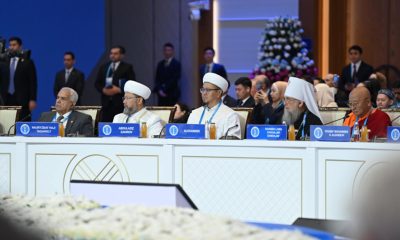
Astana's congress of world religions: A global platform for dialogue in an age of division
-
 Child sexual abuse4 days ago
Protect children from online sexual abuse: Call for urgent negotiations and permanent solution
-
 Kazakhstan4 days ago
Solana company partners with Kazakhstan on $6B Alatau Crypto Megacity
-
 Iran4 days ago
Will the Gulf monarchies rise above internecine disputes in the interest of collective security?