Cigarettes
#OLAF prioritizes terrorist financing and cigarette smuggling


 The smuggling of cigarettes and other tobacco products is a global phenomenon which, in the EU alone, results in an annual loss of more than €10 billion in public revenue.
A KPMG study commissioned by RUSI last year, analyzing the illicit cigarette market in the European Union, Norway and Switzerland, revealed that more than 9% of all cigarettes consumed in Europe in 2016 were illegal. Amounting to 48 billion cigarettes, only five countries - France, Poland, UK, Germany and Italy – accounted for more than 62% of all illegal consumption in Europe.
Speaking at a high-level conference organized by the European Anti-Fraud Office (OLAF) and hosted by the European Economic and Social Committee (EESC), Budget Commissioner Günther H. Oettinger pointed out that the smuggling of tobacco products is not limited only to health and fiscal issues any more, but it currently became a major source of income to organized crime and even sometimes terrorism financing.
However, there is still a low awareness amongst the consumers about the link between terrorism financing and cigarette smuggling. According to Mihai Ivascu, member of the EESC and director executive to the Romanian Chamber of Commerce and Industry, only 14% of Europeans see the illegal tobacco trade as a source of financing for organized crime. This can only show that there is a need for a strategy at EU level to combat illicit trade of tobacco products from financing organized crime.
Margarete Hofmann, OLAF Policy Director mentioned at the conference that the European Commission is working to include cigarette smuggling in the counter-terrorism strategy led by Commissioner for Security Union, Sir Julian King. To show their support to this cause, Members of European Parliament also voted a non-legislative resolution on 1 March in which they urged EU countries to track suspicious transactions and charities, and share intelligence more proactively, in order to stop money flowing to terrorists.
Commissioner Oettinger was not the only one who emphasized such a link between illicit trade and terrorism financing. All key speakers to the event highlighted that organized crime and terrorist groups are benefiting from illicit tobacco trade. Gilles Pargneaux, French Member of the European Parliament, Vice-Chair of the Committee on the Environment, Public Health and Food Safety and Member of the Budgetary Control Committee, pointed out that many French jihadists who headed to Syria and Iraq financed their travel through producing and selling illicit tobacco products. In addition to this, David Petit from the French Customs declared that 'tackling the illicit trade in cigarettes will help with other security issues – such as terrorism'.
This does not come as a surprise for the Counter Extremism Project (CEP), a non-profit organization which aims at combatting the growing threat of extremist ideologies: “We agree with the speakers’ assessment and see a direct link between cigarette smuggling and terrorism financing. Illegal tobacco trade is not only damaging to governments’ revenues and consumers’ health but also to national security. Combatting terrorism and radicalization in schools, universities and on the grassroots level is vital, but if we don’t tackle terrorism financing, we will not stop extremist groups from operating and plotting their next attack,” said CEP Executive Director David Ibsen.
Another pressing issue that was highlighted at the high level conference by Nicolas Ilett, Acting Director-General of OLAF, is the ongoing trend of ‘cheap whites’ in EU. These are brands of cigarettes that are produced legally, but smuggled or traded illegally. OLAF is mainly worried about the countries situated at the Eastern border of EU, such as Belarus, where for example, OLAF seized 2.5 million ‘cheap whites’ in only one operation held in co-operation with the Ukrainian authorities in 2017.
Nicolas Ilett also clearly pointed out that the issue of ‘cheap whites’ is supplemented by the original problem of oversupply of genuine product: "There are worrying indications that genuine products produced for the North African market in Algeria are finding their way across Mediterranean in greater bulk that could be justified. There is clear indication that there is a grow in the sale of genuine products which came from North Africa."
Share this article:
EU Reporter publishes articles from a variety of outside sources which express a wide range of viewpoints. The positions taken in these articles are not necessarily those of EU Reporter. Please see EU Reporter’s full Terms and Conditions of publication for more information EU Reporter embraces artificial intelligence as a tool to enhance journalistic quality, efficiency, and accessibility, while maintaining strict human editorial oversight, ethical standards, and transparency in all AI-assisted content. Please see EU Reporter’s full A.I. Policy for more information.



Can digital sovereignty survive an open trading system?

Friedman Institute and Trends Group at the Italian parliament: Countering the Muslim brotherhood

From a remote island to shelves around the world: The story of Azorean canned fish

EU deploys wildfire support to face multiple fires across Portugal and France

Europe’s job market is shifting, and EURES is ready to lead the way into 2030

EU agricultural markets remain robust despite uncertainties and rising input costs

Commission report highlights achievements of EU rules on animal health

Deposits to Swiss banks from Bangladeshi nationals nearly tops all time peak

EU foreign ministers to discuss options for restricting trade with Israeli communities in Judea and Samaria

Safer cars, safer roads: New rules take effect

Survey of city economic experts: Cities are driving Draghi’s competitiveness agenda, but need EU recognition to scale action

Europe's Cloud moment: The DMA must now deliver

EU-Mexico: While others build walls, Europe builds bridges

New EU strategy must help farmers move toward a more humane food system

Kashmir's 9,765 missing women and girls demand international attention

Quarterly reports show a surge in solar energy and e-vehicles, with record highs in 2025

Kazakhstan reforms under scrutiny at Brussels Press Club round table

Japan should face up to history and contribute more to regional peace

Ambassador calls for 'speeding up' of co-operation between EU and Kazakhstan

Timur Turlov at Smart Moves Summit 2025: How chess can transform global education

Shevtsova’s case: Out-of-court sanctions dismantling trust in Ukrainian cause

The future of European transport

Trump Vs Trueman

US 'no longer' an 'unconditional ally' for Europe - MEP
-
 Digital economy5 days ago
Can digital sovereignty survive an open trading system?
-
 Islam4 days ago
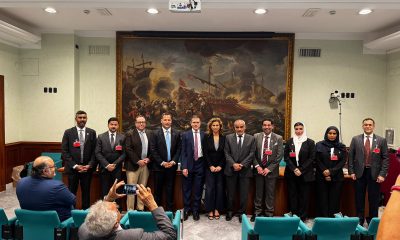
Friedman Institute and Trends Group at the Italian parliament: Countering the Muslim brotherhood
-
 Maritime5 days ago
From a remote island to shelves around the world: The story of Azorean canned fish
-
 Wildfires5 days ago
EU deploys wildfire support to face multiple fires across Portugal and France