EU
#Oceana calls for pirate fishing to be made an environmental crime


Oceana is sending out an SOS to urge national governments to make pirate fishing a punishable environmental crime. Illegal, unreported and unregulated (IUU) fishing – also known as pirate fishing – is a widespread and illicit practice worth tens of billions of euros every year and damages the marine environment, jeopardizing global fish supplies and the entire ocean ecosystem.
The call for governments to establish measures to be able to take legal action against pirate fishing comes amid an international awareness campaign by the United Nations on 5th June – also World Environment Day – to tackle the magnitude of the problem.
“On World Environment Day and International Day for the Fight Against IUU Fishing, we’re sending out an SOS to call on governments around the world to make illegal fishing an environmental crime,” said Lasse Gustavsson, executive director of Oceana in Europe. “Countries need to recognize that large-scale illegal fishing is organised crime and should be dealt with as such. Pirates should be behind bars, not sailing free on the world’s oceans,” added Gustavsson.
Globally, IUU fishing is estimated to account for 20% of total fish catches[1]. Conservative evaluations of illegal and unreported fishing put the annual cost in loses to the global economy at between €9-20 billion which, in terms of fish, is 11 to 26 million tonnes.
The impact of IUU fishing not being treated as a crime in most countries is taking its toll on the environment and society. Those that participate in IUU fishing break or avoid fisheries rules, resulting in an overexploitation of already overfished fish stocks and the destruction of vital marine habitats and ecosystems. High-value species such as sharks and tunas are often the targets of unlawful fishing. Overfishing these predators as well as endangered species creates an unbalance in the whole marine ecosystem, putting ocean health and abundance at risk.
For society, IUU fishing also puts the fishermen and women who fish legally at a disadvantage and brings adverse knock-on effects for the economic and social well-being of fishing communities.
As part of a drive to reach the 2020 target deadline to end IUU fishing and destructive fishing practices under the UN’s Sustainable Development Goals, the General Fisheries Commission for the Mediterranean (GFCM) - a UN regional fisheries body - spearheaded the initiative to dedicate an International Day to tackle IUU fishing. The day was officially adopted at the UN General Assembly on 22 November 2017.
Share this article:
EU Reporter publishes articles from a variety of outside sources which express a wide range of viewpoints. The positions taken in these articles are not necessarily those of EU Reporter. Please see EU Reporter’s full Terms and Conditions of publication for more information EU Reporter embraces artificial intelligence as a tool to enhance journalistic quality, efficiency, and accessibility, while maintaining strict human editorial oversight, ethical standards, and transparency in all AI-assisted content. Please see EU Reporter’s full A.I. Policy for more information.



Can digital sovereignty survive an open trading system?

Friedman Institute and Trends Group at the Italian parliament: Countering the Muslim brotherhood

From a remote island to shelves around the world: The story of Azorean canned fish

Can the EU resist US pressure on medicine prices?

EU deploys wildfire support to face multiple fires across Portugal and France

Europe’s job market is shifting, and EURES is ready to lead the way into 2030

EU agricultural markets remain robust despite uncertainties and rising input costs

Commission report highlights achievements of EU rules on animal health

Safer cars, safer roads: New rules take effect

Survey of city economic experts: Cities are driving Draghi’s competitiveness agenda, but need EU recognition to scale action

Europe's Cloud moment: The DMA must now deliver

EU-Mexico: While others build walls, Europe builds bridges

New EU strategy must help farmers move toward a more humane food system

Kashmir's 9,765 missing women and girls demand international attention

Quarterly reports show a surge in solar energy and e-vehicles, with record highs in 2025

EU deploys wildfire support to face multiple fires across Portugal and France

Kazakhstan reforms under scrutiny at Brussels Press Club round table

Japan should face up to history and contribute more to regional peace

Ambassador calls for 'speeding up' of co-operation between EU and Kazakhstan

Timur Turlov at Smart Moves Summit 2025: How chess can transform global education

Shevtsova’s case: Out-of-court sanctions dismantling trust in Ukrainian cause

The future of European transport

Trump Vs Trueman

US 'no longer' an 'unconditional ally' for Europe - MEP
-
 Digital economy4 days ago
Can digital sovereignty survive an open trading system?
-
 Islam4 days ago
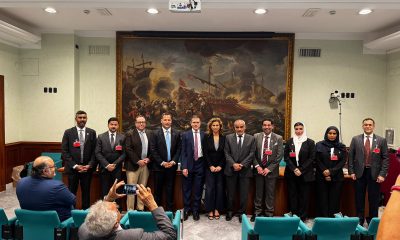
Friedman Institute and Trends Group at the Italian parliament: Countering the Muslim brotherhood
-
 Maritime4 days ago
From a remote island to shelves around the world: The story of Azorean canned fish
-
 Health5 days ago
Can the EU resist US pressure on medicine prices?