EU
Summertime consultation: 84% want Europe to stop #ClockChange


The European Commission has published the preliminary results of the public consultation on clock change in Europe.
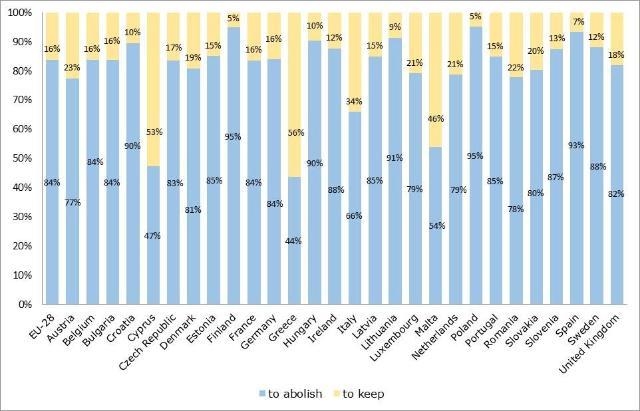
This online consultation, which ran from 4 July to 16 August 2018, received 4.6 million responses from all 28 member states, the highest number of responses ever received in any Commission public consultation. According to the preliminary results (see annex), 84% of respondents are in favour of putting an end to the bi-annual clock change.
Transport Commissioner Violeta Bulc presented these preliminary results to the College of Commissioners that held a first discussion on the possible next steps. Commissioner Bulc said: "Millions of Europeans used our public consultation to make their voices heard. The message is very clear: 84% of them do not want the clocks to change anymore. We will now act accordingly and prepare a legislative proposal to the European Parliament and the Council, who will then decide together."
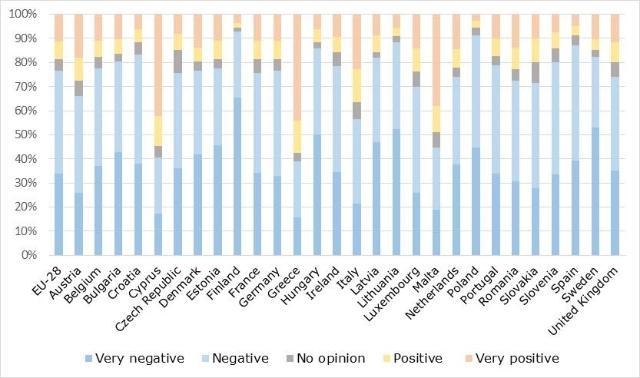
The preliminary results also indicate that more than three quarters (76%) of the respondents consider that changing the clock twice a year is a 'very negative' or 'negative' experience. Considerations related to the negative health impacts, increase of road accidents or the lack of energy savings, were put forward by respondents as motivations to put an end to the change.
European Commission President Juncker put the summertime question on the political agenda as part of his pledge to be big on the big things while leaving it to member states to take decisions where they are best placed to do so. The public consultation on clock change arrangements was organised by the European Commission as part of its ongoing assessment of the current arrangements on clock change in Europe. It also follows the European Parliament's resolution in February 2018, as well as requests from member states, stakeholders and citizens.
Next steps
The final results of the public consultation will be published in the coming weeks. The Commission will now make a proposal to the European Parliament and the Council with a view of changing the current clock change arrangements.
Background
Between 4 July and 16 August 2018, the European Commission organised a public consultation as part of its ongoing assessment of the current arrangements on clock change in Europe. It took the form of an online survey seeking the views of Europeans, notably on their overall experience with the change of clock or their preference over the main alternatives (i.e. maintaining the current system unchanged or abolishing it for the whole EU). Public consultations are one of the tools the Commission uses to make its assessment on policy, alongside other elements such as scientific studies. Other past prominent consultations include the Birds and Habitat legislation (more than 550,000 replies) or the modernization of the Common Agriculture Policy (more than 322,000 replies).
Most member states have an old tradition of clock change arrangements, many of which date back as far as the First and Second World Wars or to the oil crisis in the 1970s. Since the 1980s, the European Union gradually adopted legislation whereby all member states would agree to co-ordinate the clock change and put an end to diverging national schedules. Since 1996, all Europeans have been changing their clock forward by one hour on the last Sunday of March and by one hour backward on the last Sunday of October. The purpose of EU rules was not to harmonize the time regime in the EU but to address the problems, notably for the transport and logistics sectors, which arise from an uncoordinated application of clock-changes in the course of the year.
In parallel to the daylight saving time arrangement in the European Union, the Member States apply three different time zones or standard times. The decision on the standard time is a national competence.
ANNEX
All results are preliminary and subject to changes
Participation rate in each member state (in percentage of the national population):
| Germany | 3.79% |
| Austria | 2.94% |
| Luxembourg | 1.78% |
| Finland | 0.96% |
| Estonia | 0.94% |
| Cyprus | 0.88% |
| Slovenia | 0.73% |
| Slovakia | 0.60% |
| Czech Republic | 0.59% |
| France | 0.59% |
| Belgium | 0.55% |
| Croatia | 0.52% |
| Sweden | 0.48% |
| Latvia | 0.39% |
| Poland | 0.34% |
| Greece | 0.34% |
| Lithuania | 0.34% |
| Portugal | 0.33% |
| Malta | 0.25% |
| Ireland | 0.24% |
| Hungary | 0.21% |
| Spain | 0.19% |
| Bulgaria | 0.18% |
| Netherlands | 0.16% |
| Denmark | 0.11% |
| Italy | 0.04% |
| Romania | 0.04% |
| United Kingdom | 0.02% |
Which of the following alternatives would you favour?
What is your overall experience with the clock change?
Share this article:
EU Reporter publishes articles from a variety of outside sources which express a wide range of viewpoints. The positions taken in these articles are not necessarily those of EU Reporter. Please see EU Reporter’s full Terms and Conditions of publication for more information EU Reporter embraces artificial intelligence as a tool to enhance journalistic quality, efficiency, and accessibility, while maintaining strict human editorial oversight, ethical standards, and transparency in all AI-assisted content. Please see EU Reporter’s full A.I. Policy for more information.




Astana's congress of world religions: A global platform for dialogue in an age of division

Protect children from online sexual abuse: Call for urgent negotiations and permanent solution

Solana company partners with Kazakhstan on $6B Alatau Crypto Megacity

Will the Gulf monarchies rise above internecine disputes in the interest of collective security?

Europe must double down on nuclear progress to achieve its long-term ambitions

International Plastic Bag Free Day – from single use to reuse

Study: Europe's defense runs on American servers

Commission proposes five joint defence projects to strengthen Europe's industrial capabilities

Safer cars, safer roads: New rules take effect

Survey of city economic experts: Cities are driving Draghi’s competitiveness agenda, but need EU recognition to scale action

Europe's Cloud moment: The DMA must now deliver

EU-Mexico: While others build walls, Europe builds bridges

New EU strategy must help farmers move toward a more humane food system

Kashmir's 9,765 missing women and girls demand international attention

Quarterly reports show a surge in solar energy and e-vehicles, with record highs in 2025

EU deploys wildfire support to face multiple fires across Portugal and France

Kazakhstan reforms under scrutiny at Brussels Press Club round table

Japan should face up to history and contribute more to regional peace

Ambassador calls for 'speeding up' of co-operation between EU and Kazakhstan

Timur Turlov at Smart Moves Summit 2025: How chess can transform global education

Shevtsova’s case: Out-of-court sanctions dismantling trust in Ukrainian cause

The future of European transport

Trump Vs Trueman

US 'no longer' an 'unconditional ally' for Europe - MEP
-
 Kazakhstan5 days ago
Astana's congress of world religions: A global platform for dialogue in an age of division
-
 Child sexual abuse5 days ago
Protect children from online sexual abuse: Call for urgent negotiations and permanent solution
-
 Kazakhstan5 days ago
Solana company partners with Kazakhstan on $6B Alatau Crypto Megacity
-
 Iran5 days ago
Will the Gulf monarchies rise above internecine disputes in the interest of collective security?